AI in the Steel Industry: The 2026 Guide to What Works, From the Mill to the Back Office
Ask a steelmaker how far along they are with AI, and the answer is usually some version of not very far. In a 2024 Roland Berger survey on AI in steelmaking, steel manufacturers rated their AI implementation at just 1.8 out of five. For all the talk about artificial intelligence in the steel industry, that score says most of the work is still ahead.
Then look at Tata Steel. In April 2026 it announced, with Google Cloud, that it is deploying a fleet of more than 300 specialized AI agents in just nine months. They help answer employee questions, process invoices, plan maintenance and analyze live video in high-risk zones.
Tata's agents run on data every steelmaker already has: tickets, invoices, sensor data and camera feeds. Steel plants produce four kinds of data, and each one fits a different AI method.
Start from the data rather than the use case: which operational data your plant already has, which method fits it, and what it takes to build on it. The four methods below are the ones with documented results in steel, and we build systems like them for clients in other industries.
Key Focus Areas
- AI in the steel industry follows four data streams: process history, images from the line, paperwork and plant knowledge.
- Machine learning on process data drives yield, energy efficiency, scheduling and maintenance. BCG reported more than 15% higher end-to-end yields in its 2021 steel work.
- Computer vision handles surface inspection and safety zones, but rare defects need models that learn from few examples.
- Document AI and RPA clear the paperwork: mill test certificates, purchase orders, invoices and contracts.
- Generative AI agents sit over all three as the interface, as Tata Steel's 300 agents show, while operators stay accountable.
AI in the Steel Industry: Where It Pays in 2026
AI in steel production pays where a method meets the data it needs. Machine learning works on process and sensor history, and computer vision works on images from the line. Document AI works on paperwork, and generative AI works on manuals, procedures and records.
✂️ SNIPPET BAIT - Definition for featured snippet and AI Overview capture
How is AI used in the steel industry? AI in the steel industry is used in four ways, each tied to a kind of data the plant already has. Machine learning on process and sensor history improves yield, energy use, scheduling and maintenance. Computer vision inspects steel surfaces and watches safety zones, document AI and RPA process certificates, orders and invoices, and generative AI agents answer questions from manuals and records on top of all three.
Read the table left to right: data first, then method, then result. Every result in it is published by the company or its partner, with the year.
Which Data Stream to Start With
Start with production data if your historian is clean and your metallurgists have a yield or energy target. Start with paperwork if certificates and invoices pile up on desks. Start with vision if cameras already sit over the line, and start with plant knowledge if your manuals and tickets are already digital.
Often one stream is clearly ready. That stream is where AI starts saving money first, whatever the vendor lists say.
Two things the table leaves out matter as much as what it shows. Generative AI does not set furnace or mill production parameters; it sits above the control systems as an assistant. And a model trained on one mill's data often needs retraining before it works on another's.
Why Steel AI Follows the Data, Not the Use Case
Steel plants already produce four streams of data. Process and sensor history comes from furnaces, casters and rolling mills. Cameras on the line produce images and video. The business side produces paperwork: mill test certificates, purchase orders, invoices and contracts.
The fourth stream is knowledge: maintenance manuals, operating procedures, grade standards, repair tickets and complaint records. It is mostly text, scattered across systems, and much of it lives in experienced people's heads until someone writes it down.
Each stream fits one method. Machine learning reads numbers over time, computer vision reads pixels, document AI reads forms and tables, and retrieval-based generative AI reads text. Plants stall when they choose a use case first and only later discover that the data behind it is missing or messy, which is a data governance problem before it is a model problem.
Here is how it goes wrong. A team picks predictive maintenance because it sounds like a quick win. Then it finds the failure records live in paper logs, and the sensors on the old mill stand were never connected to the plant's industrial internet. The use case was fine, but the data was not ready.
BCG's 2021 analysis of AI in steel names this problem under the heading "Challenges in Culture and Data". Older plant equipment may not capture the right data, or any at all. BCG also notes that melting, milling and annealing can be improved without connected data. Back-end finishing is harder.
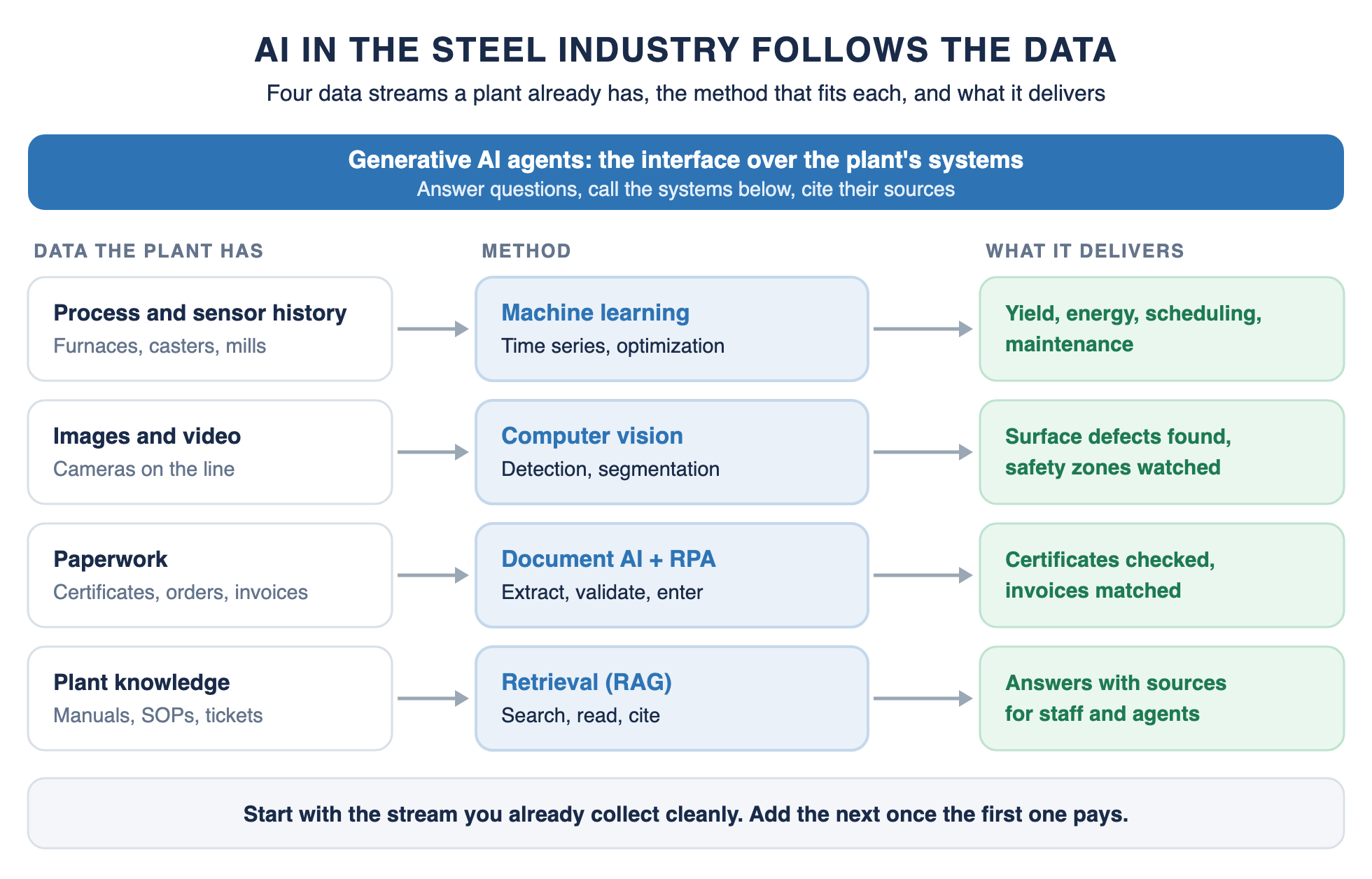
The practical rule follows from the data. Start with the stream you already collect cleanly, prove one result on it, and add the next stream as the data improves.
A Quick Data Audit Before Any AI Project
Four questions tell you which stream is ready. Is the data recorded at all, and for how long? Is it time-stamped and tied to a heat, coil or order number? Is it labeled with the outcome you care about, such as a defect, a failure or a rejected certificate?
The fourth question is access. Can someone pull the data out of the historian, the camera system or the document store without a six-month IT project? A stream that passes all four is your first pilot. A stream that fails one tells you what to fix first.
AI in Steel Manufacturing Starts With Process Data: Yield, Energy, Scheduling and Maintenance
AI in steel manufacturing starts with process data, because steel production has recorded it for decades. Readings like temperature, chemistry, speed and pressure already flow into the plant historian and quality systems. Machine learning algorithms find patterns across hundreds of variables that no person can hold in their head at once.
Yield and Recipe Optimization
BCG reported that AI in its steel engagements could reduce raw material input costs by more than 5%, raise throughput at bottlenecks by more than 6% and increase end-to-end product yields by more than 15%. Those figures are from 2021, so treat them as a direction for steel production efficiency rather than a promise for your plant.
The pilot detail is more useful than the headline. At a US steelmaker, a machine learning model improved yield by 15% for one product family, worth about $500,000 a year on a single product line. It was in place in less than eight weeks, followed by three months of validating the results in production, and it produced significant insights for the metallurgy team. Repeated across product lines, gains like that can add up to saving steel manufacturers millions.
Production Scheduling
Scheduling is a constraint problem with hundreds of moving parts: grades, heats, continuous casting sequences, maintenance windows, inventory levels and customer orders. C3 AI built a production schedule optimizer for a $1 billion mill's bar steel caster in 26 weeks from kickoff. It reported about a 1% increase in net production, more than 1,000 tons of additional finished product, and scheduling time cut by 99%, from up to a week to about an hour.
Cutting and nesting plans are the same problem at a smaller scale, aimed at reducing material waste. A GoSmarter trial at Midland Steel optimized 734 tonnes of steel across 193 jobs and saved 20.22 tonnes, about 2.75% of the material.
How Process and Scheduling Models Work
Process models are often not exotic deep learning models or full digital twins. Tabular models such as gradient-boosted trees learn how settings and raw materials relate to an outcome such as yield or a defect rate. Time-series models learn how a signal moves, which is what you need to forecast a furnace temperature or a failing bearing, and the same models drive demand forecasting and inventory optimization.
Scheduling adds an optimizer for resource allocation on top. The models predict what will happen, and a solver searches for the production plans that do best within the plant's rules. The C3 AI system handled more than 300 variables and constraints, and it matched or beat expert schedules on all 46 historical production cycles it was tested on.
Energy
Reheating furnaces and electric arc furnaces are where energy models pay, by improving energy efficiency and cutting energy waste. In a UK Made Smarter innovation project, Deep.Meta's Deep.Optimiser was tested at Spartan UK's Gateshead plate mill and at the Materials Processing Institute (MPI). The case study says the project showed the potential to cut energy consumption by 24 kilowatt hours per tonne of steel, a direct route to lower energy costs. The goal is just the right amount of heat and raw materials for the required quality, and using less of both also cuts emissions such as fine particulate matter.
Predictive Maintenance
Predictive maintenance reads vibration, temperature and current from motors, gearboxes and rolls to flag failures before they stop a line. Tata Steel's Asset Sphere agents evaluate equipment health to plan proactive maintenance. Worthington's AssetWatch deployment covers 17 steel processing and pressure cylinder facilities with more than 1,800 sensors on more than 650 assets, enabling predictive maintenance at every site.
The output is simple. Predictive maintenance systems give each piece of critical equipment a risk score or an estimate of days to failure. Planners use the score to move a repair into a planned stop instead of losing shifts to sudden equipment failures, which keeps operational costs down.
Plants often run many AI models at once. Wizata reports 76 models deployed through its platform for one long-product metal producer. Plant datasets are often small, such as a few years of failures for one machine type. The TabPFN approach gives a solid first forecast on small datasets without heavy tuning.
What Process Models Need From Your Data
Three things decide whether a process model works. The data must be clean and lined up in time, the target must be something the production process already measures, and metallurgists must check every recommendation. The same approach carries over to other heavy industries: machine learning in oil and gas uses sensor history to build virtual flow meters, which estimate flow where no physical meter exists. BCG runs early AI alongside metallurgists and operators, and says plainly that they "will always be required."
Computer Vision on the Line: Surface Inspection and Plant Safety
Computer vision on a steel line has two jobs: finding surface defects and watching for people in danger zones. Both are harder than in a clean assembly plant, because heat, scale, steam, vibration and high line speeds distort what the camera sees. The same methods behind computer vision applications across industries, such as counting parts and checking assembly on other production lines, need sturdier cameras, lighting and training data here.
Surface Inspection
Defect inspection is two different tasks. Detection draws a box around a scratch or inclusion and labels it, while segmentation marks the exact pixels, which matters when the size of a defect decides whether a coil is downgraded. Semantic segmentation labels every defect pixel by class, while instance segmentation also splits two touching scratches into separate defects, so each can be measured.
Public datasets show the shape of the problem. The NEU surface defect database holds 1,800 grayscale images across six defect classes, from rolled-in scale to scratches. The 2019 Severstal steel defect detection competition on Kaggle used four defect classes. A real line has more classes than either, and some of them are rare.
Rare defects are where standard models struggle. Our zero-shot detection post puts traditional object detection at 5,000 or more examples per class in a retail setting, and no mill has that many images of a defect that appears a few times a year. Text-guided open-vocabulary segmentation and zero-shot detection can find a new class from a short text description or a few examples. Fine-tuning on your own images then lifts accuracy on the classes that matter most.
Fine-tuning is often where the biggest gain comes from. On retail product matching, off-the-shelf CLIP picked the right product 41% of the time, and our fine-tuned image embedding model reached 89% top-1 accuracy. That is a different domain, but the lesson carries: a model trained on your own images beats a general one. When an inspection vendor quotes an accuracy figure, ask which test set it came from, and ask for results on your own coils before you buy.
AI-powered vision systems also check iron ore pellets for size and shape and monitor steel coils for surface defects as they move through the plant, which helps keep consistent product quality. A senior AI expert at Primetals Technologies notes that human operators still decide when a model flags an unusual process state.
How a Surface Inspection Model Is Trained
Training starts with images from your own line, collected across grades, speeds and lighting. Inspectors label each defect, and the rare classes get extra attention, because a model only learns what it sees. The labeled set is then split by coil, so the test images come from coils the model never saw in training.
That split matters more than the model choice. A model tested on images from the same coils it trained on will look better than it is. After launch, track what inspectors overrule, because those overrides are the next round of training data.
Plant Safety
Safety is the second job. Tata Steel's Safety EyeQ agent analyzes live video feeds in high-risk zones. The method behind it is human activity recognition, where a model follows a person's movements across frames and labels the action. The same kind of model can watch exclusion zones and check for protective gear.
What it takes on your data: labeled images from your own line, including the rare defects, and a camera and lighting setup that holds up to heat and steam. Start with one defect type that costs real money, prove the model finds it, and add classes from there. A narrow model that works beats a broad one that inspectors stop trusting.
Document AI and RPA for Steel Paperwork: Certificates, Orders and Invoices
The paperwork side is less visible than the mill, but it touches every ton that ships. Steel moves through complex supply chains on paper as much as on rollers. Every heat ships with a mill test certificate, every order starts as a customer purchase order, and every delivery ends in an invoice that has to match both.
Mill Test Certificates
A mill test certificate certifies the chemical and mechanical properties of a heat of steel. Under EN 10204 type 3.1, the mill reports actual test results, and the certificate carries the heat number. Buyers, service centers and fabricators check those values against the order specification and the grade standard, often by hand.
Document AI reads each certificate, pulls out the values and checks them against the spec, sending anything it cannot clear to a person. Certificates arrive from many mills in many layouts, which is why traditional methods like template-based extraction break. We found no public benchmark for mill test certificate extraction, so measure any system on a sample of your own certificates.
What an Automated Certificate Check Looks Like
Take one certificate for one heat. The system reads the heat number, the grade, the chemistry values such as carbon and manganese, and the mechanical test results. It then compares each value with the range in the order specification and the grade standard.
Values inside the range pass. A value outside it is flagged with its name, the number and the limit it broke, and the certificate goes to quality for review. Low-confidence reads, such as a smudged scan, go to a person too.
Where to set that confidence threshold is an economic decision, not a technical one. More review means fewer misses and more labor, and each plant picks its own balance.
Orders, Invoices and Contracts
Purchase orders, delivery notes and invoices, the paperwork of supply chain management, follow the same pattern. Three-way invoice matching checks the order, the goods receipt and the invoice against each other before payment, including freight charges and other transportation costs. Tata Steel's back-office agents process invoices, sort tax items for India's GST and review contracts.
Where RPA Fits
RPA and AI are often confused, and in steel paperwork they do different jobs. AI reads the certificate or invoice and decides whether it matches, and RPA enters the result into the ERP. In short, robotic process automation executes what it was told, and AI decides what should happen.
How a Document Pipeline Works
A production pipeline runs in stages. It classifies the document, understands its layout, runs OCR tuned to the inputs, extracts each field, validates it against a schema, and routes low-confidence fields to a person. On invoice line items, a pipeline built this way reached 95.6% accuracy in our intelligent document processing work, a figure from invoices rather than steel certificates.
Generative AI and Agents: The Interface Over Everything Else
Generative AI in steel does not run the furnace. It sits on top of the systems that do, as an interface people can ask questions of, and as agents that call the process, vision and document systems for answers.
Maintenance Copilots
U.S. Steel announced in August 2023 that it would use Google Cloud's generative AI to simplify equipment maintenance for more than 60 haul trucks at its Minntac and Keetac mining operations. The application, MineMind, was built on Document AI and Vertex AI, with a goal of cutting the time to complete a work order by an estimated 20%. We found no published result against that target.
At Acciaierie Bertoli Safau in Italy, a team with Danieli Automation and BeanTech presented a generative AI copilot for plant maintenance at AISTech 2025. It pairs a language model tuned for steel with search over maintenance records and manuals. It runs in the cloud or on-premise, and staff can type or speak to it. The paper reports shorter intervention times and easier onboarding for new staff, without published numbers.
Assistants and Agents Across the Business
Tata Steel shows the scale this can reach. The Tata Digital Assistant helps the HR helpdesk resolve more than 70% of routine employee tickets autonomously, and an agent for customer complaints cut average turnaround time by 50%. Its Zen AI platform for building agents runs on Google Cloud's Agent Development Kit, with Gemini and PaliGemma models.
How Plant Agents Work, and Their Limits
The method is called retrieval-augmented generation, or RAG. The agent searches manuals, procedures, standards and tickets, reads the pages that fit, and answers with a citation for each claim.
In agentic RAG, the agent plans its searches, checks whether the pages it found answer the question, and searches again before it writes. Our tax research agent is the closest match to a library of grade standards. It cites exact pages, and it ranks the current version of a document above older ones.
Citations are what make an agent safe to use in a plant. When every answer points to the page it came from, a technician can check it in seconds. When it does not, nobody should act on it.
Three limits matter for AI powered systems in a plant. Some mills need models on-premise for data sovereignty, so check deployment options early. Answers must cite their source so an operator can check them, and an operator, not the model, stays accountable for any action on the line.
Where to Start With Plant Agents
Start read-only. An assistant that answers questions from manuals, procedures and past tickets, with a citation for every answer, is useful on day one and cannot change anything on the line. Measure how often its answers are right before you give it more.
The next step is letting the agent call other AI driven systems, such as a maintenance planner or a document checker, with a person approving each action. Tata Steel's CIO, Jayanta Banerjee, described the aim as turning AI from a technical experiment into a specialized partner for every employee.
For agents that call plant systems, the build choice is how much structure to give them. LLM-powered autonomous agents plan their own steps, while a framework like LangGraph fixes the steps, retries and approvals in code, which is easier to audit on a plant floor.
Build, Buy or Bring In a Partner
BCG's roadmap gives the order. Supervised pilots come in months one to six, then a "snowball" of models that need low technology investment and offer high returns in months six to 24. Integrated AI that supports autonomous decisions comes after month 24.
Buy where a proven product already fits your line and your data, such as inspection hardware, a plant optimization platform or digital twin technology. Build where the value is in data only you have: your grades and recipes, your coils, your certificates and your manuals. That custom layer, trained and tested on your data, is the part off-the-shelf platforms miss, and it is what we build.
Bring in a partner for the first pilot when the team has the data but not the time to implement AI itself. The goal of that pilot is a measured result, such as cost savings or higher yield, on one data stream and a team that can run the next one.
Questions to Ask Any Steel AI Vendor
Four questions sort real AI driven solutions from demos. Which test set produced your accuracy figure, and can you run on our data before we sign? Where does the model run, and does our data leave the plant?
Who owns the trained model and the labels we create? And what happens when our grades, lines or document layouts change? Good vendors answer all four plainly, and the answers tell you whether to buy, build or do both.
What a First Pilot Looks Like
A good first pilot has one data stream, one metric from your key performance indicators and a baseline measured before work starts. Yield on one product family, reducing waste on one line, scheduling time on one caster or review time per certificate are all good choices. Agree on the success threshold before the first model is trained, so the result cannot be argued after.
BCG's US pilot gives a realistic pace: less than eight weeks to put the model in place, then three months of validation in production. Run the model alongside the current process during validation, and switch over only when the improved efficiency holds up in the numbers.
Start Where Your Data Already Is
AI in the steel industry follows the data. Machine learning works on process history, computer vision on the line, document AI and RPA on the paperwork, and generative agents over all three.
The plants getting results from AI in the steel industry did not start with a vendor list or a plan for revolutionizing steel manufacturing. They started with data they already had.
Pick the stream you already collect cleanly, prove one result in a pilot, and build the next step on what you learned. If your plant has the data and needs the build, we can scope that pilot with you.
Start With One Data Stream
Tell us where your data already is: process history, line images, certificates and invoices, or manuals and maintenance records. We will scope a pilot on that data, with results measured on your own plant.
• A pilot scoped to one data stream and one result
• Models trained and tested on your coils, documents or manuals
• Accuracy measured on your data, not a vendor demo
• A team that can run the next step after the pilot
Frequently Asked Questions
How is AI being used in the steel industry?
AI in the steel industry is used in four main ways. Machine learning on process data improves yield, energy use, scheduling and maintenance. Computer vision checks steel surfaces and watches safety zones. Document AI and RPA process certificates, orders and invoices, and generative AI agents answer questions from manuals and records.
Will metallurgy be replaced by AI?
No. AI can weigh more variables at once than a person can, but BCG's roadmap runs AI alongside metallurgists and operators and says they will always be required to handle exceptions. The model recommends, and the metallurgist decides.
What is level 2 automation in steel industry?
Level 2 is the process control layer above Level 1 basic automation. Primetals calls it the process optimization system, which controls values such as strip temperature, profile and thickness. Danieli lists it as process control systems. The ISA-95 standard numbers its levels differently, so check which convention a vendor means.
Which AI is best for manufacturing?
The best AI for manufacturing is the method that fits the data you already have. Machine learning suits sensor and process history, computer vision suits images, document AI suits paperwork, and generative AI suits manuals and records.
Is RPA the same as AI?
No. RPA follows fixed rules on structured data, while AI reads unstructured inputs and makes decisions. In steel paperwork they work together: AI reads and checks a certificate, and RPA enters the result into the ERP.
Is AI used for quality control in steel?
Yes. Computer vision inspects steel surfaces for defects, and machine learning predicts quality from process data before a coil is finished. Document AI also checks mill test certificates against the order spec, which is quality control on paper.
What data do you need to start using AI in a steel plant?
You need one data stream that is recorded, time-stamped, linked to a heat, coil or order, and labeled with the outcome you want to improve. Process history, line images, certificates and maintenance tickets all work, so check which of them your plant already records well.
Can generative AI control a steel mill?
No, and it should not. Generative AI works as an assistant and an agent above the control systems, answering questions and calling other tools. Furnace and mill setpoints stay with process control and with the operators who are accountable for them.
How long does an AI pilot take in a steel plant?
BCG's US pilot was in place in less than eight weeks, followed by three months of validation in production. C3 AI's scheduling application took 26 weeks from kickoff to production-ready.
