In this article, I reviewed the most valuable AI agents for ecommerce in 2026. I focused on how each one performs in a real store, what it is best at, and where it falls short. I did not limit the list to constantly talked about domains like customer service, because the agents that actually move the needle in ecommerce also live in your product data, your product pages, your on-site search, and your marketing.
TL;DR
In this guide, I focus on:
The top AI agents in the market right now, across the whole ecommerce stack.
What each tool is actually good at, and what it is not.
Key capabilities that matter for each one, and a general view of where the space is moving.
The distinction that separates real agents from assistants.
How I evaluated and ranked each platform for an ecommerce business.
Why AI Agents Matter in Ecommerce
Ecommerce is full of work that is repetitive, high-volume, and operationally expensive. It is the thousands of product pages that need accurate, complete data for SEO and AEO. It is the workflow for media buying. It is the shoppers who cannot find the right product, the support tickets, and the lifecycle marketing. Every one of those is a place an agent can take real work off your team. The stakes on the product-data side alone are large: Akeneo found that two-thirds of shoppers abandoned a purchase in the past year because the product information was missing or inaccurate.
I evaluate ecommerce AI agents through questions with clear metrics:
Does it take real action or produce shippable output, or does it only assist and suggest? Does it require constant user input?
What is the automation rate and did we lose accuracy?
Does it work at catalog and volume scale, not one item or one conversation at a time?
Does it connect to your real data, your catalog, orders, and systems, so it works from truth rather than guesses?
For customer service related automations, what is the resolution quality?
The equation around how much work is removed, how much does it cost, and what is the tradeoff in accuracy drives all decisions for automations.
The Best AI Agents for Ecommerce
These items I chose are based solely on the equation above.
1. Pumice.ai Merchandising Pipeline
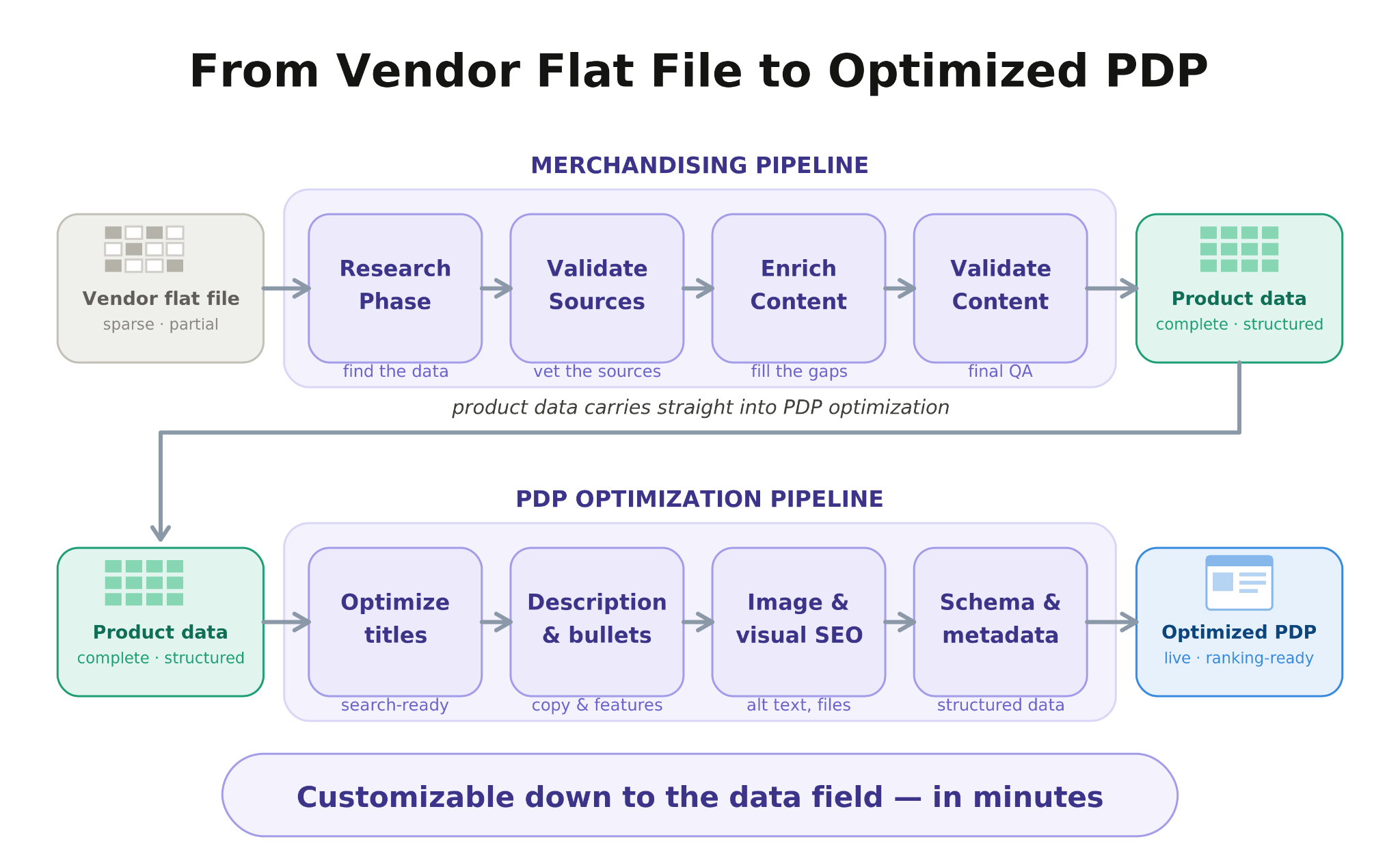
The Pumice merchandising pipeline is built as an ai agent framework for solving a huge issue in ecom: quality product data that is accurate, optimized, and fits brand copy guidelines. The agentic pipeline researches, writes, and validates product content at catalog scale, not a copy tool that spits out one description at a time.
You point it at your catalog and it walks through these processes:
Researches live web data and PDFs to find accurate and validated product data for your same SKU, or competitor data that is already performing.
Drafts product content that is grounded in real truth data, and is customized to your rules, guidelines, schemas, and channel requirements.
Validates data to ensure its correct before pushing back.
Best for: Wholesalers, distributors, marketplaces, or anyone with large catalogs with a decent sized delta of new products each month coming from vendors. Most of these types of companies have teams set up to manually research SKUs to grab relevant content, then have a copywriting team to enrich for publishing.
Key capabilities
Research phase: a Universal Scraper finds each product and a Smart Scraper extracts real attributes from your listings and the web. Pull all product data, images, and competitor pricing.
Generation with rules, examples, and validation, plus a retry loop so outputs ship compliant.
Catalog-scale batch processing across thousands of SKUs in one run.
Marketplace-specific outputs, including Amazon titles and Item Highlights. Take your existing catalog and augment it based on 3rd party channel requirements and rules.
Where it is strong
Produces shippable output, not suggestions.
Grounded in real, scraped data, so attributes are accurate.
Scales to the whole catalog without a linear increase in effort. SKU inventory management becomes a remedial task.
Limitations
Requires creation of configuration files that are in charge of the steps the ai agent system takes.
It is focused on product data and content, not support or search.
2. Fin by Intercom
Fin is the customer-support agent built as an agent system. It works to resolve support conversations end to end rather than just suggest replies, and when it is wired into your order and billing systems it can process refunds, edit orders, and handle returns.
In ecommerce, that execution matters, because most support volume is operational, WISMO, returns, refunds, and order status, rather than informational. Fin is designed to handle those all the way through when it is integrated correctly, with lowered support costs.
I really like their native support for model training and optimization. While it leads to more setup, the long term increase in ability and use case specific accuracy will way outperform fully out of the box inflexible solutions.
Best for: support teams pushing automation rate up without dropping resolution quality. Ecom brands where human customer service teams are becoming a real bottleneck.
G2 rating: 4.5 / 5 (2,900+ reviews).
Key capabilities
Full workflow execution: refunds, returns, cancellations, and subscription changes. Integrate with existing support tools easily.
Backend integrations with OMS, billing, and CRM to take real actions.
Knowledge grounding from help center, policies, and structured data.
Omnichannel and multilingual support.
Where it is strong
High ceiling on automation rate and multi-step workflows. Handles complex support queries.
Consistency across channels.
Ability to fine-tune and train models
Limitations
Requires solid integration setup to unlock full value.
More robust than a very small team needs.
3. Gorgias
Gorgias is the default helpdesk for a lot of Shopify brands. Its edge is not raw autonomy; it is how tightly it pulls Shopify order data into the support workflow. The AI layer is more assistive than fully autonomous, but it still removes real manual work and speeds up responses on routine customer inquiries.
I reach for it when the priority is a fast, Shopify-native support desk rather than maximum hands-off automation.
Best for: Shopify brands optimizing support-team operational efficiency and less human involvement.
G2 rating: 4.6 / 5 (547 reviews).
Key capabilities
Shopify-native: orders, refunds, and customer data in one interface.
AI-assisted replies and auto-completion without human intervention.
Macros and automation rules for repetitive tasks.
Omnichannel inbox and AI-driven ticket routing.
Where it is strong
In my experience the ai shopping assistants they deploy are much stronger than basic RAG ai assistants.
Deep Shopify integration and fast setup.
Real productivity gains for support teams.
Limitations
More assistive than autonomous.
Still relies on human agents for full resolution.
4. Pumice PDP Optimization Playbook
Optimize Product titles, product descriptions, attributes, images, bullets, and FAQs
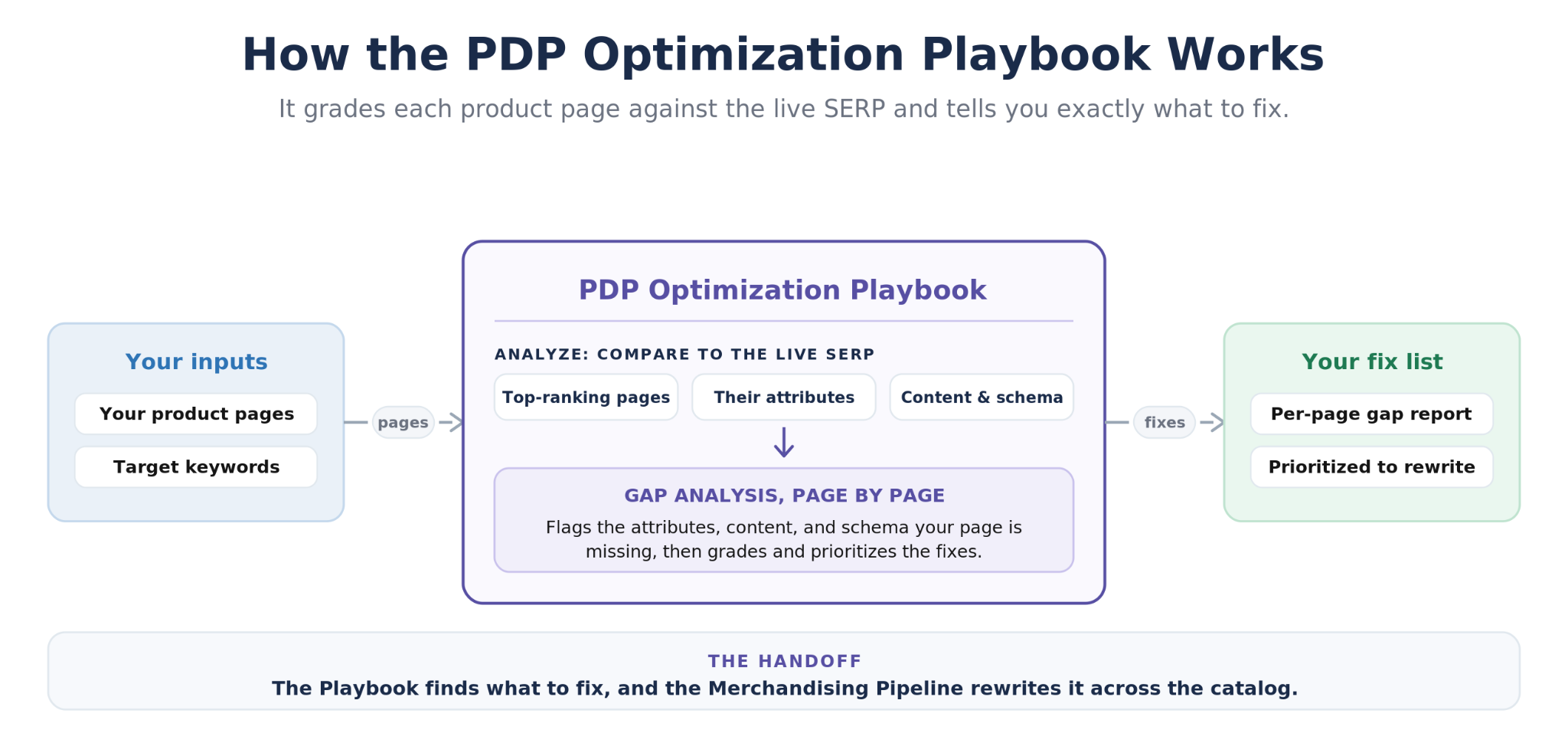
The PDP Optimization Playbook is the agent system optimizing your existing product detail pages for SEO and AEO. The system works through these complex ai agents for each of your SKUs:
Competitor analysis for your target SEO keywords and generative ai AEO queries
Gap analysis between your existing PDP and the key data competitors are using to rank
Keyword analysis and relevant AEO query analysis
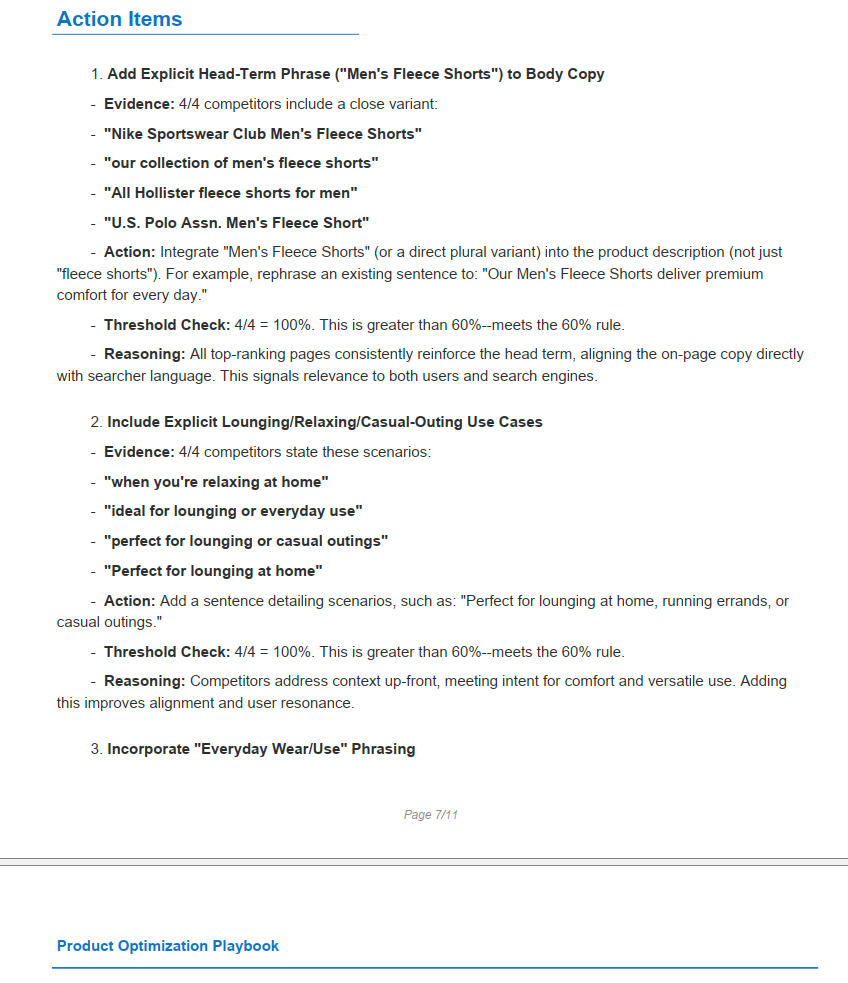
The agent framework creates a final marketing brief for each product with detailed data, recommendations, and action items for every field of the PDP. These are long form marketing brief PDFs like what you get from an agency.
Snippet of a playbook generated for a mens shorts product.
Best for: teams with existing product pages that underperform in search and want to know exactly what to fix, page by page, and care about understanding the actual data behind the recommendations.
Key capabilities the ai agents perform
Per-page gap analysis against the live SERP and AEO for each page's target terms.
Identifies missing attributes, content, and structure that ranking pages have.
Prioritized, page-by-page fixes rather than generic advice. Grounded in actual data for you to review.
Runs across the catalog and hands off to the Merchandising Pipeline for the rewrite.
Where it is strong
Turns PDP SEO into a concrete per-page checklist with real time data.
Grounded in what is actually ranking right now, not best-practice guesses. Most store owners need this data to make decisions.
Scales the analysis across a large catalog.
APIs integrate with existing systems.
Limitations
Strongly focuses on provided copy for a given SKU, not as useful if your PDP is sparse, that's where the merchandising pipeline above comes in.
Focused on on page optimizations, not off page.
5. Algolia
Algolia is the agent for on-site search and discovery. When a shopper cannot find the product, no amount of support or marketing saves the sale, and Algolia's AI search and recommendations put the right products in front of them fast.
I always include search optimization tools because discovery is where a lot of ecommerce revenue is quietly won or lost, and it is easy to overlook when you are only thinking about the support inbox. It’s a fairly straightforward process to optimize and gives you wins in an area not focused on human effort automation.
Best for: stores where search and product discovery drive conversion. Brands that want natural language search functionality in their search system.
G2 rating: 4.5 / 5 (452 reviews).
Key capabilities
Machine learning and vector search with strong ranking and relevance controls.
Recommendations and merchandising rules.
Fast APIs and a deep front-end ecosystem.
Where it is strong
Speed, relevance, and scalability for e-commerce search.
Strong developer experience and documentation.
Limitations
Costs can climb at high query volume.
More of a platform to implement than a plug-and-play app.
6. Nosto
Nosto is the ai personalization and on-site merchandising agent. It adapts the storefront in real time, product recommendations, dynamic category merchandising, and content, based on each shopper's behavior. I love these guys.
I think of it as the agent that decides what each shopper sees, and works towards getting the most AOV out of each purchase, while improving the LTV through more data to optimize on (more unique SKUs purchased).
Best for: brands personalizing recommendations and merchandising at scale. Brands that want to improve customer experience in a way that clearly improves purchase metrics.
G2 rating: 4.6 / 5 (235 reviews).
Key capabilities
Real-time personalization and product recommendations.
Dynamic category merchandising and content.
A/B testing and segmentation.
Ai agents learn over time, improving results.
Where it is strong
Proven lift on conversion rate and average order value.
Strong merchandising controls.
Specialized agents for each piece.
Full e-commerce platform for integrating ai into the entire buying journey on page.
Limitations
The interface can be complex to master.
A significant investment for smaller catalogs.
If your customer history is limited, the ability for the ai models to learn real trends is harder to work through.
7. Bloomreach
Bloomreach spans search, personalization, and marketing in one platform, with an AI layer running across all three. It is the closest thing on this list to a cross-domain suite.
I include it for teams that would rather run discovery, personalization, and lifecycle marketing under one roof than stitch point tools together.
Best for: larger teams consolidating search, personalization, and marketing.
G2 rating: 4.6 / 5 (735 reviews).
Key capabilities
AI search and merchandising.
Personalization across the storefront. These ai agents improve over time from customer interactions.
Email and SMS marketing automation, content, and analytics.
Where it is strong
Breadth across three domains in one platform.
Strong support reputation and enterprise scale.
The ai agents integrate with lots of systems.
Limitations
Enterprise weight and cost.
More platform than a small catalog needs.
8. Klaviyo
Klaviyo is the marketing agent: email, SMS, and lifecycle automation driven by your store's data, with AI for segmentation, send-time, and content. Marketing is where a lot of repeat revenue lives, and Klaviyo's AI turns customer data into flows and campaigns without a marketer building every branch by hand.
I reach for it when the goal is repeat revenue and retention rather than support or product data.
Best for: e-commerce teams driving repeat revenue through email and SMS.
G2 rating: 4.6 / 5 (1,325 reviews).
Key capabilities
AI segmentation and predictive analytics (churn, lifetime value).
Automated flows and send-time optimization.
Natural language processing for content generation and a deep ecommerce data model.
Where it is strong
Rich customer data model and strong automation.
Large ecosystem and integrations.
Data processing ability
Limitations
Cost scales with list size.
Human intervention in the day to day operations of the email workflows is required. We usually overcome this by building custom email creation dashboards that use ai to learn from what works and what doesn’t.
Focused on marketing, not support or product data.
How I Choose AI Agents for Ecommerce (Review)
Once you have seen the tools, the real question is how to choose between them. Here is the framework I actually use, and it works whether you are buying a support agent, a search platform, or a product-data pipeline.
Start with the job, not the tool
Before comparing vendors, I name the job: is the bottleneck the support queue, the product data, the product pages, discovery, or marketing? Each of those is a different agent. Most teams have more than one, and no single tool covers all five well, so I match the agent to the job rather than buying one platform and hoping.
Execution versus assistance, the distinction that matters most
This is the single most useful filter in the market. Some agents assist: they suggest, draft, or answer, and a human still finishes the work. Others execute: they take a real action or produce finished, shippable output. Execution removes the work; assistance only speeds it up.
Approach
What it does
Impact
Assistance
Suggests replies, drafts copy, or answers questions
Saves some time, but a person still has to finish and check the work
Execution
Takes an action, or produces finished, validated output
Removes the work itself, at scale, not just the first draft
So I prioritize agents that produce output you can ship or actions you can trust, work at catalog and volume scale, and connect to your real data. On this list, the Merchandising Pipeline and the PDP Optimization Playbook sit on the execution side for product data and product pages, and Fin sits there for support. Most of the rest assist to different degrees, which is fine as long as you know which you are buying.
Data access and integration
An agent is only as good as the data it can reach. For product-data and PDP agents, that means your catalog and the live SERP. For ai powered support agents, it means your ecommerce platform, OMS, CRM, and billing systems. Without that access, the agent is limited to generic output, which is exactly where thin, hallucinated product copy and shallow support replies come from.
Build, buy, or build custom
For most jobs on this list, there are three paths, and the right one depends on how specific the work is to your catalog and rules.
Option
Pros
Cons
Buy (self-serve app)
Fast and cheap to start; good for commodity tasks and simple AI systems
Generic; may not fit your catalog, rules, or accuracy needs. Hard to implement complex workflows
Build in-house
Full control over the workflow, and easier to adjust to market trends
Needs an ML and engineering team; slow and expensive to maintain
Build custom (partner)
Tailored to your catalog and wired to your data, without staffing an ML team
Needs a partner; not instant self-serve
For commodity work like a support desk or a marketing tool, buying is usually the practical path. For the high-value, catalog-specific work, product data and PDP optimization, a custom agent tends to win, because that is where generic output costs you the most in accuracy and rankings. That is the gap Pumice is built for.
The Bottom Line | Deploy ai agents with real ROI
The best AI agents for ecommerce are not one tool, and they are not all chatbots. They are a small set of agents that each execute a real job across your stack: writing and grading your product data and pages, resolving support, powering search and personalization, and running marketing. Pick by the job, favor execution over assistance, and keep the highest-value, catalog-specific work close with a custom agent. That is how you get compounding output instead of a pile of tools that each save you a little time.
Ready to see execution on your own catalog?
Width.ai builds Ai integrations into your existing Ecom stack, we’ve implemented all of these tools for large ecommerce brands and helped them navigate the build vs buy equation targeting their most important questions about getting the most out of the product. Let’s chat about how we can help you integrate these ai agents into your workflow and drive real business change.
Frequently Asked Questions
What are the best AI agents for ecommerce?
Across the stack, the best AI agents for ecommerce are the Pumice Merchandising Pipeline and PDP Optimization Playbook for product data content optimization and product-page SEO, Fin by Intercom and Gorgias for customer support, Algolia, Nosto, and Bloomreach for search and personalization, and Klaviyo for marketing.
What is the difference between an AI agent and ai chatbots?
A chatbot answers questions. An AI agent takes an action or produces finished output, processing a refund, generating validated product data, or grading a product page, and does it as part of a workflow rather than a single reply. The execution is what makes it an agent.
Which AI agents work beyond customer support?
Plenty. Product data enrichment (Pumice Ai), product-page SEO (Pumice PDP Optimization Playbook), search and discovery (Algolia, Bloomreach), personalization (Nosto, Bloomreach), and marketing (Klaviyo) are all ecommerce AI agent domains. Support is one part of the stack, not the whole thing.
Can AI automation agents handle product data and PDP SEO, not just support?
Yes, and it is one of the highest-leverage uses. The Pumice Merchandising Pipeline generates complete, validated product data across a whole catalog, and the PDP Optimization Playbook grades each product page against the live SERP and tells you what to fix. Together they cover the product-data and product-page work most support-focused lists ignore.
Should I build, buy, or build a custom AI agent?
Buy self-serve apps for commodity work like a support desk or marketing automation. Build custom for the work that is specific to your catalog and rules and where accuracy drives revenue, which is usually product data and PDP optimization. Building fully in-house rarely pays off unless you have a dedicated ML team or have a very very specific use case.
What is the biggest mistake ecommerce teams make with AI agents?
Three mistakes. The first is choosing assistive tools that only suggest, so the work still lands on your team. The second is treating a support bot as your entire AI strategy while your product data, product pages, and discovery, the things that decide whether shoppers find and trust your products, get no agent at all. Third is reduced customer satisfaction when the systems do not perform well. If you don’t set these ai agents up properly, you’re moving backwards.