If your team is debating whether to invest in agentic RAG or stick with traditional RAG, the answer depends almost entirely on what you're building. For most production workloads in 2026 (internal search, FAQ bots, support assistants) well-tuned traditional RAG systems deliver faster, cheaper, and more predictable results. Agentic RAG justifies its added cost and complexity only when your tasks genuinely require multi-step reasoning, cross-source synthesis, or tool-driven workflows where the business value per task is high enough to absorb 5–10× more compute and engineering overhead.
Three factors decide it: query complexity (single-hop lookups favor traditional RAG; multi-document investigations favor agentic RAG), cost and latency tolerance (traditional RAG wins hands down on both), and team maturity (agentic systems demand orchestration, safety, and observability skills that most teams are still building). The deciding question isn't "Is agentic RAG better?", it almost always is on benchmarks, but "Is the marginal improvement worth what it costs us, right now?"
The short answer: Agentic RAG is worth it selectively. Usage of agentic RAG is generally recommended for high-stakes, complex domains (compliance, financial analysis, multi-step research) where improved accuracy and adaptive reasoning directly translate to business value. For everything else, enhanced RAG without agents remains the smarter investment.
✂️ The short answer
Is agentic RAG worth it?
Agentic RAG is worth it selectively. It earns its cost where retrieval is the thing that is failing, meaning queries that need several lookups, multiple sources, or tool calls to answer at all, and where the value of one completed task is high enough to absorb more compute and engineering. For single-hop lookups, FAQ bots and policy search, a well-tuned traditional RAG pipeline is faster, cheaper and more predictable. The practical answer for most teams is neither one nor the other: route the 10 to 20% of queries that genuinely need planning into an agentic path and send the rest straight through, which keeps the blended cost close to traditional RAG while fixing the queries that a single retrieval pass was always going to get wrong.
Agentic RAG vs Traditional RAG: How They Compare at a Glance
The table below provides a fast, decision-level experimental comparison across the dimensions that matter most when choosing between these RAG approaches.
At a glance
Agentic RAG vs traditional RAG on the dimensions that decide it
Factor
Traditional RAG
Agentic RAG
Best for
High-volume FAQ, document search, support assistants
+21.8 pp recall@1 on BRIGHT vs the best embedding baseline; +13% relative factuality on WixQA
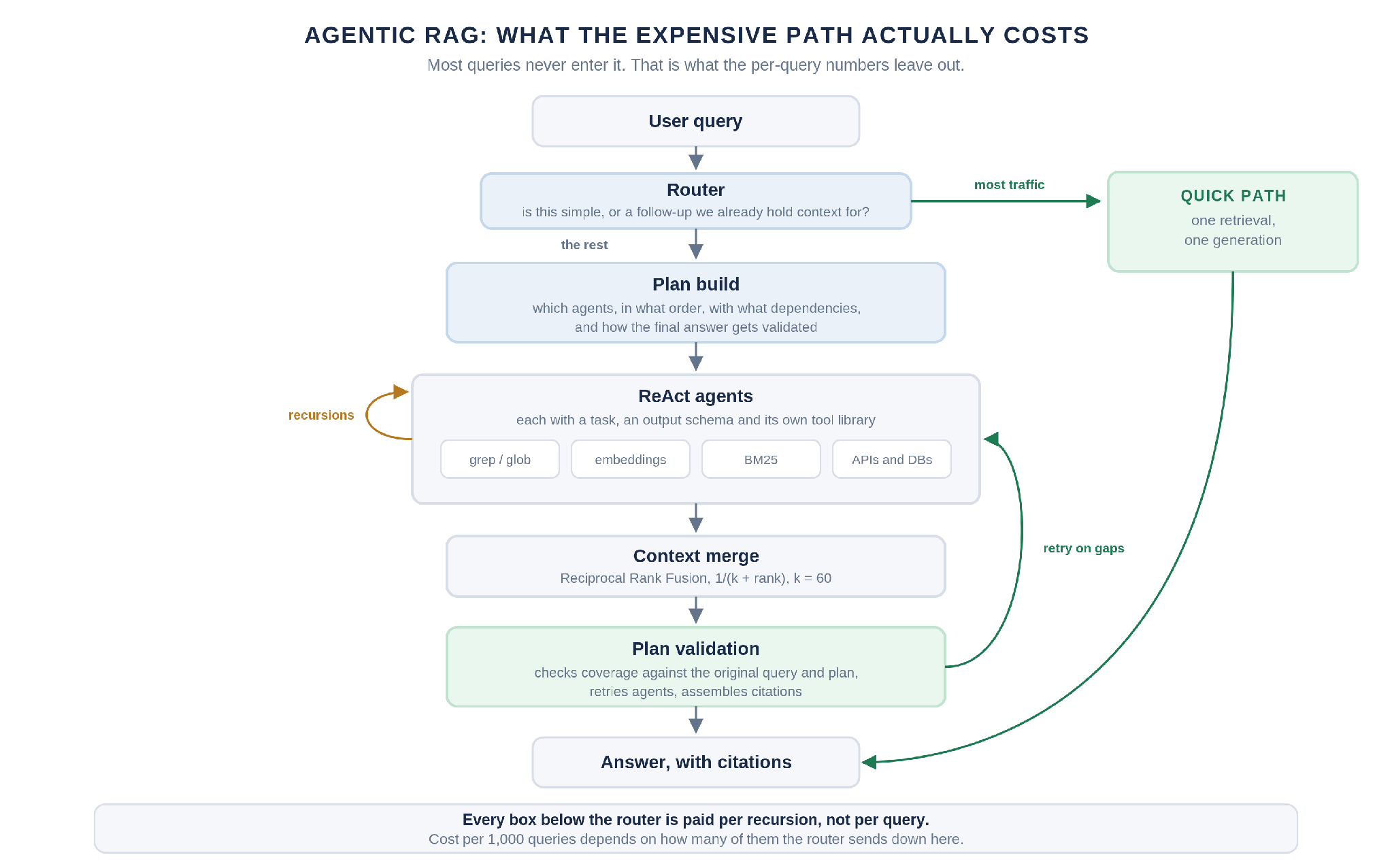
One caveat on the cost and latency rows: they describe a query that takes the agentic path. With routing in place, most queries never do, so the blended figure sits far closer to the traditional column than this table implies.
The main trade-off is clear: agentic RAG buys adaptability, depth, and improved accuracy at the price of cost, latency, and governance burden. We walk through the architecture we actually run, plan build through validation, in our agentic RAG architecture write-up.
Decisive Factor #1: Problem Complexity & Query Type
The complexity of queries determines the feasibility of investing in agentic RAG, and this is usually the first question any team should ask. Are your users asking single-hop questions, or do they need AI systems that can plan, reason, and synthesize across multiple scenarios?
Traditional RAG handles direct information needs well. Questions like "What's our refund policy?" or "How do I reset my password?" are single-retrieval problems: the RAG pipeline finds the relevant document, extracts textual context, and generates an accurate response. For product support FAQs, analytics over structured data, and policy lookup, this is fast and reliable. But traditional RAG struggles when the user query requires decomposition-"Compare our EU vs US data retention policies and draft a customer email" involves multiple retrieval steps, reasoning, and composition that a single pass cannot coordinate.
Agentic RAG is suited for complex queries requiring synthesis from multiple sources. In research workflows, compliance investigations, and multi-document reasoning, the agent decides which data sources to query, routes sub-questions to different retrieval endpoints, and interleaves retrieval with tool calls. Agentic RAG systems can handle complex queries more effectively because the AI model can plan sub-queries and synthesize findings step-by-step. For example, Microsoft's AgenticRAG research reported 49.6% recall@1 on BRIGHT, a reasoning-intensive retrieval benchmark, against 8.41% for single-shot search, a 5.9x improvement with Claude Sonnet 4.5 and 5.2x with GPT-5-mini. On FinanceBench the same system reached 92% answer correctness, within two points of oracle access to the right documents.
Retrieval method matters here as much as agent design. Since 2026 a growing share of agentic retrieval runs on file search tools like grep and glob rather than an index, which wins on exact identifiers, where two codes one digit apart are near neighbours to an embedding model and completely unrelated to the person reading them, and on corpora that change faster than you can re-index them. Consider the contrast: a customer support triage bot answering “Where’s my order?” versus an end-to-end insurance claims handler that must cross-reference policy documents, check regulatory databases, verify coverage limits, and draft a determination letter. The first is a traditional RAG problem. The second is where agentic RAG work genuinely pays off.
Winner: It depends on the task. Traditional RAG wins decisively for narrow, single-question use cases, and agentic RAG is not worth it for simple FAQ bots or straightforward queries. Agentic RAG wins for open-ended, evolving tasks requiring planning and multi-source coordination. The trade-off: agentic RAG is overkill for the majority of queries most teams actually handle.
Decisive Factor #2: Cost, Latency, and Operational Overhead
Budget constraints, SLA requirements, and infrastructure limits are where the agentic RAG vs traditional RAG debate gets uncomfortable. Agentic RAG consumes significantly more tokens and compute resources than standard RAG, and the gap is wider than most teams expect going in.
Cost drivers for traditional RAG
Traditional RAG pipelines incur a single LLM call per query, simple retrieval operations against vector databases, and modest context windows. Costs are predictable, so you can reliably estimate spend per 1,000 queries. Hosting and scaling are straightforward.
Cost drivers for agentic RAG
Agentic RAG systems can incur higher operational costs through multiple mechanisms: planning calls, retrieval loops, verification steps, and tool invocations all add up, and each one is paid per recursion rather than per query. The retrieval step itself carries real latency: a reranked pipeline typically spends somewhere between a third of a second and two seconds before the model is handed anything, and because most rerankers top out near a 4096-token window, a big retrieval has to be broken into several calls and stitched back together. Agentic RAG systems also require investment in observability, audit logging, and safety infrastructure that traditional RAG simply doesn't need. One qualifier matters for the arithmetic: in the systems we build, quick routing sends simple queries and follow-ups we already hold context for straight past the planning step, so these per-query figures apply to the subset that routes into the agentic path, not to every query the system answers.
Latency in practice
Traditional RAG delivers responses in ~0.5–2 seconds for most queries. Agentic RAG latency is more variable: decomposed tasks, multiple fetches, and tool calls can push response times to 3–20 seconds in production settings. Higher latency is a drawback of agentic RAG due to its iterative processing style, and for user-facing chatbots with tight timeout SLAs, this can be a dealbreaker. Back-office automation, where a 15-second processing time is acceptable, is more forgiving.
Research like the A-RAG framework shows that hierarchical retrieval interfaces hold retrieved token counts at or below existing approaches across open-domain QA benchmarks, so more depth does not have to mean proportionally more context. That result is measured on public benchmarks rather than your corpus, and the area is still moving.
Operational overhead
More moving parts means more failure modes. With agentic RAG, teams must manage an orchestration framework, memory stores, tool APIs, routing logic, permissions, and on-call burden for when any piece breaks. Debugging a five-step agent chain is fundamentally harder than tracing a single retrieve-and-generate pass. Latency can increase due to more complex model outputs, and incident blast radius grows when agents interact with production systems.
Winner: Traditional RAG, for cost, latency, and operational simplicity in the vast majority of cases. Agentic RAG may be justifiable when business value per task is very high (e.g., a $10,000 compliance review automated for $5 in compute), but teams should model costs carefully before committing.
Decisive Factor #3: Accuracy, Reliability, and Safety
Many teams assume agentic RAG automatically delivers more accurate responses. The reality is more nuanced: agentic RAG improves accuracy through iterative optimization, but it also introduces new classes of risk that traditional RAG doesn't face.
Traditional RAG: strengths and failure modes
Traditional RAG provides factual grounding when retrieval is good, and answers are directly tied to retrieved documents, making attribution straightforward. The system is read-only and sandboxed, with fewer moving parts to monitor. But it suffers from retrieval misses and hallucinations when the textual context is thin or the retrieval component returns irrelevant information. Traditional RAG has no mechanism to detect or correct noisy or suboptimal retrieval on its own.
Agentic RAG: gains and new risks
Our agentic rag pipeline
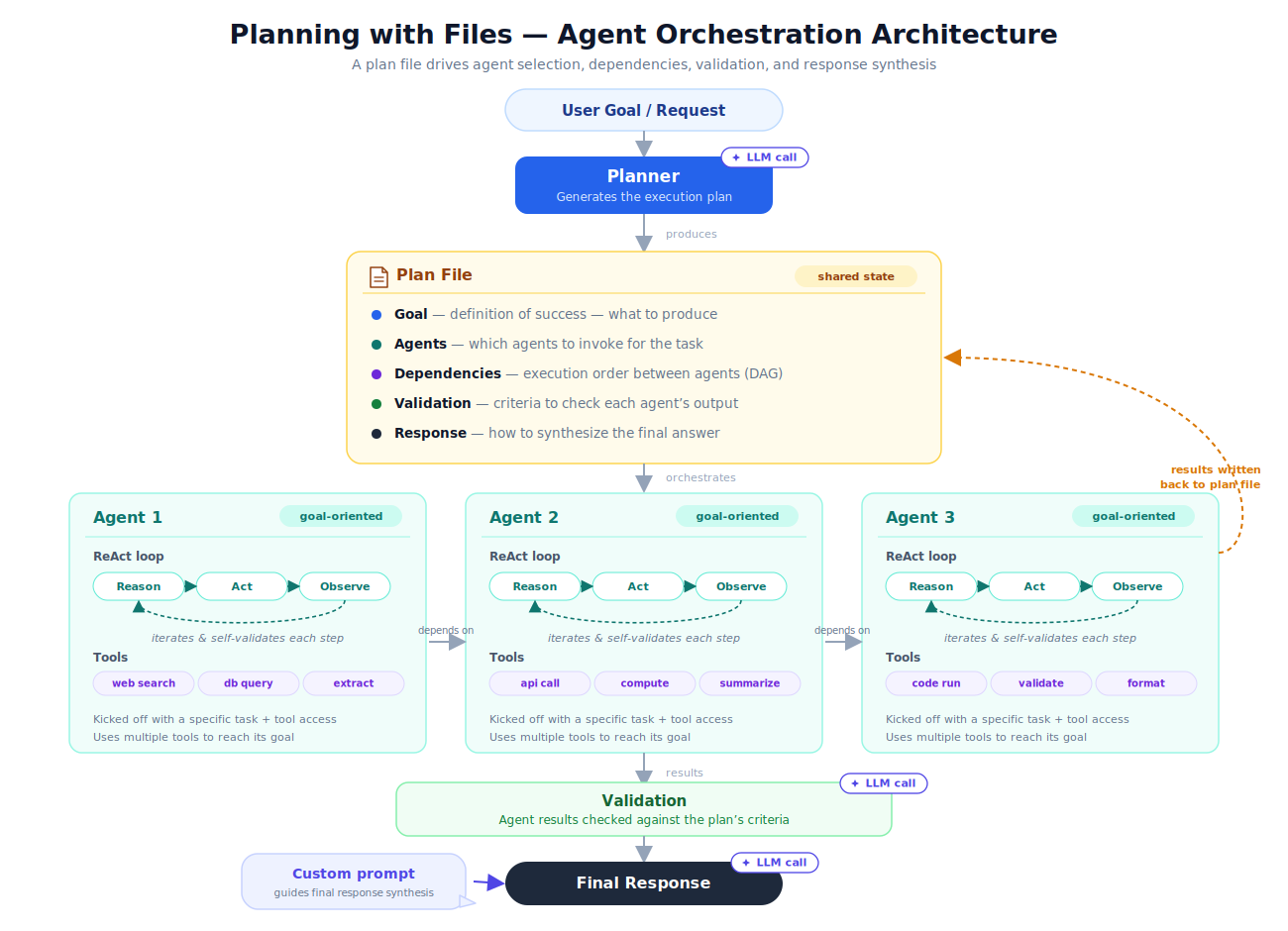
Agentic RAG improves accuracy by validating context before generating responses. The gain starts upstream of generation: answer accuracy cannot exceed retrieval accuracy, so recursion matters because it raises recall before the user ever sees a response, not because the model reasons better. In our architecture that check is a discrete step. A plan validation prompt evaluates what the agents returned against the original query and the plan, and it can retry agents, assemble citations, and only then generate the answer. Traditional RAG has no equivalent, since it returns a response based on whatever context came back. Microsoft's AgenticRAG experiments showed a 13% relative improvement in factuality on WixQA, an enterprise support benchmark. Microsoft's AgenticRAG experiments
But agentic RAG cannot completely eliminate hallucinations in outputs. And it introduces its own set of risks: tool misuse (agents calling APIs incorrectly), compounding errors across steps (wrong retrieval feeds a false premise that the agent builds on), and security vulnerabilities when agents can write data or trigger production side effects. Systematization studies from 2025–2026 document risks including retrieval misalignment, hallucination propagation, and "memory poisoning" in systems with persistent state. Increased complexity can lead to collaboration issues among agents in multi-agent architectures, and agentic RAG systems may struggle with task completion reliability when tool chains are fragile.
Agentic RAG excels in environments where accuracy and compliance are critical, but only when paired with proper governance. Emerging best practices include human-in-the-loop approvals for high-stakes actions, least-privilege permissions for non-human identities, and comprehensive audit logs across tool chains.
Winner: Nuanced. Traditional RAG wins for safe, read-only information access where the risk surface must stay small. Properly governed agentic RAG can win on accuracy in complex reasoning tasks and complex domains. But the safety burden shifts heavily onto the team, and if your organization isn't ready to invest in governance, the accuracy gains come with unacceptable risk.
Decisive Factor #4: Team Maturity and Time-to-Value
Internal capabilities matter as much as architecture choice. The best agentic RAG system in the world delivers negative ROI if your team can't operate, monitor, and secure it.
Traditional RAG: fast to deploy
The minimum skill set for traditional RAG is manageable: embeddings, vector search, prompt design, and basic evaluation. Many teams reach first production in weeks to a couple of months using off-the-shelf platforms and well-documented patterns. Evaluation of traditional RAG performance is also simpler, since retrieval precision, answer relevance, and latency are well-understood metrics.
Agentic RAG: longer runway to stable production
Agentic RAG demands orchestration frameworks, tool design, state management, safety review, and more advanced evaluation metrics. The architectural complexity of agentic RAG makes it harder to debug and maintain. Teams need experimentation cycles to discover failure modes, governance alignment with security and legal stakeholders, and clear fallback mechanisms. Agentic RAG enables adaptive reasoning and decision-making in AI systems, but building that decision-making reliably takes time.
A practical roadmap
A staged path works best for most organizations: start with baseline RAG, improve it with hybrid search, rerankers, and query rewriting (this is enhanced RAG), measure performance against clear metrics, and then selectively introduce agentic behavior where bottlenecks remain. This approach lets teams build model capability and operational maturity incrementally, without betting everything on a system they can't yet support.
Winner: Traditional RAG (or enhanced RAG without agents) for teams in their first 12–18 months of AI deployment. Agentic RAG is the right move for mature teams that already run stable RAG systems, have observability infrastructure in place, and need more autonomy to handle real world applications that static pipelines can't address.
Is Agentic RAG Worth It? Segmenting the Recommendation
There is no single winner in the agentic RAG vs traditional RAG debate. The results provide practical insights that map cleanly to specific team situations:
Choose traditional or enhanced RAG if:
Your main use cases are Q&A, document search, and support assistants that answer user queries with relevant information from a knowledge base.
You need predictable cost and low latency at scale.
Your team is still building foundational AI and MLOps capabilities.
Your current data and retrieval needs are served by accurate retrieval from a single source.
Choose agentic RAG if:
You're automating complex workflows: investigative compliance reviews, multi-step financial analysis, research synthesis across external databases and multiple data sources.
Each task has high business value, justifying higher compute and engineering cost. Agentic RAG enhances flexibility by accessing multiple data sources and supports multimodal data types like images and audio.
You can invest in security, monitoring, human-in-the-loop review, and continuous improvement of your agent pipelines.
Agentic RAG incorporates reasoning and planning into retrieval in ways that your use case genuinely requires.
Adopt a hybrid approach when:
You want RAG agents only for the 10–20% of queries that are complex, while routing the rest to cheap, fast RAG. This is already common best practice in mature enterprise deployments. When the agentic path pulls from several retrievers at once, Reciprocal Rank Fusion is the standard way to merge them: each document scores 1/(k + rank) in every list with k conventionally set to 60, and the sums decide the final order, which avoids having to reconcile two scoring systems that were never measured on the same scale. 10–20% of queries that are complex
You're incrementally layering agentic behavior on top of an existing RAG stack, wrapping existing endpoints with an agent layer for planning and routing.
To pilot agentic RAG safely: pick a narrow, high-ROI subdomain; define clear success metrics before building; run an empirically driven evaluation comparing agentic performance against your best traditional RAG baseline (not a weak strawman); monitor cost per task, error rates, and safety incidents; and keep a rollback plan. If the numbers work, expand. If they don't, you've learned cheaply.
Not Sure Which Half of Your RAG Is Failing?
Most teams reach for agents when the problem is retrieval, and no amount of planning fixes a pipeline that never surfaced the right chunk. Width.ai has been building retrieval systems since 2021, for banking clients and law firms where the latest information is not optional. Send us a handful of queries your current system gets wrong and we will tell you which layer broke.
Frequently Asked Questions About Agentic RAG's Value
Does agentic RAG really reduce hallucinations enough to justify the cost?
Agentic RAG reduces hallucination by validating context before generation and through iterative self-checking. In Microsoft's AgenticRAG work, factuality improved 13% in relative terms on the WixQA enterprise benchmark. But agentic RAG cannot completely eliminate hallucinations in outputs, since errors can compound across steps, and agents can build on false premises from bad retrievals. Governance, evaluation, and human review are still required regardless of architecture. The improvement is real but not magic.
Should we skip "plain" RAG and go straight to agentic RAG?
For most organizations, no. Evaluation of agentic RAG should consider its ability to improve outcomes over standard RAG, but you need that standard RAG baseline first. A staged path works: baseline RAG → enhanced RAG (rerankers, query rewriting, hybrid search to address specific weaknesses) → targeted agentic extensions where ROI is proven. Skipping stages means you won't know whether your performance problems come from bad retrieval, bad generation, or genuinely needing agentic AI capabilities.
Can we bolt agentic behavior onto our existing RAG system?
Yes, and this is how most teams start. You can wrap existing RAG endpoints with an agent layer that handles planning, routing, and verification for complex queries while passing simple queries straight through to the existing pipeline. Key considerations: you'll need observability across the agent's decision-making steps, permissions and safety guardrails for any tools the agent can call, and you should keep your legacy RAG behavior as a fallback. Frameworks like LangGraph and LlamaIndex are designed for exactly this kind of incremental adoption.
What metrics should we track to decide if agentic RAG is worth it?
Focus on metrics that connect to business outcomes: task completion rate, manual review time saved, cost per successfully completed task, user satisfaction scores, and incident/error rates. Compare these against a strong traditional RAG baseline, not a naive RAG implementation with no tuning. Track agentic-specific signals too: average number of agent steps per query, tool call success rates, and latency distribution. If the generative AI system isn't measurably outperforming your best non-agentic alternative on these metrics, the added complexity isn't paying for itself.
Is agentic RAG necessary to stay competitive in 2026 and beyond?
Not universally. Many companies will succeed with advanced but non-agentic retrieval augmented generation RAG for years, especially where use cases center on document search, support, and structured data retrieval. Agentic RAG becomes strategic in domains with complex workflows, high automation pressure, and where out of scope queries frequently require multi-source synthesis. Trends like standardized tool discovery, 1M+ token context windows, and managed agentic platforms from Google and Azure are lowering barriers. The Model Context Protocol is worth tracking specifically: it versions by date rather than semver, and the 2026-07-28 revision added a mandatory server discovery call, which changes how agents find tools at runtime. The right move for most teams is still targeted experimentation in high-value workflows, not blanket adoption.