AI adoption in marketing crossed the majority mark years ago, and the model landscape underneath it has turned over completely since. The question marketers keep asking, "which AI is best for digital marketing?", gets answered badly because it usually gets answered by feature list. The models that matter in 2026 differ on four things that a feature list does not show: how much context they hold, whether they lead on reasoning or throughput, what they can reach without custom engineering, and whether they can act at all or only return text.
This guide compares the models and systems on those terms, explains what each specification actually changes about your output, and gives you a framework for matching one to the constraint that is currently binding on your team.
Answering the Core Question: Which AI Is Actually Best for Digital Marketing?
There is no single "best AI" for digital marketing. The landscape in 2026 includes general-purpose models like Claude, ChatGPT, and Google Gemini, alongside specialized platforms like Perplexity for research and orchestration platforms for autonomous execution. Each serves a different marketing function, and the best ai marketing tools are the ones that match the job you need done.
The useful way to separate them is by the capability each one leads on, because that is what decides whether it can do your job at all:
Context depth. Claude and Gemini carry the largest usable windows, which is what lets you hand over a full analytics export or an entire site crawl in one pass instead of chunking it. Chunking is where analysis quietly loses accuracy, because the model never sees two related rows at the same time.
Reasoning versus throughput. Every provider now splits its family into a frontier reasoning tier and a cheaper high-speed tier. Claude and the top ChatGPT tier lead on sustained multi-step reasoning. The speed tiers underneath them are what you point at volume work, and they cost roughly an order of magnitude less.
Grounding and retrieval. Perplexity is a retrieval layer rather than a base model, so its value is a live index and enforced citations rather than raw model quality. Any claim you publish that needs a source behind it is a retrieval problem first and a writing problem second.
Native reach. Gemini is the only one of the four with first-party access to Google Ads, GA4 and Workspace without you building the connection yourself. Everything else reaches your stack through an API you or a vendor wires up, and the newest frontier tiers can also operate software directly rather than only returning text.
Here's our overall verdict:
Claude - best all-around copilot for strategy, long-form content creation, and data-heavy analysis.
ChatGPT - best for speed, experimentation, ideation, and broad accessibility.
Gemini - best for marketing teams deeply embedded in Google Ads, GA4, and Google Workspace.
Perplexity - best for competitor research and always-up-to-date market intelligence. Execution platforms lead on hands-off campaign management.
The rest of this article will walk through how we evaluated each AI, detailed breakdowns with strengths and limitations, a quick comparison table, and a decision framework for building your marketing stack.
How We Evaluated "Best AI for Digital Marketing"
We studied real marketing workflows from 2025–2026 rather than relying on lab benchmarks. Our evaluation covered general-purpose ai models (Claude, ChatGPT, Gemini) alongside marketing-specific platforms, testing them against the work digital marketers actually do: content creation, SEO, ad campaign management, CRO, lifecycle marketing, analytics, and agentic automation.
AI marketing tools automate tasks like data analysis and content creation, but the real differentiator is how well a tool fits your specific workflows and channels. Here's the criteria we used.
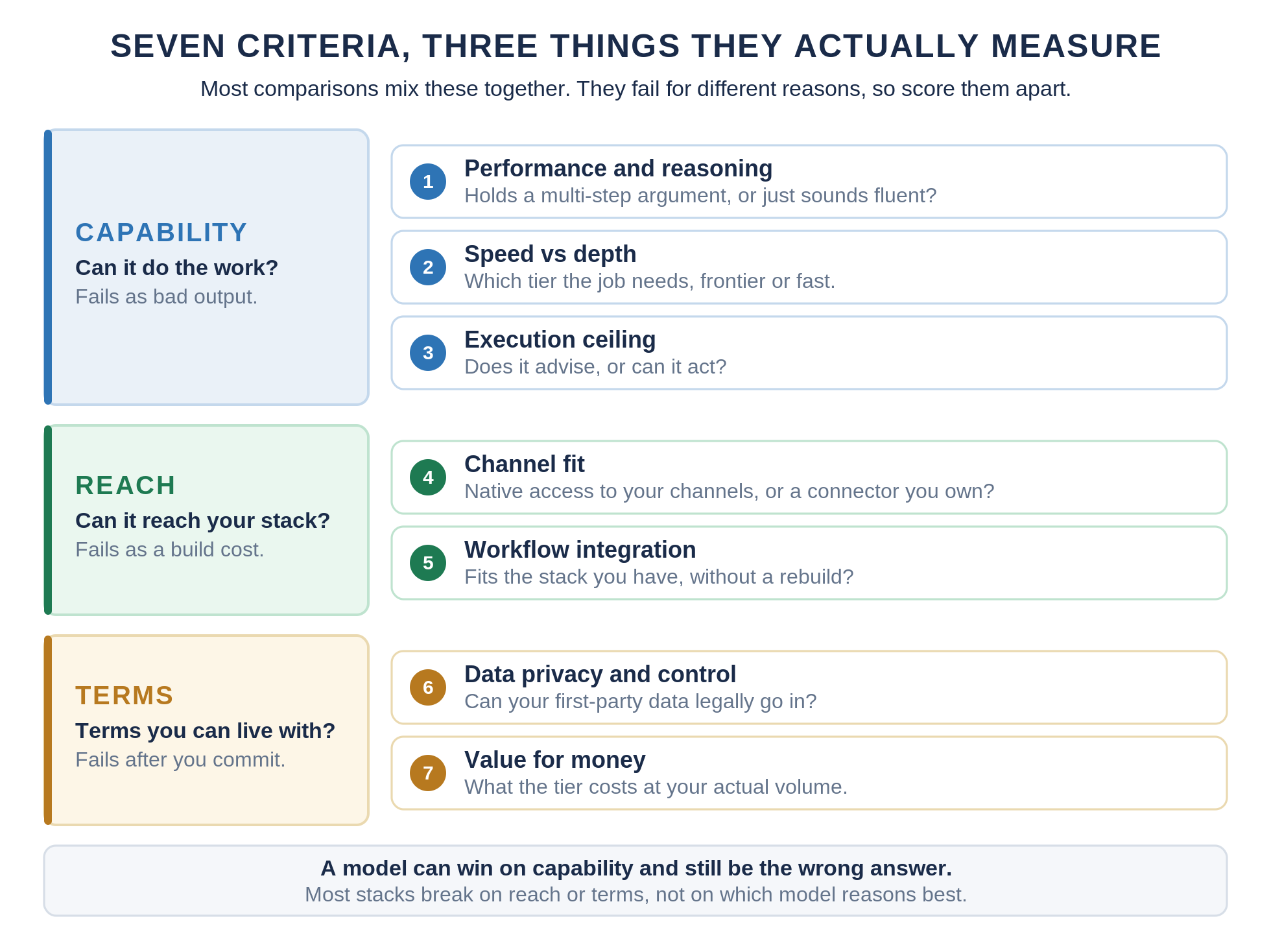
Evaluation Criteria and Why They Matter
Each criterion below reflects a real decision point for marketing teams evaluating ai marketing software in 2026.
Performance and reasoning. Can the AI handle complex marketing tasks like multi-campaign analysis, attribution hypotheses, audience segmentation, and strategy synthesis? AI can analyze millions of data points in seconds, but the quality of the conclusions matters more than raw speed. Claude's performance on graduate-level reasoning benchmarks (GPQA, MMLU) reflects the kind of depth needed for strategic marketing work.
Channel fit. How naturally does the AI plug into core channels: search platforms, paid media, email, social media management, on-site personalization, and CRM? Gemini's direct integration with Google's ad products makes it strong for Search and YouTube. Perplexity connects well to SEO and content workflows. Agentic platforms increasingly cover multiple channels simultaneously.
Workflow integration. Does the tool offer native integrations with GA4, Google Ads, Meta, HubSpot, Salesforce, or Shopify? Can it connect through Zapier or Make, or via custom APIs? AI tools automate data analysis, saving marketers significant time-but only when they fit into existing processes without requiring a full rebuild of your tech stack.
Speed vs. depth tradeoff. Some marketing tasks need rapid copy variations (ad headlines, social media posts). Others demand deep analytics and thoughtful strategy. ChatGPT leans toward speed and ideation. Claude trades some speed for depth. Understanding this tradeoff shapes which tool you reach for on any given marketing task.
Data privacy and control. When you're feeding first-party data-CRM records, ad logs, revenue data-into an AI, privacy matters. Cisco's 2025 Data Privacy Benchmark Study shows rising awareness among companies about responsible AI governance. Many enterprise tools now offer plans where user data is not used for training. Tools like Perplexity Enterprise explicitly commit to zero training on customer data in certain plans.
Execution ceiling. How far can the tool move from answering a marketer's question to carrying out the work itself? This is the frontier of ai powered tools in marketing-systems that don't just advise, but act. AI tools can analyze customer behavior in real-time and respond accordingly when set up with proper governance.
Value for money. How do pricing tiers and API costs translate into ROI for small marketing teams vs. mid-market vs. enterprise? Flagship-tier models run a few dollars per million input tokens and $15 per million output tokens. Agentic suites tend toward custom enterprise pricing. Subscription tools like Jasper and Copy.ai offer lower tiers but with limited autonomy.
What Actually Separates These Models
Before the individual profiles, it helps to know which specifications actually change your results and which are marketing copy. Four dimensions do the work.
Context window. Flagship tiers now carry roughly a million tokens, which is the difference between summarizing a campaign export and reasoning over the whole thing. A year ago the practical ceiling was a couple of hundred thousand, and the jump matters for anyone feeding in raw GA exports, full ad-account histories, or an entire site crawl. Below the flagship tier, context drops sharply, which is the most common reason a cheaper model suddenly starts losing the thread.
Reasoning tier versus speed tier. Every major provider now ships at least two tiers off the same family: a frontier model tuned for multi-step reasoning, and a faster one priced for volume. The frontier tier is the one that holds an argument together across a long analysis. The speed tier is the one you point at ten thousand product descriptions. Picking the wrong tier is a more expensive mistake than picking the wrong provider.
Pricing structure, not headline price. Flagship input pricing sits at a few dollars per million tokens with output typically around five times that, so output length drives your bill more than input volume does. The levers that actually cut cost are batch processing, which usually halves both numbers, and prompt caching, which can drop repeat input by an order of magnitude. A team running the same brand-guidelines preamble on every call and not caching it is paying for the same tokens thousands of times.
What the model can reach. The newest frontier models can operate software directly rather than only returning text, which moves the boundary between an assistant and an operator. More practically for marketing teams, the differences that bite are integration surfaces: which model has first-party access to your ad platform, which has a usable API for your ESP, and which requires you to build the connection yourself.
Everything in the profiles below is downstream of those four. Where two models look interchangeable on a feature list, they are usually separated by tier pricing and by what they can reach without custom engineering.
The 5 Best AIs for Digital Marketing in 2026
We narrowed the field to five core AIs and ecosystems that realistically underpin most high-performing digital marketing stacks today. These are foundational ai models or platforms, not the hundreds of vertical SaaS tools built on top of them. Top AI tools for digital marketing include solutions for content generation, SEO, and social media management-but the models below are what powers them.
1. Claude – Best Overall AI Brain for Digital Marketing Strategy
Claude from Anthropic is the strongest general-purpose AI for marketing strategy work in 2026. With a million-token context window, it can ingest full GA exports, ad performance reports, SEO crawl data, survey results, and sales transcripts in a single conversation. The Artifacts feature provides live, editable content panels that make it easy to iterate on frameworks, playbooks, and campaign plans without losing context.
Claude excels at long-form content and maintaining brand voice consistency-a critical need for marketing teams producing guides, case studies, and ongoing lifecycle messaging. Content ideation and drafting are primary applications for ai marketing tools, and Claude handles both with unusual depth.
Why It Stands Out
Handles big uploads: GA exports, ad reports, SEO crawls, survey data, sales transcripts-all processed within that massive context window.
Context. A million-token flagship window, and the model holds a single long argument across that window rather than degrading into summary. This is the practical difference when you upload six months of campaign data and ask why performance moved.
Tiering. A frontier reasoning tier plus a faster tier from the same family, so the volume work and the thinking work share one prompt format and one set of brand instructions.
Deployment and reach. Direct API, plus availability through AWS Bedrock and Google Vertex for teams that need the model running inside their own cloud account. No first-party ad platform integration, so execution has to be built. In marketing terms this lands on strategy, long-form assets and data interpretation.
Key Strengths
Nuanced analysis of multi-channel campaign performance data (Meta + Google Ads + email + affiliate).
High-quality long-form drafting with fewer hallucinations on structured data.
Strong at turning qualitative data-NPS comments, reviews, sales calls-into actionable insights and messaging frameworks.
AI enhances customer insights through predictive analytics when Claude is fed the right campaign data.
AI tools streamline content creation and management in digital marketing, and Claude handles both the thinking and the writing process.
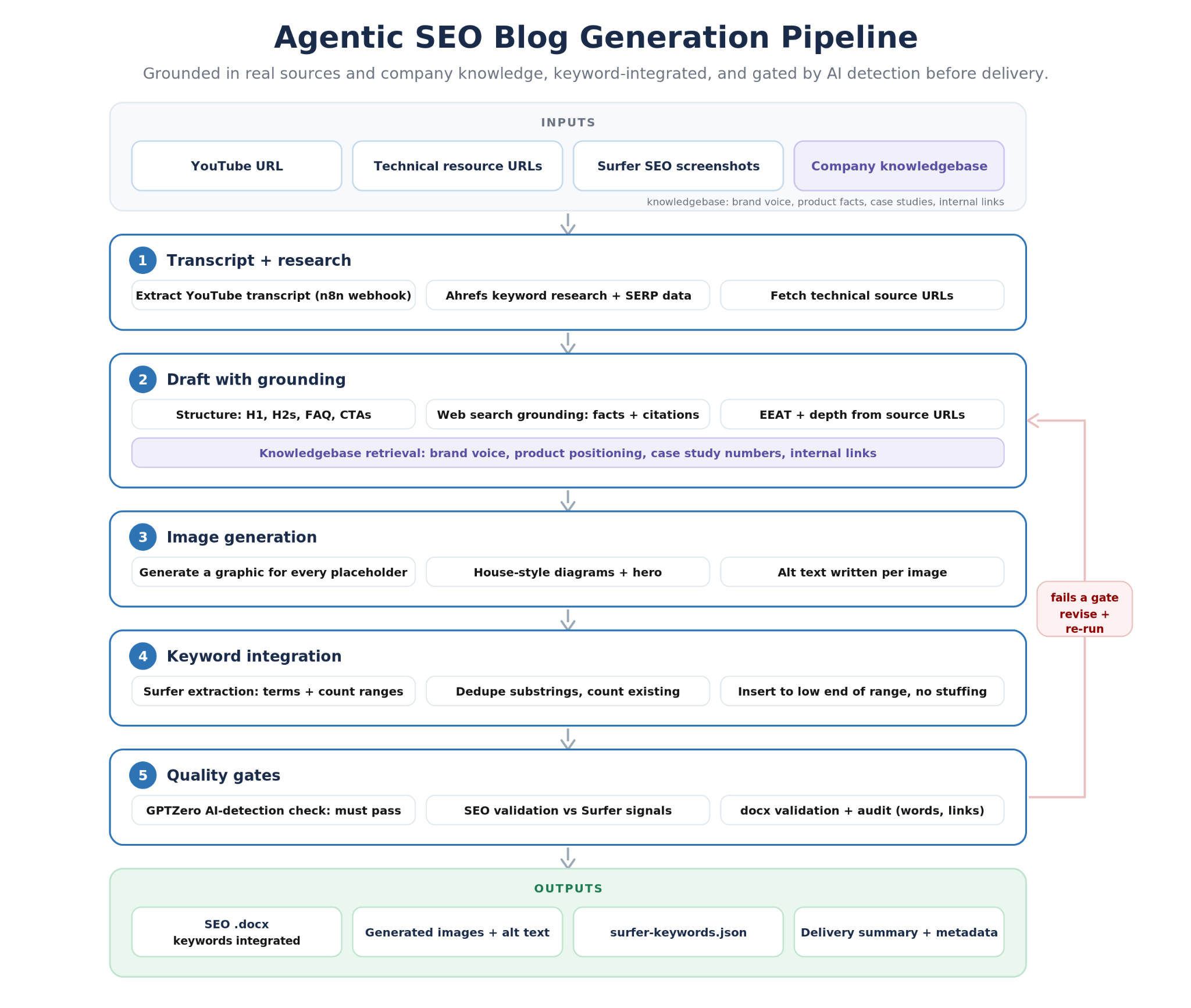
Our claude based blog post generation framework (full diagram)
Possible Limitations
Not as tightly integrated into ad platforms as Google's own Gemini for execution details-you may need manual deployment steps.
Can be slower or more verbose for quick-hit social copy and ad variations without precisely engineered prompts.
Requires thoughtful prompt design to avoid over-confident strategic recommendations when raw data is thin.
2. ChatGPT – Best for Fast Ideation, Copy Variations, and General Productivity
ChatGPT remains the most widely adopted AI assistant for digital marketers in 2026. Its main selling point is versatility: multimodal capabilities in AI tools help in generating diverse marketing assets, and ChatGPT handles text, voice, and vision inputs natively with response latency as low as 232 milliseconds for audio.
Why It Stands Out
Rapid generation of ad variants, email subject lines, and social calendars-perfect for teams that need volume.
Easy onboarding for non-technical marketers and stakeholders. The free plan and free version give teams a no-risk entry point.
Massive plugin/app ecosystem and native integrations through internal tools like n8n, which connects over 9,000 apps for automated marketing workflows.
Technical Profile
Tiering. The widest tier ladder of the four, from a cheap high-speed tier up to a frontier reasoning tier. That range is the actual argument for it: you can move a workload down the ladder once you know quality holds, and cut cost without changing vendor or prompt structure.
Integration surface. The largest third-party ecosystem, because most tooling is built against this API first. If you are buying a marketing tool with AI inside it, the odds are good this is the model underneath.
Multimodality and deployment. Image generation sits in the same interface as text, and Azure gives teams that need their own tenancy a supported path. In marketing terms this lands on fast ideation and high-volume variation work.
Key Strengths
Fast "first draft" engine for landing page copy, ad sets, and outreach sequences. AI tools can generate content at unprecedented rates.
Good at transforming formats: blog post to email sequence, webinar to social thread. Generative ai tools can automate content creation processes this way.
Image and code support useful for quick mockups or marketing tool scripts. AI image generators within the platform enable rapid visual prototyping.
Strong documentation, online community prompts, and examples tailored to social media marketing and content generation.
Possible Limitations
Can default to generic, high-level marketing language without tight instructions or brand guidelines.
Less robust for deep analytics interpretation compared with Claude on large datasets of complex data.
Brand-safe output still requires editorial review to avoid off-tone messaging or compliance issues-ai generated answers aren't always publication-ready.
3. Google Gemini – Best for Performance Marketers in the Google Ecosystem
Gemini is Google's flagship AI, deeply wired into Google Ads, GA4, and Google Workspace by 2026. For performance marketers whose budgets flow primarily through Google channels, it offers something no other AI can: native, first-party access to live campaign data and search behavior.
Why It Stands Out
Native access to campaign data, search terms, and on-site behavior through GA4 and Google Ads.
Context-aware recommendations for Performance Max, Search, and YouTube campaigns. AI-driven marketing solutions optimize ad budgets using live performance data.
Smooth use inside Google Docs, Sheets, Slides, and Gmail for everyday marketing workflows. Gemini's Business Notebooks help the AI remember your brand voice and business context.
Technical Profile
Native data access. The one real differentiator here: first-party reach into Google Ads, GA4 and Workspace with no connector to build. Every other model on this list gets at that data through something you wire up and maintain.
Context and multimodality. A long window with native video and image understanding, which matters if your creative review covers YouTube assets rather than static files.
Deployment. Vertex AI, which folds billing and governance into an existing Google Cloud contract. The trade is a documented lean toward Google's own channels in its recommendations, so treat cross-channel advice from it as a second opinion rather than a plan.
Key Strengths
On-the-fly analysis of campaign performance using live Google Ads and GA4 data.
Smart suggestions for budget reallocation, bidding strategies, and creative testing. Predictive analytics tools forecast customer behavior, and Gemini applies this directly to campaign management.
Automation of routine reporting decks in Slides and written summaries in Google Docs. AI marketing tools can automate entire marketing workflows when embedded this deeply.
Tight privacy and data control within the existing Google Cloud governance model.
Possible Limitations
Optimizations can be biased toward Google's own channels and attribution logic-may overlook Meta, TikTok, or email nuances.
Less flexible as a "neutral" strategist across competitor websites, affiliate data, and non-Google platforms.
Creative copy quality and tone may lag behind Claude or ChatGPT without careful prompting. AI features like content generation need more guidance here.
4. Perplexity – Best AI for Research, Competitor Analysis, and Data-Backed Content
Perplexity functions as an AI research assistant that combines large language models with live web search, real-time citations, and enterprise data connectors. For marketing teams that need accuracy and freshness in their research, it fills a gap that general-purpose chatbots can't.
Why It Stands Out
Always-current market data and competitor intel with clickable, verifiable sources. AI-driven SEO tools analyze search intent patterns and content gaps, and Perplexity excels at surfacing these.
Critical for data-backed content, thought leadership, and pitch decks where claims need backing.
Architecture. Not a base model. It is a retrieval layer that runs a live web index in front of other providers' models, and on paid tiers you choose which model sits underneath. Judging it against Claude or ChatGPT on reasoning misreads what it is.
What it adds. Enforced citation of sources and current index freshness. Those two properties are the product, and they are the reason a claim it returns can be checked in a way a base model's output cannot.
Cost and limits. Priced per seat for most teams rather than per token, which makes it cheap to give an entire team. An API exists, but the retrieval layer is the value, not a foundation to build products on. In marketing terms this lands on competitor research and sourcing claims.
Key Strengths
Fast, source-linked answers that can be dropped into decks and briefs with citations-great for competitive analysis.
Good at analyzing competitor site structures, messaging, and content themes across competitor websites.
Useful for trend scouting new ai tools, emerging channels, formats, and market trends before committing to tests.
Pairs well with Claude or ChatGPT: Perplexity supplies the research, another model handles the narrative work. AI can automate content audits and gap analysis for SEO when these tools are combined.
Note: SEO tools like Semrush and Surfer SEO provide data-driven content optimization suggestions that complement Perplexity's research. Surfer SEO optimizes content based on keyword density and readability. Surfer SEO also analyzes content for keyword density and readability, while AI tools like Clearscope provide detailed content insights for SEO. ContentShake AI combines LLMs with Semrush data for SEO-optimized drafts. Brandwell generates articles that pass AI detection tools, though these are best ai marketing tools for execution, not research.
Possible Limitations
Not a full creative or execution environment-better as an ai layer for research than a copy machine.
Still requires marketer judgment to filter noisy or irrelevant sources. Browse ai features help, but human review remains essential.
May have paywall or rate-limit constraints for very heavy agency use. Paid plans start at levels that may challenge smaller budgets.
5. Orchestration Platforms: When You Need Execution, Not Answers
The four tools above answer questions. This last category acts on them. These platforms sit above the models and connect them to your ad accounts, CRM, and analytics so campaigns can be monitored and adjusted without a person in every loop. Salesforce Agentforce, Adobe Agent Orchestrator, HubSpot Breeze AI, and Albert.ai are the established names, and most of them run one of the models above underneath.
The distinction that matters for this comparison is what you are buying. Claude, ChatGPT, Gemini, and Perplexity are capabilities you prompt. An execution platform is infrastructure you configure, with the setup cost and governance overhead that implies. It earns its keep at roughly $500k a year in media spend or when campaign volume has outgrown the people managing it, and it is overkill below that. We have written separately about what these systems look like in production across seven marketing surfaces, including the architecture patterns and where the human review gates belong. what these systems look like in production across seven marketing surfaces
Best for: brands above roughly $500k in annual digital media spend, teams buried in bid adjustments and creative rotations, and organizations with the data governance to support automated decisions.
Strengths: always-on KPI monitoring, structured experiments at scale, and first-party CRM data driving audience decisions. Acts as a spine connecting several underlying models into one operating layer.
Limitations: needs clean event tracking or it amplifies bad signals at machine speed, carries real setup and change-management cost, and is unnecessary for small accounts.
Quick Comparison: Which AI Is Best for Which Digital Marketing Use Case?
The pairings below are worth reading as layers rather than as products: retrieval feeds reasoning, and reasoning feeds execution. Most stacks that work are one model per layer, not four models competing for the same job.
Tool
Leads on
Pick it when
Watch out for
Claude
Sustained multi-step reasoning over a million-token window
Teams whose bottleneck is thinking, not typing
Not wired into ad platforms for execution
ChatGPT
Tier range: a cheap speed tier through to frontier reasoning
Small teams and non-technical marketers
Generic without tight brand instructions
Gemini
Native first-party reach into Google Ads, GA4 and Workspace
Stacks already inside Google's ecosystem
Biased toward Google's own channels
Perplexity
A live retrieval index with enforced citations, not a base model
Work where claims need citations
A research layer, not a creative environment
Execution platforms
Approval gates and platform integrations, not model quality
Media spend above roughly $500k a year
Needs clean tracking and real setup effort
The first four are models you prompt. The fifth is infrastructure you configure, which is why it belongs in a different budget conversation.
Pairings that cover more than one layer:
Retrieval plus reasoning. Perplexity gathers and cites, Claude reasons over what came back. You are separating the freshness problem from the thinking problem and using the model that is actually built for each.
Native data plus execution. Gemini reads Google's first-party data directly, then an execution platform acts on it across channels Google does not own.
Throughput plus execution. A speed-tier model produces volume, a platform with approval gates runs what survives review. The gate is the part teams skip and then regret.
Two reasoning models, deliberately. Claude for cross-channel work where vendor neutrality matters, Gemini where Google's own data is the input. Running both is a hedge against a single provider's bias, not redundancy.
How to Choose the Right AI for Your Digital Marketing Stack
The "best" AI depends on your channel mix, team maturity, and data infrastructure. No amount of ai features will compensate for choosing a tool that doesn't fit your actual marketing efforts. Here's how to frame the decision.
Choose Based on Where Your Data Already Lives
The practical constraint is rarely model quality. It is whether the model can reach the data you need without a build, because a connector you have to maintain is an ongoing engineering cost that never appears in the pricing page comparison.
Data inside Google. If the numbers that drive decisions sit in Google Ads, GA4 and YouTube, Gemini reads them natively and nothing else on this list does. The rest reach that data through an API integration you own, and the maintenance on those connections is the cost people underestimate.
Data in text and documents. If the input is briefs, transcripts, crawls and research, this is a context problem, not an integration problem. A million-token window and a frontier reasoning tier handle it directly, with a retrieval layer in front when claims need sources attached.
Data across many systems. If it is split across an ESP, a CRM and three ad platforms, no model reaches all of it natively and the real decision is what sits in the middle. That is an integration layer or an execution platform, and the model choice becomes secondary to whether the plumbing exists at all.
Choose Based on Team Size and Skills
Team size changes everything about which AI investment makes sense. Ai literacy varies dramatically across organizations.
Solo and small marketing teams: Start with one general-purpose model-either ChatGPT or Claude. Add Perplexity later when you need evidence-backed content. A free plan or free version can get you started before committing budget. Jasper AI has over 350,000 users for copywriting tasks, making it another accessible option for small teams needing basic ai features.
Mid-market teams: Use at least two complementary AIs (e.g., Claude + Gemini) and connect them into shared marketing workflows. Zapier connects over 9,000 apps, making it simple to bridge these tools without engineering resources. Image generators and video generation tools can layer in as your content creation process matures.
Enterprise teams: Evaluate full execution platforms and data-governed deployments-private instances, VPC, custom fine-tuning. Your marketing stack at this level likely involves search platforms, CRM, CDP, and multiple ad platforms that need a unified ai layer orchestrating across them.
Choose Based on Data Maturity and Compliance Needs
Your data infrastructure determines how much value you can extract from any AI tool. AI tools enhance customer insights through data analysis, but only when the underlying data is clean.
High-maturity teams with clean analytics, defined KPIs, and reliable tracking can unlock the full value of automated execution and advanced modeling. AI-driven tools provide advanced insights for analytics and optimization of marketing strategies only when raw data is trustworthy.
Early-stage teams should begin with low-risk use cases: copy, ideation, research, and content generation while they fix tracking and attribution. Don't invest in execution platforms until your data infrastructure supports them.
Heavily regulated brands (finance, healthcare, EU markets) must consider enterprise-grade security options, on-prem or VPC deployments, and vendor SOC2/ISO certifications. The EU AI Act, effective August 2026, requires synthetic content to be labeled in machine-readable formats. Verify that enterprise or Pro plans do not train on customer data without consent.
Which AI Is Best for You? Practical Recommendations
If you want a decision shortcut, work backward from the constraint that is actually binding on you. In most stacks it is one of four, and each one points at a different kind of system.
Pick on reasoning depth when the work is analysis that has to hold together across many steps: attribution that does not reconcile, a channel mix decision, a strategy document that has to survive scrutiny. This is the frontier reasoning tier, and Claude is the strongest of them on sustained argument. Paying frontier prices for work a speed tier handles is the most common way teams overspend.
Pick on context size when the input is large and cannot be split without losing the answer: a full analytics export, an entire crawl, a year of creative performance. A million-token window is the requirement, which rules out most of the cheaper tiers regardless of how capable they look on a feature list.
Pick on native data access when the bottleneck is getting at your own numbers rather than thinking about them. Gemini reaches Google Ads, GA4 and Workspace directly. Anything else means building and maintaining that connection, which is a real engineering cost people tend to price at zero.
Pick on grounding when the output has to be checkable: claims you publish, competitive intelligence, anything a client will question. A retrieval layer with enforced citations solves this. A larger base model does not, because scale does not make a model's recall verifiable.
Pick on execution when the constraint is operational volume rather than quality of thought. At that point you are buying a system with approval gates and platform integrations, not a better model, and the budget conversation changes accordingly.
Reading the same thing by company profile:
DTC ecommerce. Native Google data access is usually the binding constraint, so Gemini plus a speed-tier model for volume content covers most of it. The execution layer only earns its setup cost once spend passes roughly $50k a month.
B2B SaaS. Reasoning depth and grounding are binding, volume rarely is. A frontier reasoning tier plus a retrieval layer covers the work, and the money that would have gone to an execution platform is better spent on the analytics plumbing feeding the models.
Agency. All four constraints bind at once because every client is different, which is the one case for running multiple models deliberately: a reasoning tier for strategy, a speed tier for production volume across accounts, a retrieval layer for pitch work, and execution only for the clients whose spend justifies it.
Final Thoughts
The best AI for digital marketing in 2026 isn't a single tool-it's a system. The highest-performing marketing teams are building stacks that combine a primary reasoning model (Claude or ChatGPT) for strategy and content, a data-grounded research layer (Perplexity or similar) for accuracy and market data, and increasingly, an agentic layer that connects everything into real marketing workflows that execute autonomously.
Think in terms of systems and stacks, not individual tools. AI marketing tools automate data analysis tasks and AI tools can analyze customer behavior in real-time, but those capabilities only matter when they're tied to clear revenue and efficiency goals. The question isn't which AI has the most impressive benchmarks-it's which combination helps your marketing efforts move faster, convert better, and scale without proportional headcount growth.
Looking ahead, the practical question keeps shifting from which model writes best to which model plugs into the systems you already run. Tighter integration with ad platforms, CRMs, and analytics tools means the tool you pick matters less than how cleanly it reaches your data. Re-evaluate the stack every couple of quarters: the capability gaps between the major models close faster than the integration gaps do.
Build the system
Picking the model is the short part. Making it reach your stack is the rest.
Tell us the workflow you want running: the data it has to read, the channels it has to touch, and the volume it has to hold. We will tell you what it actually takes to build.
Which tier the work needs, and where a cheaper one holds up just as well
What the integration costs against the systems you already run
Where the workflow breaks, and what has to gate it before it runs unattended
Whether this is worth building at all, said plainly, before anyone scopes it