Claude for Small Business: More Output From the Same Hours, at a Fraction of the Cost of Hiring
Claude for Small Business explained for owners: 43 workflows by department, the tools they
Width.ai
October 20, 2026
Every article about agentic AI in digital marketing is a framework guide. McKinsey estimates agents will come to power as much as two-thirds of current marketing activities, and the articles ranking for this topic explain that shift well: definitions, archetypes, skills to develop.
What none of them show is a production system actually doing the work. We actually build those systems for clients, so this guide takes the opposite approach: seven digital marketing surfaces where agentic AI is landing right now, each anchored by a real system we run in production, with the architecture patterns that make them work.
The short version:
Agentic AI in digital marketing is the move from artificial intelligence as an assistant to artificial intelligence as an operator. A generative tool waits for a prompt and returns a draft. An agentic system takes a goal, breaks it into steps, uses tools (search, scrapers, SEO APIs, your product catalog), checks its own output against real criteria, and iterates until the result clears the bar, then hands a finished asset to a human for review. That loop, plan, act, validate, repeat, is what separates agentic AI in marketing from the chatbot-with-a-brand-voice most teams have deployed so far. It is also a different animal from traditional marketing automation: automation tools fire predefined rules and business rules on a trigger, while agentic AI systems decide their own steps and pull in human intervention only at the gates you define.
The reason agentic AI matters here: the assist model has hit a ceiling. Most marketing teams have generative AI somewhere in the workflow, and most of the output still needs enough human rework that the time savings are thin. Agentic AI for marketing attacks the whole workflow instead of one step of it, which is why the interesting question is no longer what the technology is, but which surfaces it is winning on.
Most teams we work with focus on a few key benefits when exploring agentic ai for marketing:
I usually recommend focusing on one at a time, then merging together as much as possible. This matrix can be difficult to optimize for all at once.
Here are the seven surfaces where we see agentic AI in marketing landing in production.
Long-form SEO content is strangely absent from most agentic digital marketing coverage, and it is one of the strongest fits. The problems with single-shot AI content generation usually are:
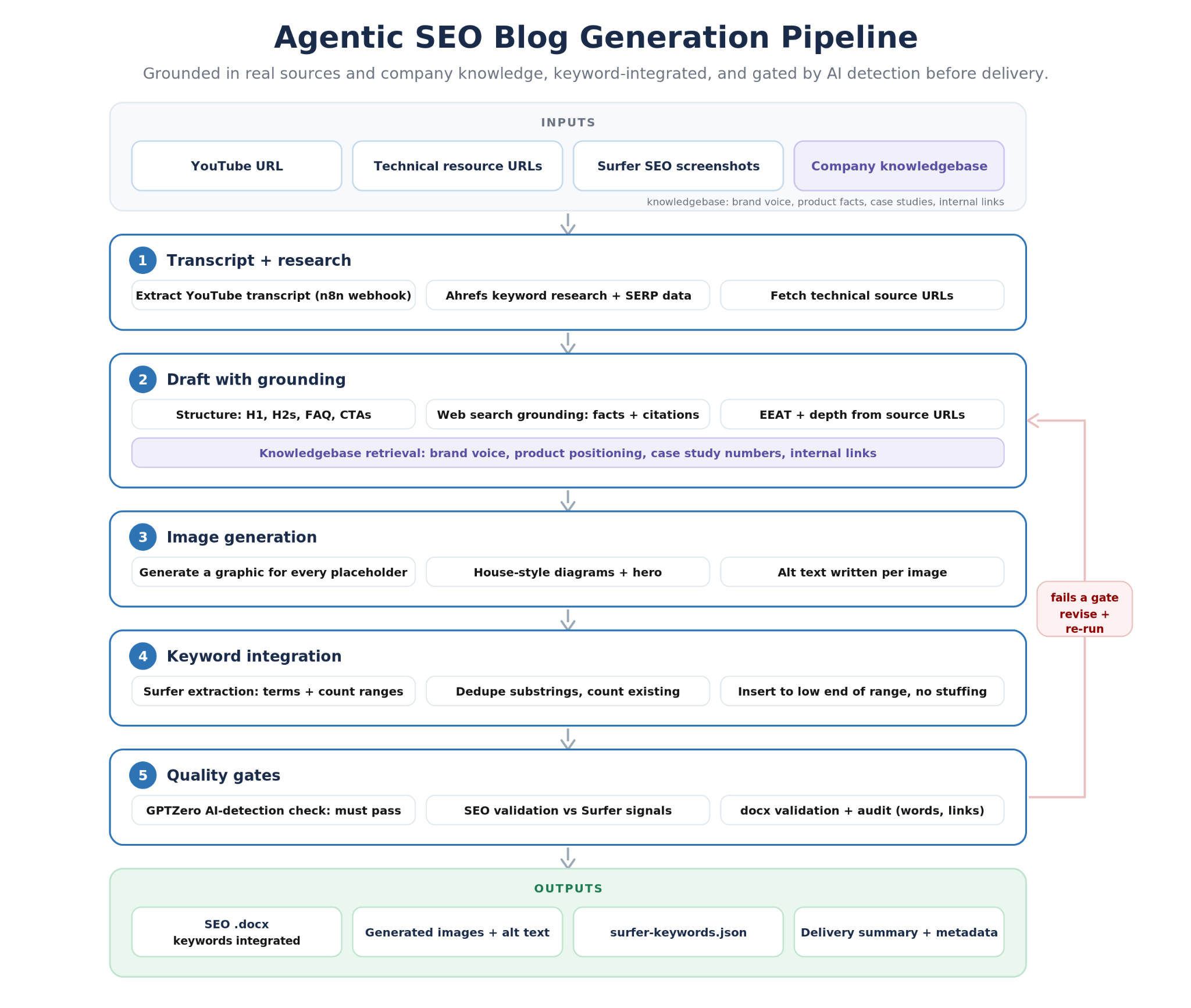
We built an agentic framework that generates fully SEO-optimized blog posts by integrating the stack a marketer already trusts: Ahrefs for keyword research and SERP data, SurferSEO for on-page structure and semantic completeness, and web search to ground every article in current facts rather than training data. The differentiating gate is GPTZero: the system iterates until the post passes AI detection, so output clears both the ranking bar and the quality bar in the same pipeline.
The agentic flow also works with some of our below agentic frameworks to build a complete content roadmap. Deciding how to write this specific piece based on:
In production it has allowed customers to nearly 5x the content output for just top of funnel and mid funnel content. On top of that we compared the average ai detection score for a Claude generated article to our framework, and went from 34% ai content to 7%. The average human written article has a score of 5.8%.
Here’s a diagram of a version we built that uses youtube videos as an input.
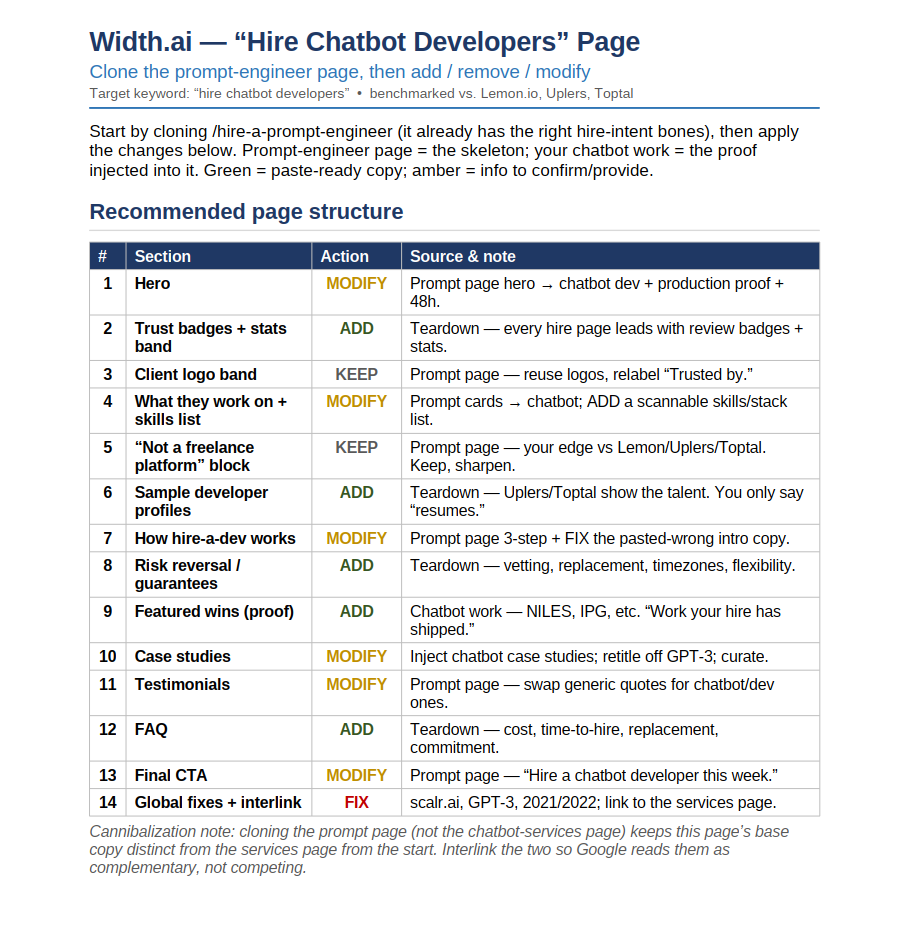
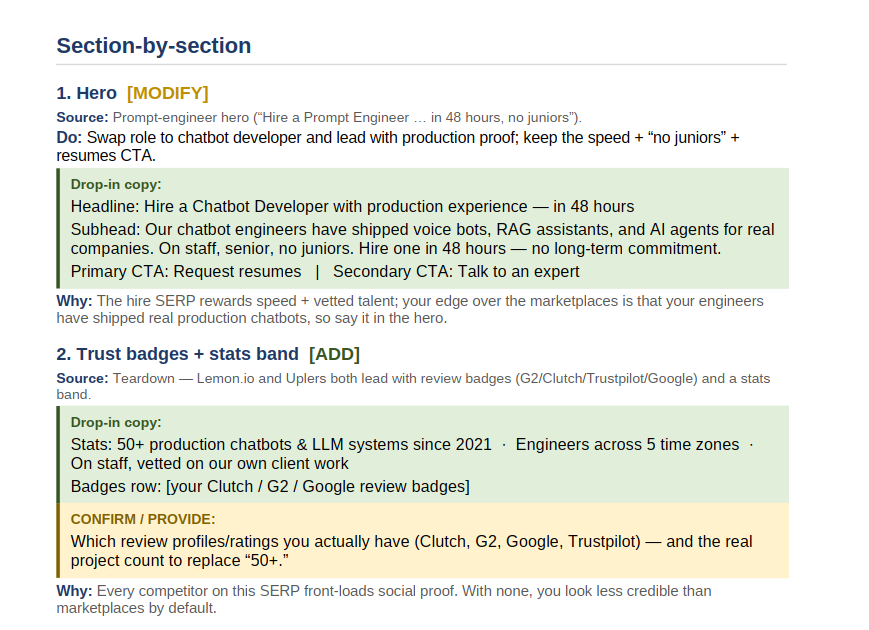
No content I see for agentic marketing treats as a first-class agentic use case, which is odd given how mechanical the underlying work is. A manual competitor research & teardown takes a marketer two to four hours per page, and even more time to rebuild and test the new page. If the goal of the landing page is SEO, the feedback loop of success can take months to see.
Our landing page optimization framework takes your existing page, a set of competitor pages, and optional target keywords, then researches every competitor structurally: layout, above and below the fold, image and video placement, CTA design, value prop outline, case studies and logo walls. It runs gap analysis both directions (what they have that you do not, what you have that they do not), and the load-bearing step is correlating your differentiators to the target keyword, so the plan prioritizes what actually matters for the search intent. Since this agentic system has access to our content library and company knowledgebase, it makes recommendations that are driven in what we actually do and specific value propositions, not generalized ideas that are SERP focused.
The output is deliberately not a rewritten page: it is a detailed plan document your team executes, which keeps strategy human-owned and execution grounded. The teardown that used to cost a strategist half a week lands as a rubric-driven PDF document in minutes, and because the rubric is identical across every competitor, the gap analysis is comparable instead of impressionistic.
The frameworks I see lump social into 'basic content writing,' but a LinkedIn post, a tweet thread, and a TikTok script are different jobs with different constraints. We run an open n8n agentic workflow that triggers on every new blog post, extracts the article, and generates channel-adapted posts with per-platform constraints enforced: character limits, hook patterns, hashtag conventions. It runs on open orchestration infrastructure rather than a proprietary black box, a free-tier version exists, and a human reviews everything in Slack before it ships. A lighter system than the others here, and that is the point: agentic marketing scales down as well as up.
We’ve deployed this a ton for companies already rocking on website content that want to automatically double down and handle social as well, turning articles into multi channel campaigns that keep customer engagement up without new headcount. Entire social media gameplan with a simple Slack notification.
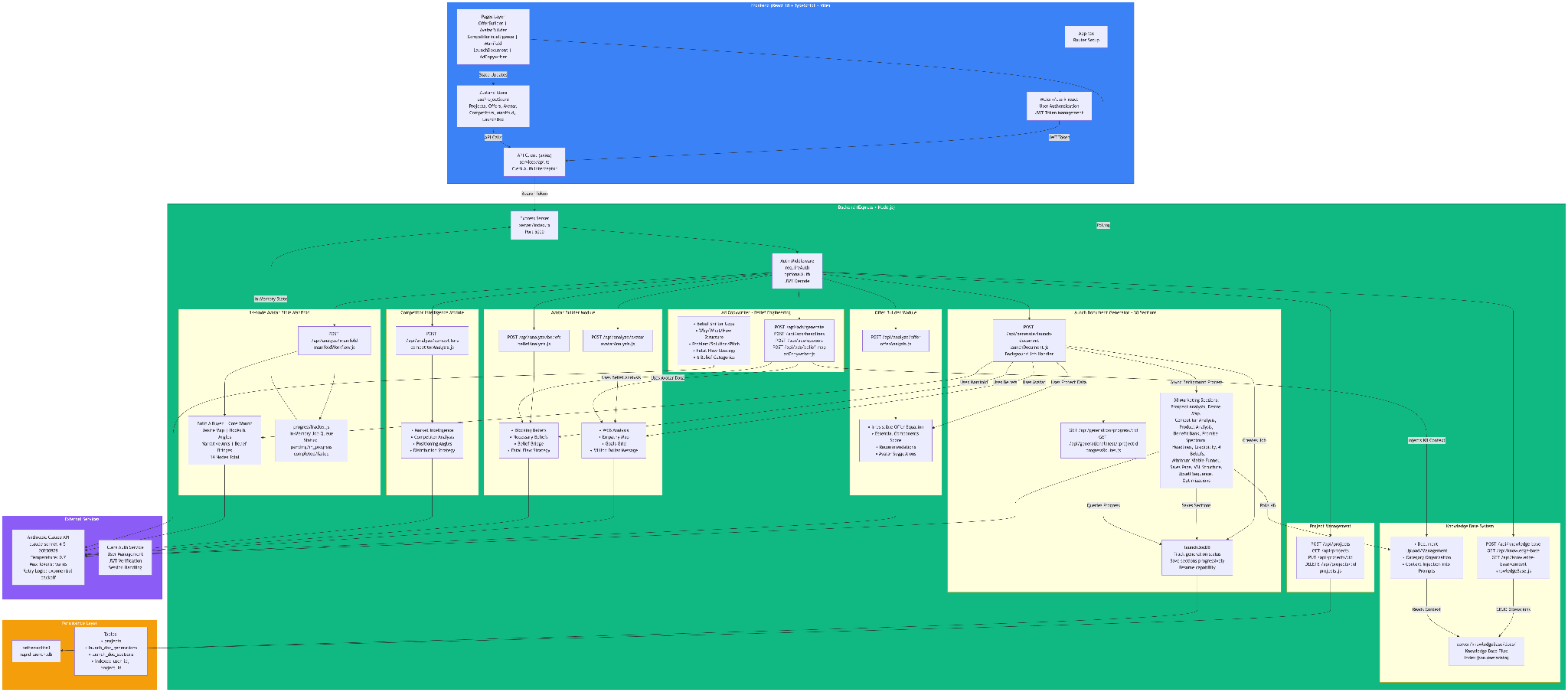
Every framework article mentions ad copy generation in a sentence. None of them touch the part that makes ad copy work: the strategic layer underneath. For a media buying agency, we built an agentic framework that runs multi-step agents through named marketing frameworks rather than free-form generation: offers are scored with the Irresistible Offer Equation, buyer avatars are built by a 14-node Avatar Bible agent workflow, competitors get forensic structural breakdowns via custom agents, and the system assembles a 38-section product launch document covering messaging and positioning end to end. Only then does it generate Meta ad copy variants, driven by a Belief Engineering framework, so the copy is grounded in the offer analysis and avatar work instead of being another generic variant everyone on Meta is already running. The agency uses it in production for Meta media buying today, where it has taken avatar and launch-doc turnaround from days to 4 hours grounded in REAL data from their own ads and competitor ads. It does so much more in the backend:
For companies that are serious about media buying this agentic framework is the hand holder for optimization and iteration.
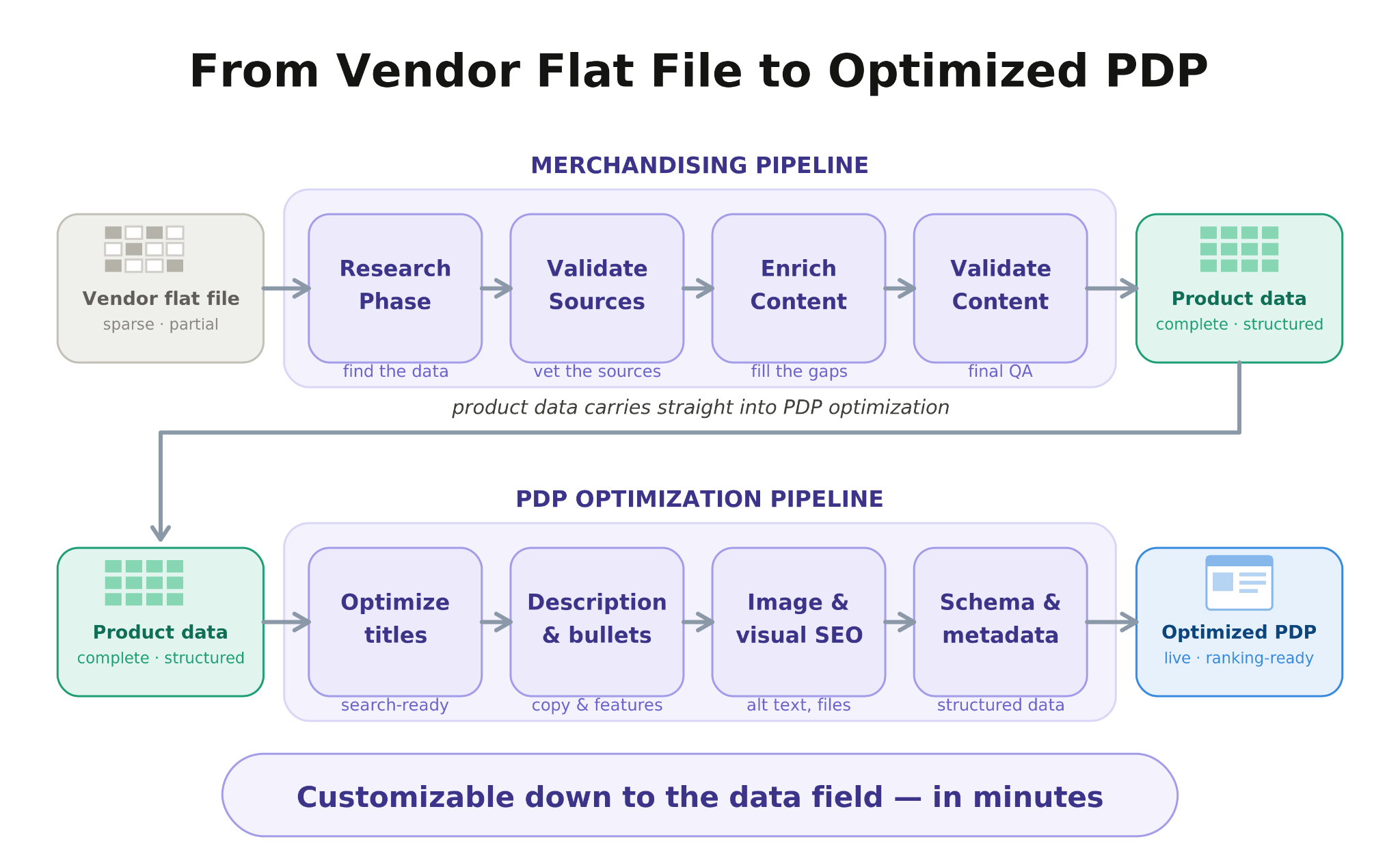
Product content is one of the largest live agentic AI production surfaces in ecommerce and it appears in none of the top articles for agentic ai for marketing. The failure mode is well known: single-shot generation hallucinates specs and invents attributes, which is disqualifying when the output feeds a live catalog. We built an agentic enrichment framework for a large-catalog client that goes from a PDF catalog or sparse vendor flat file to fully enriched SKU data: attributes, descriptions, categorization, structured metadata. From there we run through our SEO optimization agentic flow to complete the new PDP.
The architecture is the story: the system writes planning files before it acts, runs multiple agents in parallel with dedicated tools, follows a ReAct loop (reason, act, observe, repeat) with recursion and feedback across iterations, and validates every enrichment against catalog-specific rules before anything is written back. No ungoverned generation touches the catalog.
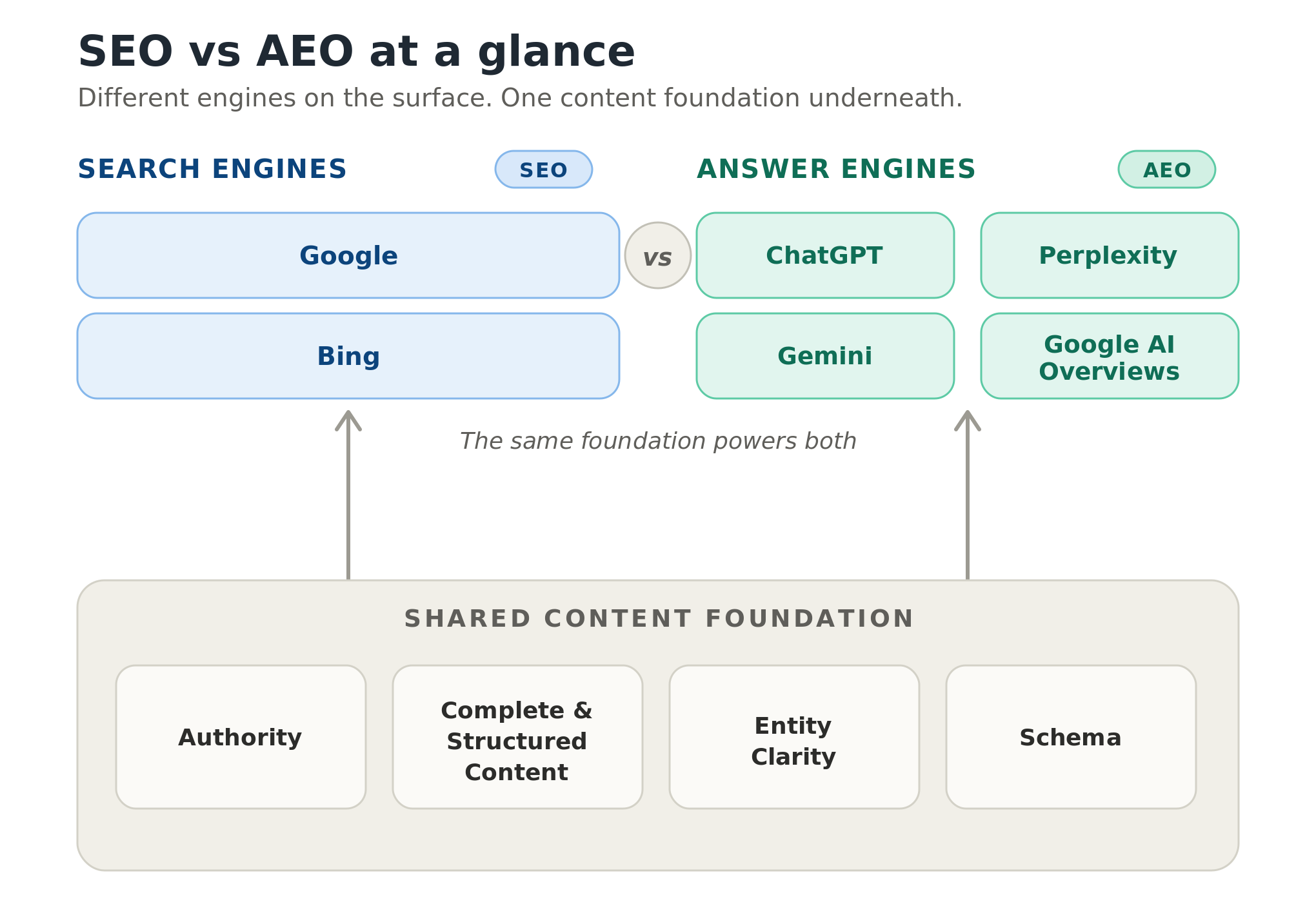
The biggest gap in the entire topic: search is fragmenting across Google, AI Overviews, ChatGPT, and Perplexity, and none of the ranking articles treat answer engine optimization as an agentic use case. Roughly 77% of ChatGPT users in the US already treat it like a search engine (Adobe), and that habit is reshaping how shoppers find products. AEO and SEO are different, but the two share many signals but reward different things, and for an ecommerce catalog, the gap now decides how often shoppers find your products.
This is where we can name the system: Pumice.ai's Product Optimization Playbook. Give it a product page and a target keyword (validated against live search volume and difficulty first), and a sequence of agents runs competitor analysis for both the traditional SERP and the sources AI engines actually cite, which are overlapping but different sets of pages. It follows with gap analysis against your current PDP, keyword and AI-engine query analysis, and per-field review of the title, description, bullets, and images. The output is a PDF written like a marketing brief: a Key Items checklist that enforces the entity completeness AI models need to cite a product confidently, keyword frequency rankings across the winning pages, word count comparisons that flag thin descriptions, and per-field action items a merchandiser can execute. One report drives both channels, because the patterns that rank are increasingly the patterns that get cited.
The newest surface flips the model: agents as the audience instead of the workforce. Open-source engines like MiroFish build a simulated social world from human input seed material (market research, a launch brief, a public opinion report), populate it with thousands of LLM agents that hold distinct personas and long-term memory, and let the simulated customer interactions play out and evolve. You then inject a variable, a campaign message, a price change, a risky announcement, and watch how the synthetic audience reacts. The system returns a prediction report, and you can interview any agent in the simulation about why it responded the way it did. Built on the OASIS multi-agent simulation engine and self-hostable, it turns the 'synthetic audience testing' bullet point from the consulting decks into something a team can actually deploy. The marketing jobs this fits are the expensive-to-be-wrong ones: pretest three campaign angles or creative variations against simulated customer behavior before committing media spend, rehearse the public response to a sensitive announcement before legal and comms sign off, or stress-test a launch offer and pricing change on personas seeded from your actual market research and customer behavior data. Treat the output as a directional rehearsal rather than a forecast: the value is surfacing the reaction you did not anticipate while it is still cheap to change course, and validating anything consequential with a real-market test afterward.
Strip the marketing surface away and the systems above are variations of one agentic architecture. Multi-agent orchestration splits the job into specialist agents instead of one overloaded prompt. Planning comes before acting: the enrichment system writes execution plans up front rather than reacting turn by turn. Validation gates every step: SEO output iterates against GPTZero and SurferSEO signals, catalog output is checked against catalog rules, ad copy is grounded in scored offer analyses. Recursion and feedback loops mean first-pass output is a draft the system critiques, not the answer. And tool integrations (Ahrefs, SurferSEO, web search, competitor scrapers, n8n) connect agents to real data instead of model memory. This is also the answer to why a one-shot LLM call cannot do this work: a single generation has no plan, no tools, no validation, and no second attempt. The piece most teams discover late is evaluation: the system needs a definition of good it can score against, or the recursion loops have nothing to aim at.
I”ve written a ton about our agentic framework we use in production for a ton of domains. Same pattern, same framework, tweaked for different use cases and automation goals.
The right governance model falls out of the three axes from earlier, because each one moves the humans differently. Velocity systems keep people exactly where they already were: the review for final approval gates stay, there is simply far more flowing through them, so the design problem is making review fast. That is why the social workflow queues posts in Slack instead of publishing, and why the Playbook outputs a brief a merchandiser can act on in minutes; the human step survives, compressed. Effort-removal systems take a person out of a step, which means the checking that person was silently doing has to be rebuilt as architecture: encoded rules the system cannot skip, like the per-step catalog validation that gates every enrichment before it is written back. Quality systems move humans up a level, from doing the work to defining what good means: the GPTZero threshold, the SurferSEO signals, and the scored offer frameworks are all human judgment encoded as evaluation criteria the system iterates against.
This is also the practical argument for one axis at a time. Each axis changes the governance model in a different direction, and chasing all three at once means removing reviewers, raising throughput, and redefining quality simultaneously, which is how output quietly drifts off-brand, off-fact, and into worse customer experiences. Pick the axis, place the humans accordingly, and merge in the next axis only after the gates have proven themselves.
Pick one surface with a measurable output, repetitive tasks, and an owner who feels the pain weekly: a content team drowning in repurposing, a catalog full of thin PDPs, a media buyer rewriting the same avatar decks, a lifecycle team mapping customer journeys by hand, or ad performance drops. Build or adopt one system there, wire it into the marketing automation stack and tools you already trust rather than replacing them, and put the human review gate where mistakes would be expensive. Then expand in waves, the way the consulting frameworks rightly suggest, except with a working system as wave one instead of a taxonomy. The tooling is not exotic: Ahrefs and SurferSEO have APIs, n8n is open source, and the orchestration patterns above are documented practice at this point. Expect the first build to spend most of its engineering time on validation and integrations rather than prompts; that ratio is normal, and it is exactly what makes the output shippable. Agentic ai works when you create clear metrics to understand business outcomes.
The surfaces above are where agentic workflows for marketing are already working. Start with the one that hurts most.
We’ve worked on agentic marketing systems for huge companies like IPG, Triple Whale, Keap.com, and small services companies looking to automate huge chunks of the marketing ops that drive business. Let’s chat about how we can integrate these exact frameworks that are already rocking in production into your business.
Agentic AI in digital marketing is the use of autonomous, multi-step AI systems that plan, execute, and validate marketing work: digital transformation, generating and testing personalized content, analyzing competitors, optimizing marketing campaigns, and lifting customer engagement across the customer journey, with humans reviewing at defined checkpoints. That is the line: agentic AI refers to systems that execute whole workflows, where generative AI assists with single drafts.
Traditional AI and generative tools produce an output from static workflows or a single prompt; agentic AI pursues a goal through multiple steps. An agentic marketing system decomposes the job, calls tools like search and SEO APIs, checks results against gates it cannot skip, and reworks weak drafts before delivering. The generation step still happens inside it, but it is one step among many rather than the whole product. Traditional marketing automation runs a fixed flow; an agentic system chooses its own.
Concretely: a blog content delivery framework that iterates against Ahrefs data, SurferSEO signals, and a GPTZero detection gate; an ad copy system that scores offers and builds a 14-node buyer avatar before writing a single variant for creative direction; a catalog enrichment pipeline that plans first, runs agents in parallel, and validates every field against catalog rules. The common threads are planning, tool use, and validation gates, not a single clever prompt. Steps that require manual oversight are built in at planning, not down the road.
It replaces execution work and the repetitive tasks traditional automation never could, not marketing judgment or the customer relationships behind it. In every system we run, humans still own decision making for marketing strategies, review gates, and the strategic thinking the frameworks cannot score: which differentiator to lead with, which draft actually sounds like the brand, which recommendation to ship. The realistic model is one marketer supervising a set of systems that automate tasks. Many marketers use agentic ai to increase output while keeping quality the same.


