Our Supplier Catalog Ingestion AI Agent | Automating SKU Onboarding
How we built a supplier catalog ingestion AI agent that grounds every SKU against the real vendor source before it writes a word

Matt Payne
September 16, 2026
Run a Claude humanizer skill over a blog post and watch what it takes out. The AI vocabulary goes, which is the point. The call to action goes with it. So does the boldface that made the page scannable, the customer name that made the claim credible, and the target keyword that was sitting in the H1 doing its job. The writing sounds human now. The page no longer does what it was built to do.
That happens because most humanizers optimize for one outcome: neutral prose. Neutral is the correct human voice for a wiki entry, an internal doc, or a legal summary, so a general-purpose skill applies every AI pattern at full strength to get there. Marketing content is not trying to be neutral. A blog post has to persuade, stay scannable, carry a keyword, and end on an ask. Stripping those out is not humanizing, it is deleting the reason the page exists.
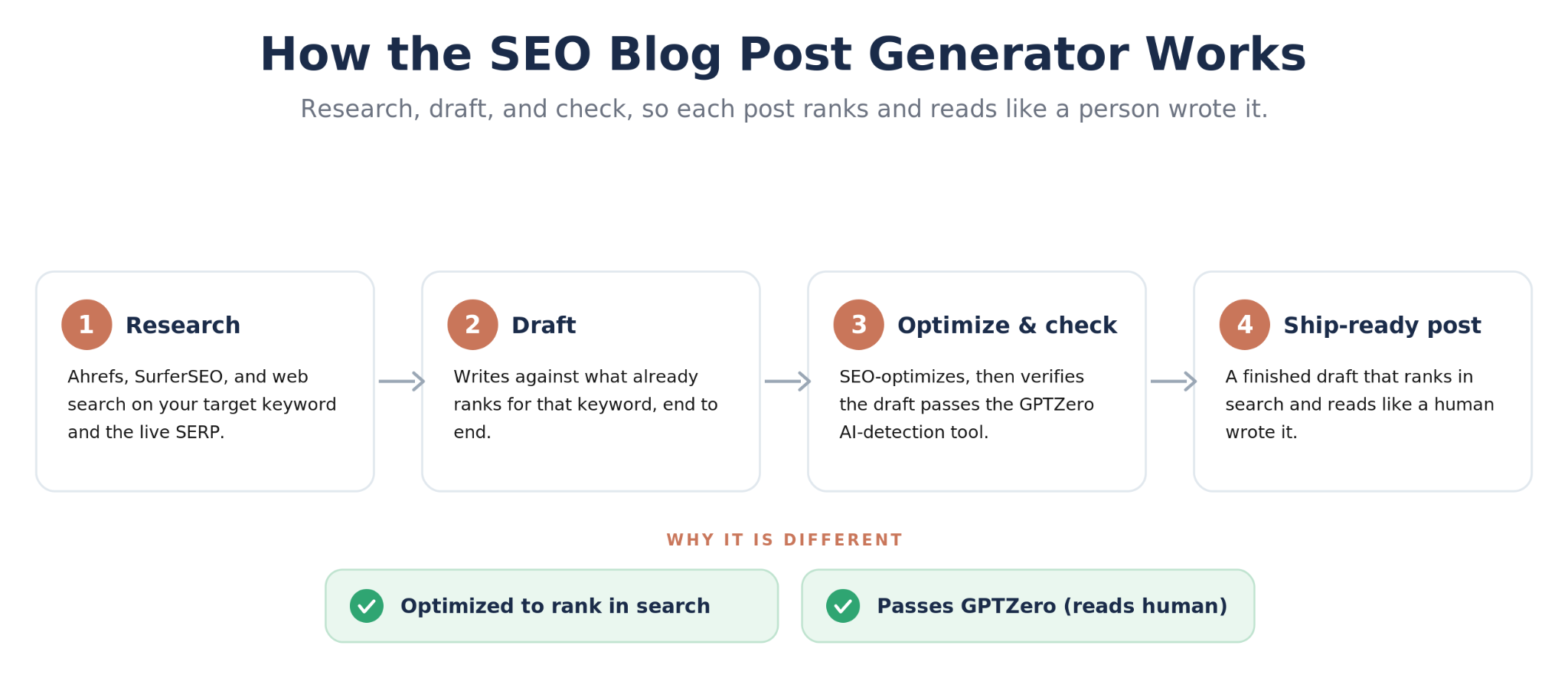
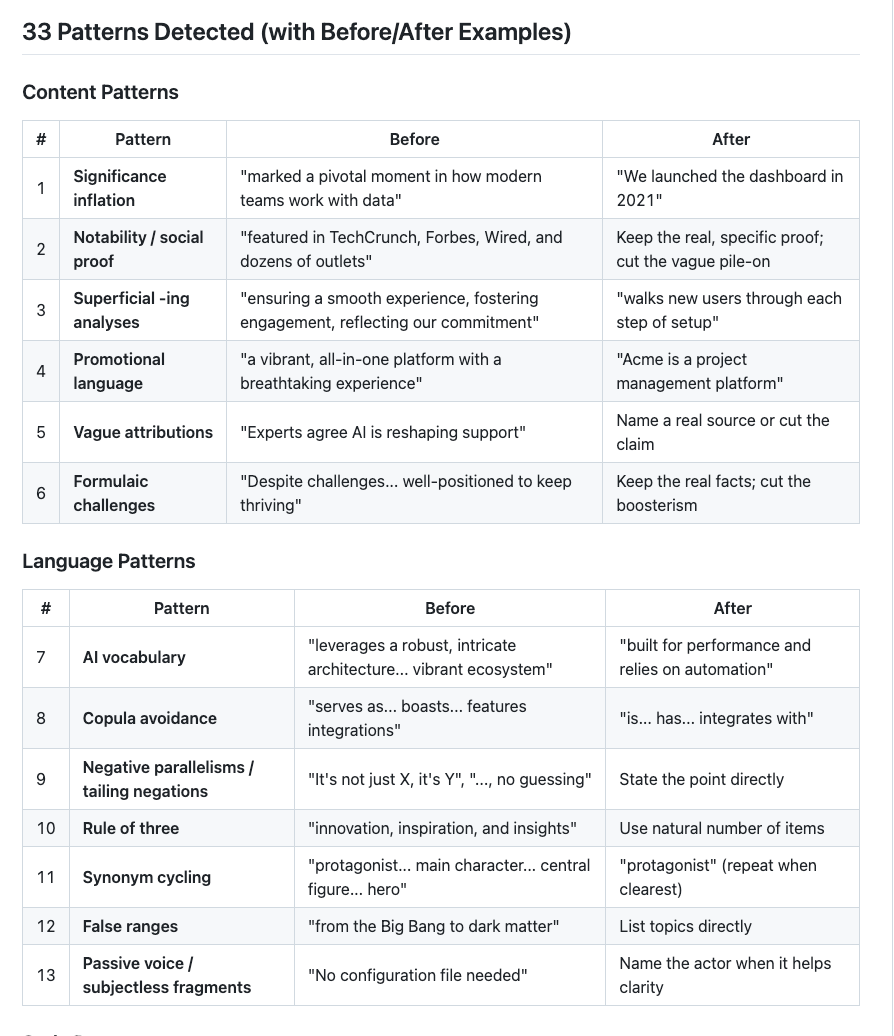
We built the Width.ai humanizer skill for that gap. It runs two modes: reference mode, where all 33 patterns apply at full strength, and marketing mode, where nine of them switch from delete to keep the sell, a structure preservation pass protects the target keyword, headings, links, images, and CTA, and a no-fabrication rule stops the rewrite from inventing statistics to sound specific. It is the exact skill running inside our blog post generation framework. Here is what it removes, what it protects, and how to run it.
Agent skills are Markdown (.md) instruction files your Claude harness (Cowork, code, chat) loads on demand. There is no model, no API, and no configuration file needed: the skill for Claude describes what AI text looks like and how to rewrite it. Our pattern catalog builds on Wikipedia's Signs of AI writing guide, maintained by WikiProject AI Cleanup, which catalogued the tells across thousands of instances of AI generated text.
That page also explains why the AI patterns are so consistent, and the key insight is a statistical one: LLMs use statistical algorithms to guess what should come next, and the result tends toward the most statistically likely result that applies to the widest variety of cases. That is why every model reaches for the same AI vocabulary, the same rule of three, the same em dash overuse. The tells are what regression to the mean sounds like.
The skill runs a loop rather than a single pass. It writes a draft rewrite, then asks two questions: what makes the below so obviously AI generated, and does it state any fact that is not in the source? It answers both, then a second pass produces the final version. That audit catches the AI patterns surviving the first rewrite, and it usually changes more than the draft did.
A general-purpose humanizer has one job: get to neutral. For a wiki entry or a legal summary that is right. A blog post is supposed to persuade, stay scannable, carry a target keyword, and end on an ask, so a full-strength pass produces prose that reads more human and performs worse. The failure modes we hit on our own drafts, in order of damage:
None of this makes full-strength humanizing wrong. It makes it correctly scoped for a job marketing teams do not have. We use this skill all the time for our blog post generation agentic workflows (guide).
The skill routes on content type, detected from the content itself (a hero headline plus a CTA button is a landing page, an intro with H2s and a repeated keyword is a blog post) and overridable in the prompt. Reference mode applies every pattern at full strength. Marketing mode switches nine patterns from delete to make it concrete and keep the sell:
Every other pattern still applies in full, and the no-fabrication rule gets stricter here rather than looser.
Marketing mode loads a separate structure preservation module that treats eight things as hard constraints. The target keyword keeps its placements in the title, the first 100 words, and at least one H2, and never gets paraphrased into a synonym. Heading hierarchy survives: rewrite heading text for tone, but do not delete a heading, change its level, or dissolve a section into a run-on. Links keep their targets, carried onto equivalent anchor text when the sentence changes. Images and alt text stay. Answer-first sentences, numbered steps, and FAQ questions keep their shape, since those earn featured snippets and AI Overview citations. Meta and frontmatter are untouched, the CTA survives, and compressing dull parts is not license to gut sections that exist for coverage.
Before returning a rewrite, the skill confirms the keyword, headings, links, images, and CTA all survived. Humanizing a post that then falls out of the index is a strange definition of success.
Five of the 33 patterns target tells that show up specifically in AI-drafted long-form, and they are worth calling out because most catalogs miss them:
This matters more than it sounds. The fastest way to make writing feel human is to make it specific, and the fastest way for a model to be specific is to invent a number. A humanizer that turns "studies show engagement improves" into "a 2024 Stanford study found a 34% lift" produced better prose and a worse document. The rule is absolute: no fact, name, number, date, or citation that is not in the source, extended in marketing content to invented stats, testimonials, customers, and logos. Where a draft leans on vague attributions, drop the claim rather than fabricate a real-looking one.
The skill also ships a detection guide for what not to flag, because over-editing destroys the human signal you are protecting. Mixed feelings, first person asides, and uneven rhythm are signs of real writing. Persuasive tone in marketing copy is the format, brand style title case is a house style choice. Named customers and specific numbers are conversion assets. A repeated keyword and an H2 outline are SEO requirements, not padding. Curly quotes mean nothing on their own, since every CMS auto-curls them into straight quotes or back, and one em dash is not evidence of anything. Look for clusters of tells, not isolated ones.
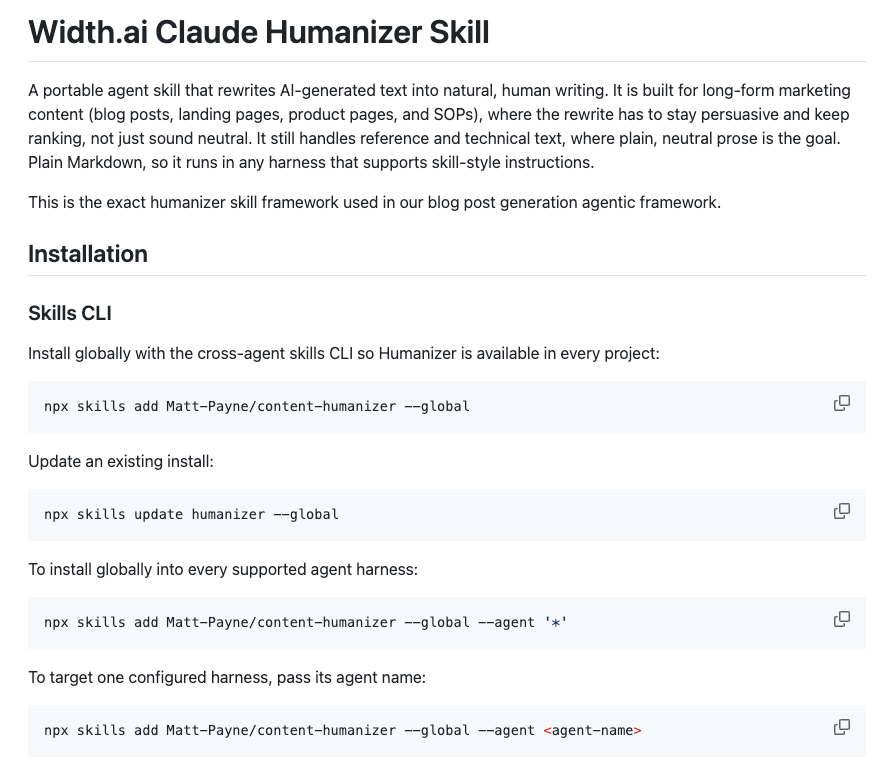
This is a Claude skill, but nothing about it is Claude-specific: it is plain Markdown, so it runs in any harness that loads skill-style instructions. Clone the whole directory, not just SKILL.md, since the entry point loads its detail on demand from the references folder:
For Claude Desktop, download the repo as a zip, then open Claude, go to Customize, click Skills, and upload it.
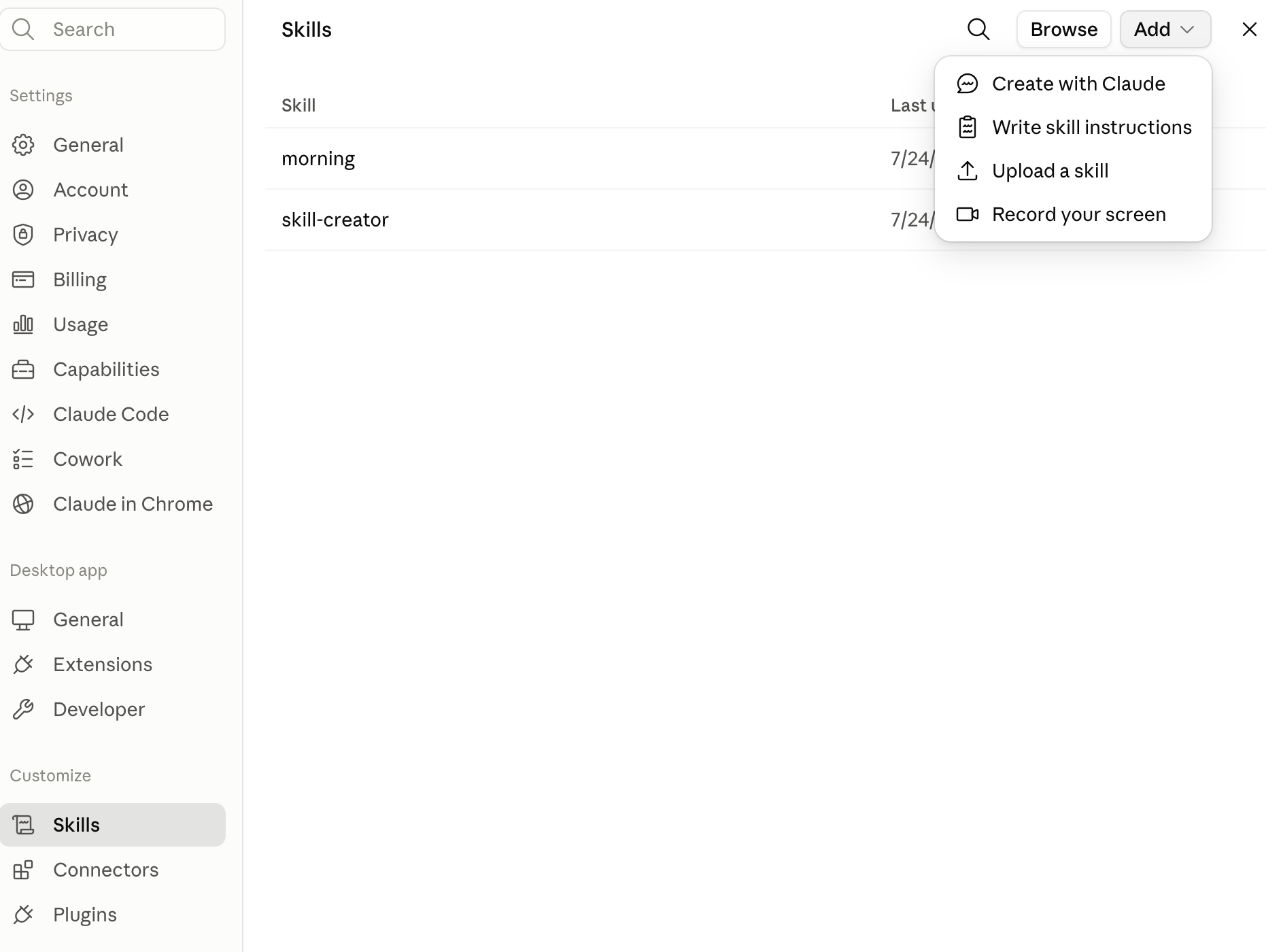
Then invoke it however your harness exposes skills:
Pointing it at a file rewrites that file in place, touching prose only and leaving code blocks, frontmatter, and link targets alone. Voice matching is worth the extra step on anything published under a byline: paste two or three paragraphs of your own writing first, and voice calibration matches your sentence rhythm and word choices instead of generic clean output. A sample outranks the skill's style rules, including the em dash ban.
Here is the worked example from the repo. The before is what a model produces unprompted:
Count what fired: significance inflation on "more crucial than ever," promotional language on "unlock unprecedented levels," negative parallelisms on "no longer optional, it's essential," filler phrases and signposting on "dive into everything you need to know," chatbot artifacts in the exclamation, and em dashes throughout. What survived is what matters: the piece still argues for segmentation, still speaks to the reader, and still says what the post delivers. The vague "studies show" attribution was dropped rather than replaced with an invented citation.
Reference mode is the right call for docs, wikipedia articles, policies, legal summaries, and academic text. Neutral is the goal there, so let every pattern fire at full strength. Marketing mode is for blog posts, landing pages, product pages, marketing emails, and SOPs, where the writing has to keep selling and keep ranking. When the content type is ambiguous, the skill defaults to reference mode, on the logic that under-protecting the sell is easier to spot in review than a keyword quietly rewritten out of an H1.
Sometimes no humanizer is the answer. Humanizing thin content does not make it rank, since search engines evaluate whether a page is useful, not whether it reads naturally. Academic and professional contexts often carry disclosure requirements a rewrite does not satisfy. And on decent writing, an aggressive audit can add fragmentation that was not there, trading one artificial voice for another.
This is not a side project. It runs as a step inside our blog post generation framework built as a real client facing agentic system: each started as something a full-strength pass broke on a real draft. It is Markdown under an MIT license, so you can add your own patterns to references/patterns.md or adapt the marketing carve-outs to your brand rules. The skill is on GitHub. Run it on a post you have already published and see what it flags.
The humanizer is one step, and it only pays off when the steps around it exist: research, briefs, drafting, and publishing. If you are wiring that up yourself, our writeup on n8n marketing automation use cases walks through content workflows for blogs and landing pages that a humanizing step drops straight into. If you would rather have the whole system built, that is the work we do. Tell us what you are building.
The humanizer skill is one step in our blog generation framework. The rest of it (research, briefs, drafting, keyword integration, and QA) is the same kind of engineering. We build these systems for teams shipping real volume.
It is a cross functional agent skill for Claude that removes signs of AI generated writing, built on Wikipedia's catalog of the tells. It detects AI patterns like significance inflation, promotional language, copula avoidance, vague attributions, em dash overuse, and filler phrases, then rewrites the text to read as human work. The Width.ai skill adds a marketing mode for content that has to stay persuasive and keep ranking.
Yes it does, but usually this is the wrong goal to focus on. Ai writing detectors score statistical regularity, and the AI patterns this skill removes are the same regularities they measure, so scores usually move in the right direction. But detector output is probabilistic and inconsistent across tools, and writing for the detector instead of the reader produces worse content. Focus on the score getting better across multiple ai detectors, not just your favorite.
Reference mode applies all 33 patterns at full strength to reach neutral prose, which is correct for docs and technical writing. Marketing mode relaxes nine of them to protect the sell, runs the SEO and structure preservation pass over keywords, headings, links, images, and the CTA, and tightens the no-fabrication rule to cover invented stats, testimonials, and customers.
It can, with a general-purpose humanizer, which is why marketing mode exists. Rewriting the target keyword into a synonym, deleting headings, dropping links, or shrinking a page below the depth its query expects all cost rankings. The structure preservation pass makes those outcomes impossible.
