The most popular open-source marketing skills library for Claude has passed 31,000 stars on GitHub, a fair sign of how quickly teams are turning Claude into a repeatable marketing operator. Claude Skills for marketing are installable files that teach Claude one marketing job and how to do it well, from keyword research to conversion optimization to paid media audits, and they are fast becoming a core tool for technical marketers and lean marketing teams.
These are the 7 most valuable Claude skills we have used in our everyday marketing stack that have had a great return on the amount of time they save. For each one, you will see what it is, what it is used for, why it is worth it, and a link to see it.
The short version before the list:
Claude Skills for marketing are SKILL.md files that give Claude a specific marketing workflow, installable in Claude Code and Claude Cowork. These are your own customized ai tools.
The ecosystem is large and growing fast: Anthropic's official plugins, big open-source collections like Corey Haines' 31,000-star library, and skills published by agencies, vendors, and individual creators, including Width.ai's own repo.
The highest-value skills cover the repeatable, context-heavy work: keyword research, SEO, copywriting, CRO, competitor analysis, and paid media.
Custom skills, like Width.ai's SEO blog generator and keyword research skill, wire in tools such as Ahrefs and SurferSEO for research-grade output.
Most install in seconds with npx skills or the Claude Code plugin system, so the cost of trying one is low.
✂️ Definition
Claude Skills for marketing are installable SKILL.md files that give Claude a specific marketing workflow, such as keyword research, conversion rate optimization, or a paid ads audit. They plug into Claude Code or Claude Cowork, and Claude applies each skill's frameworks, steps, and tool integrations when a task matches it. They are software skills you install, not marketing skills a person learns.
What Are Claude Skills for Marketing?
Claude Skills are markdown files, each a SKILL.md, that give Claude specialized knowledge and a workflow for one marketing task. Drop them into Claude Code or Claude Cowork and Claude recognizes when a request matches a skill, then follows its steps and best practices. For a marketing team, that turns repeated marketing tasks, the keyword research, the CRO teardown, the ad-spend audit, into workflows an agent can run, which removes a lot of manual work. Skills also share context: a shared context file, the product marketing context file, gives every skill the same understanding of your product, audience, and positioning, and you can connect Claude to live data through MCP connectors like Ahrefs and HubSpot. The ecosystem is already large and growing fast. You will find Anthropic's own official Marketing plugin, which bundles content drafting, campaign planning, and reporting; big open-source collections like Corey Haines' marketing skills library, which spans SEO, copywriting, CRO, analytics, and growth; and skills published by agencies, vendors, and individual creators, including Width.ai's own repo of marketing skills such as keyword research and SEO blog generation. New skills ship constantly, so treat the seven below as the ones we reach for most, not the whole field.
Why Claude Skills Work So Well for Marketing
Marketing is a strong fit for skills for two reasons. First, much of the work is context-heavy: good output depends on knowing your product, audience, and positioning, which is exactly what a shared product marketing context file provides. Second, the work repeats, every quarter, every launch, every campaign, so a skill you teach Claude once keeps paying off. That combination is why marketing teams and technical marketers are among the fastest to adopt them. Install skills once, and the repeatable marketing workflows run with far less manual work. You do not need to be an engineer either, since installing skills is largely a no code step and the skills themselves are plain markdown you can read and edit.
1. Keyword Research Skill
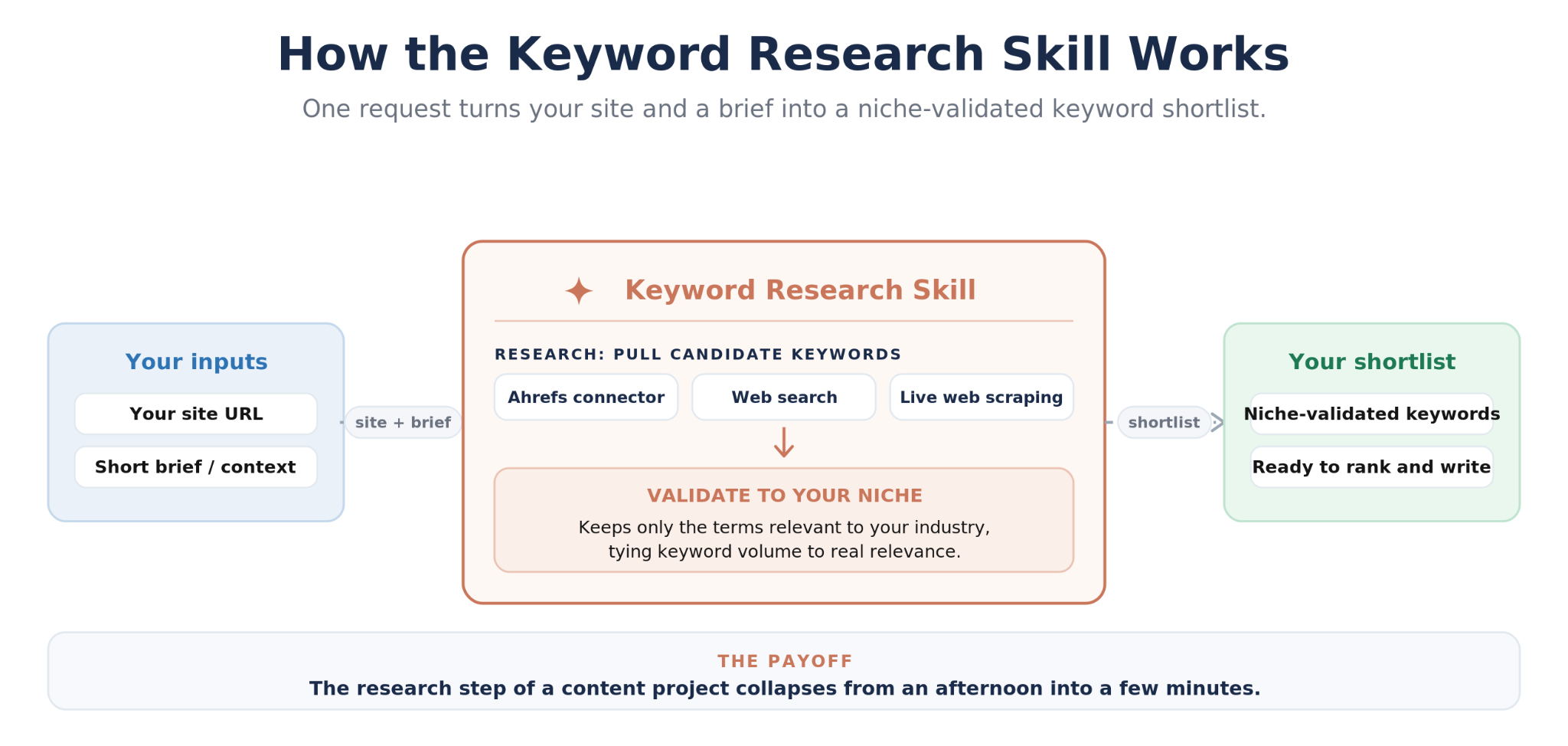
What it is: a Claude skill that runs keyword research through the Ahrefs connector, web search, and live web scraping, then validates every keyword against your niche using a URL and context you provide. What it is used for: building a focused, relevant keyword list without clicking through Ahrefs reports by hand, and filtering out terms that do not fit your industry. Our seed term generation skill steps allows for deeper search term analysis by starting at a higher level of terms and automatically deep dives down the routes.
Why it is worth it: it turns keyword discovery into a single request, and the niche-validation step means you get terms you can actually rank for and write about, which is a much easier search than working in native Ahrefs. It is one of the strongest research skills in a marketing stack because it ties keyword volume to real relevance. In practice, you point it at your site and a short brief, and it returns a shortlist of terms and search terms already filtered to your niche, so the research step of a content project collapses from an afternoon into a few minutes. Most teams use this alongside the below blog post generation skill framework.
What it is: a skill that researches and profiles competitors directly from their URLs, a fast form of competitor analysis and competitive intelligence. What it is used for: company research, mapping positioning, surfacing positioning gaps, and prepping comparison or alternative pages. Why it is worth it: it turns a list of competitor sites into a consistent, side-by-side view of how they position, price, and message, so your team spends its time acting on the intelligence instead of gathering it. In practice, you hand it five or six competitor URLs and get back a clean profile of each, their positioning, core messaging, pricing signals, and the angles they lean on, ready to feed a comparison page or a positioning review.
What it is: a skill for optimizing content for AI search, also called AEO, GEO, or LLMO. What it is used for: making your pages citable by ChatGPT, Perplexity, and Google AI Overviews, not just ranked in traditional blue links, and it pairs naturally with an seo audit and your broader content strategy. Why it is worth it: buyers increasingly research inside AI answers, and this skill structures content so those engines can quote and recommend it, which extends your SEO into the surfaces classic optimization misses. In practice, it audits a page for the structure AI engines favor, clear answers, named entities, and structured data, then rewrites the weak spots so the page is more likely to be pulled into a generated answer.
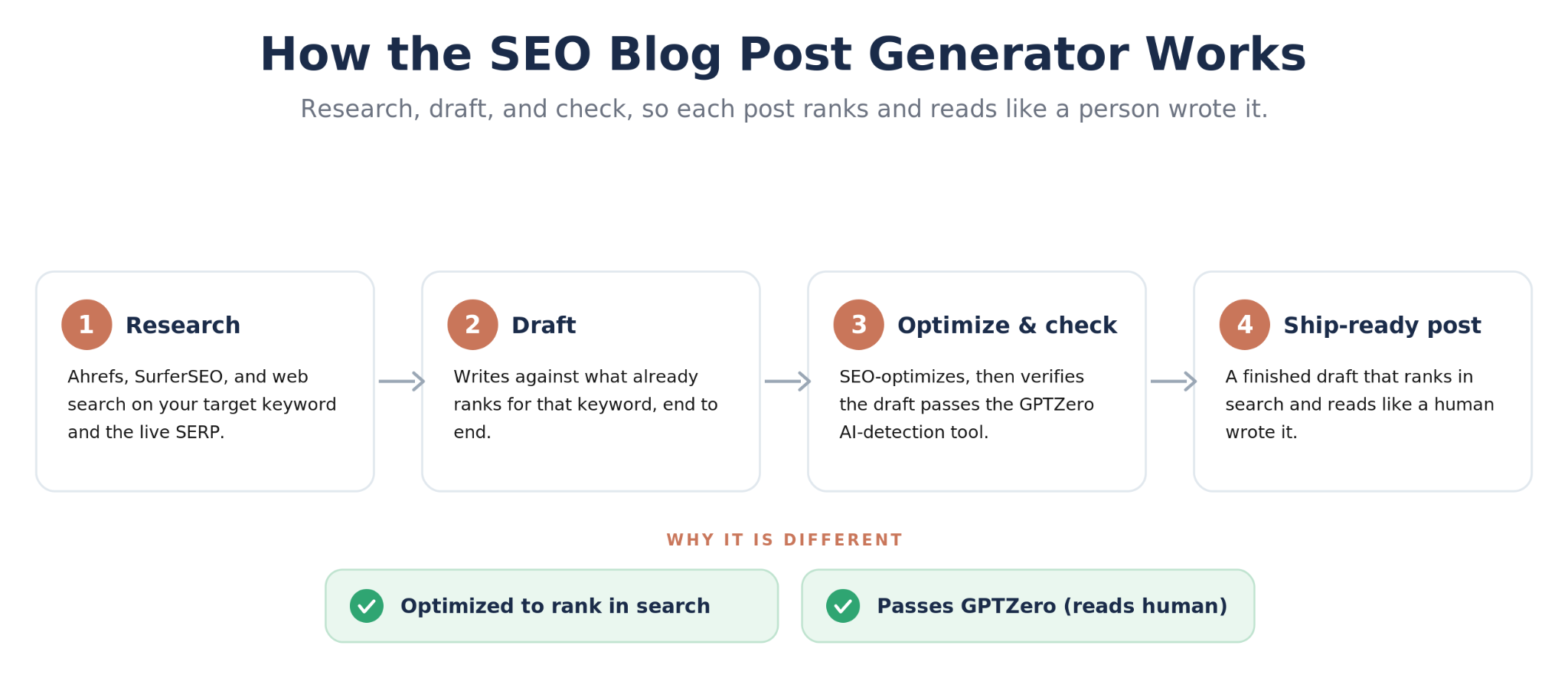
What it is: an agentic skills framework that writes SEO-optimized blog posts and is built to pass the GPTZero AI-detection tool, with Ahrefs, SurferSEO, and web search wired in to research existing blogs and target the right terms. What it is used for: producing ranking-ready, human-reading blog content end to end, from keyword and SERP research through to a finished draft, so it doubles as a content strategy engine. Why it is worth it: most AI blog output is thin and flags as machine-written, while this skill grounds each post in real search research and optimizes it so it both ranks and passes detection. In practice, it researches the live results for your target keyword, drafts against what already ranks, and checks the output so you ship a post that is optimized and reads like a person wrote it.
This skill framework is a small piece of a larger fully agentic system we’ve built to scale organic traffic. We’ve already had customers deploy this system and see lifts in traffic of 20% in just a few months. We set this up custom for you for your specific industry and content goals (booked meetings, conversions, traffic). Add as much human in the loop or as little as you want.
What it is: a skill for writing, rewriting, and improving marketing copy for any page, from the homepage to landing pages and ads. What it is used for: turning rough notes or a positioning document into on-brand marketing copy that follows proven frameworks and matches your brand voice. Why it is worth it: it reads your product and audience context first, so the copy is specific to your offer instead of the generic filler most AI writing produces. In practice, you give it a page and your positioning, and it returns copy that matches your brand voice and leads with the benefit rather than a wall of adjectives.
What it is: a conversion rate optimization skill, often called the cro skill, for any marketing page or form. What it is used for: auditing landing pages, signup flows, and forms, then producing a prioritized list of changes to lift conversion, the core of ongoing conversion optimization. Why it is worth it: it applies a repeatable CRO framework, so you get a systematic teardown with clear next steps rather than a handful of vague suggestions. In practice, you point it at a landing page and it returns a ranked list of friction points and specific fixes, from headline clarity to form length to missing trust signals.
What it is: a skill for paid media across Google Ads, Meta Ads, LinkedIn, and X. What it is used for: structuring campaigns, auditing ad accounts for wasted spend, diagnosing CPA spikes, reviewing search terms and ad groups, and flagging creative fatigue. Why it is worth it: it gives a marketer a fast, structured read on where budget is leaking and what to fix, the kind of audit that routinely surfaces real monthly savings on the first pass. In practice, it reviews a campaign export, flags the ad groups, keywords, or placements draining budget, runs a CPA spike diagnosis, and suggests the reallocations and tests to run next. Claude connectors in Cowork can connect directly to your google ads account or the others to pull data directly down, no API setup or custom integrations.
We built RLA, an agentic system for media buying agencies that uses an LLM focused agentic framework to run multi-step prompt chains against structured marketing frameworks (Irresistible Offer Equation, WEB Analysis, Belief Engineering, Todd Brown's E5 VSL, Competitive Landscape Understanding), and user-supplied inputs like product details, target market, and competitor URLs to generate scored offer analyses, buyer avatar profiles via a 14-node Avatar Bible workflow, forensic competitor breakdowns, a 38-section product launch document, and Belief-Engineering-driven ad copy variants.
The seven above are our highest-ROI picks, but the open-source library goes much wider, so it is worth knowing what else is one command away. There is a skill to write cold outreach emails and follow-up sequences, an emails skill for welcome flows and lifecycle email sequences, a brand voice review that checks content against your style guide, a content strategy skill for planning what to publish, an seo audit skill for technical and on-page fixes, and analytics and A/B testing skills for measurement. If a marketing task repeats on your team, there is a good chance a skill already exists for it, which is why installing the whole set and pruning down is a reasonable way to start.
Product data research and enrichment skill
We have a skill created to use the Pumice.ai APIs for product data research and enrichment of all fields of the product details page. This skill will find relevant ranking product pages from competitors or the manufacturer, extract the content using an ai webscraper, and will optimize your fields. Great for automating the process of product research and structured enrichment, with validations built in for your catalog rules and guidelines. https://github.com/Width-ai/workflow-diagrams/blob/main/Pumice-Product-Data-Enrichment-Skill.md
How to Build Your Own Marketing Skill
When no existing skill fits, you can build your own. A skill is just a skill file, a SKILL.md with a description and a workflow, so authoring one is closer to writing a good brief than writing code. Claude even ships a skill creator to help you scaffold and refine it, which makes building skills approachable for non-engineers. Custom marketing skills are where teams teach Claude their exact process and connect it to their own tools and data, which is what Width.ai does when it builds a keyword research or SEO blog skill wired into Ahrefs, SurferSEO, and web scraping. Start from a task you repeat, write down how you do it well, then turn that into a skill your whole team can reuse.
How to Install These Skills
Most of these install in seconds. For the open-source skills, run npx skills add coreyhaines31/marketingskills to grab the whole set, or add the skill flag with specific names like cro and copywriting for just a few. In Claude Code you can instead add the marketplace with /plugin marketplace add coreyhaines31/marketingskills and install from there. Anthropic's Marketing plugin installs from the Claude plugin directory into Claude Cowork and adds slash commands such as draft-content, campaign-plan, brand-review, and performance-report, plus model context protocol (MCP) connections to tools like Slack, Canva, HubSpot, Ahrefs, and Klaviyo for a richer workflow. The Width.ai skills are custom builds, so the fastest way to see them is to ask for a walkthrough on your own content and catalog.
One tip before you install everything at once: most marketers start with the single skill that maps to the task you repeat most, whether that is drafting blog posts, auditing ad spend, or rewriting a landing page. A skill earns its place by saving you time on work you already do every week, and it is easier to judge that with one skill in front of you than with a dozen installed at once.
Want Custom Claude Skills Built for Your Marketing Stack?
Claude Skills turn marketing know-how into repeatable workflows an AI agent can run, and the best ones target the context-heavy work marketing teams do again every quarter: research, SEO, copy, conversion, and paid media. Start with a skill that matches a task you repeat most, install it in a minute, and see how much of the workflow Claude can carry. When you need a skill wired into your own tools and data, that is where a custom build like Width.ai's keyword research and SEO blog skills pays off.
Width.ai builds agentic Claude skills tuned to your tools and data: keyword research wired into Ahrefs, SEO blog generation that passes AI detection, and workflows that pull from web search, SurferSEO, and your own systems. Book a call and we will map the marketing workflows worth turning into skills for your team.
Frequently Asked Questions
What are Claude Skills for marketing?
They are installable SKILL.md files that give Claude a specific marketing workflow, such as keyword research, copywriting, CRO, or a paid ads audit. Claude applies the skill when a task matches it, using the frameworks and tool integrations the file defines.
Are these the marketing skills I should learn as a person?
No. Despite the name, these are software skills you install into Claude, not competencies you study. They give an AI agent the workflow for a marketing task, so a person or a small marketing team can run more of that work through Claude.
Where do I install Claude Marketing Skills?
In Claude Code or Claude Cowork. Open-source skills install with npx skills or the Claude Code plugin system, and Anthropic's Marketing plugin installs from the Claude plugin directory. Once installed, Claude uses the right skill automatically when your request matches it.
Can Claude Skills use live data from my tools?
Yes. Through MCP connectors you can connect Claude to tools like Ahrefs, HubSpot, or Google Ads, and a skill can then pull live data instead of relying on static context. That is what lets the keyword research and paid ads skills work against real numbers rather than guesses.
Can I build my own marketing skill?
Yes. A skill is just a SKILL.md file with a description and a workflow, and Claude includes a skill creator to help you author one. Building skills is how teams teach Claude their own process and wire in their tools, as Width.ai does with Ahrefs, SurferSEO, and web scraping for research-grade output. Coding agents are also great at turning your current workflow into a structured skill for specific tasks. Give it context about the way the skills should be structured and it will generate the md file.