Claude for Small Business: More Output From the Same Hours, at a Fraction of the Cost of Hiring
Claude for Small Business explained for owners: 43 workflows by department, the tools they
Width.ai
October 20, 2026
Published 2026 · 14 min read · Last updated 2026
Search agentic AI in healthcare and you get three kinds of content: academic scoping reviews, consulting surveys, and vendor design visions walking a hypothetical patient through a hypothetical system. All three are useful. None of them help you actually ship one. We build agentic systems for regulated domains, including a medical document system running at 96%+ extraction accuracy in production that a healthcare startup raised its Series A on, so this guide is the version of the topic we wish had existed when we started: what agentic AI in healthcare is, where it is actually working, and how these systems get built.
The best technical illustration currently ranking for this topic is a GE Healthcare and AWS design vision: a multi-agent tumor board on AWS Bedrock. It is impressive. It is also aspirational (the patient is hypothetical), AWS-locked, and oncology-only. If you are building on a different stack, in a different specialty, or under different regulatory constraints, you need the vendor-agnostic version. That is this article.
What this guide covers:
The clearest way to understand agentic AI in healthcare vs other approaches is by what it does that earlier AI tools do not. Narrow AI focuses on creating from predefined outputs (classify into a list, categorize). Generative AI produces content from a prompt with a defined output type, but variance in how it comes out (draft this discharge summary). Traditional automation, or RPA, follows predefined rules on a trigger (when a form arrives, copy these fields).
Agentic AI takes a goal, breaks it into steps, chooses which tools to call, checks results against criteria, and iterates, with a human reviewing at the points that matter. Athenahealth frames the difference well: traditional AI says here is a patient at risk; agentic AI says here is a patient at risk, I messaged them, booked a follow-up, and flagged the practice. Agentic Ai focuses on starting at the goal level, not a specific task or workflow level. This allows it to work through more complex tasks with various goal state outputs.
Here is the progression at a glance, with the healthcare implication of each:
The peer-reviewed literature has caught up quickly. A 2026 scoping review in npj Digital Medicine surveys the field, and a PMC study lays out an agentic architecture for healthcare with a SWOT analysis and a remote robotic surgery case over 6G. On the adoption side, Gartner projects agentic AI in 33% of enterprise software by 2028, up from under 1% in 2024. The point for a builder is that this is no longer speculative: the patterns are documented, and the interesting question has moved from what agentic AI is to how you build one that survives a regulated production environment.
Agentic AI use cases in healthcare operations generally split into clinical, administrative, and payer-facing work. The clinical use cases get the attention; the administrative and payer uses are where most of the near-term value and nearly all of the safe-to-automate volume actually sits. The most common applications across the field:
Named platforms are already in market across these surfaces: NVIDIA NeMo, Microsoft AutoGen, IBM watsonx Orchestrate, Google Gemini, UiPath Agent Builder, AWS Bedrock, Salesforce AgentForce for Health with athenaOne, and IQVIA's life-sciences agents. They are real options, and later we look honestly at when they are enough versus when a custom system is the right call.
This is the section the rest of the SERP skips. GE Healthcare's illustration is the only real architecture on the first page, and it treats AWS Bedrock as the only stack. Here is the vendor-agnostic version, the components that show up in every serious agentic clinical system regardless of which orchestration framework or cloud you choose.

The core pattern is a coordinating agent framework delegating to specialized agents through a plan. A coordinating agent (what we call our planning agent) receives the goal/task/query/document (assemble everything relevant for this patient's case review), then delegates to specialists (task specific agents): a clinical-data agent reading notes, an imaging agent interpreting radiology, a molecular agent decoding biomarkers, a labs agent flagging abnormal values.
Each task specific agent calls its own tools and returns structured findings; the coordinator aggregates and prioritizes. The same coordinating-agent-plus-specialists pattern that runs a catalog data enrichment pipeline in ecommerce maps directly onto a multi-specialty case conference, which is why the architecture transfers across domains even when the data does not.
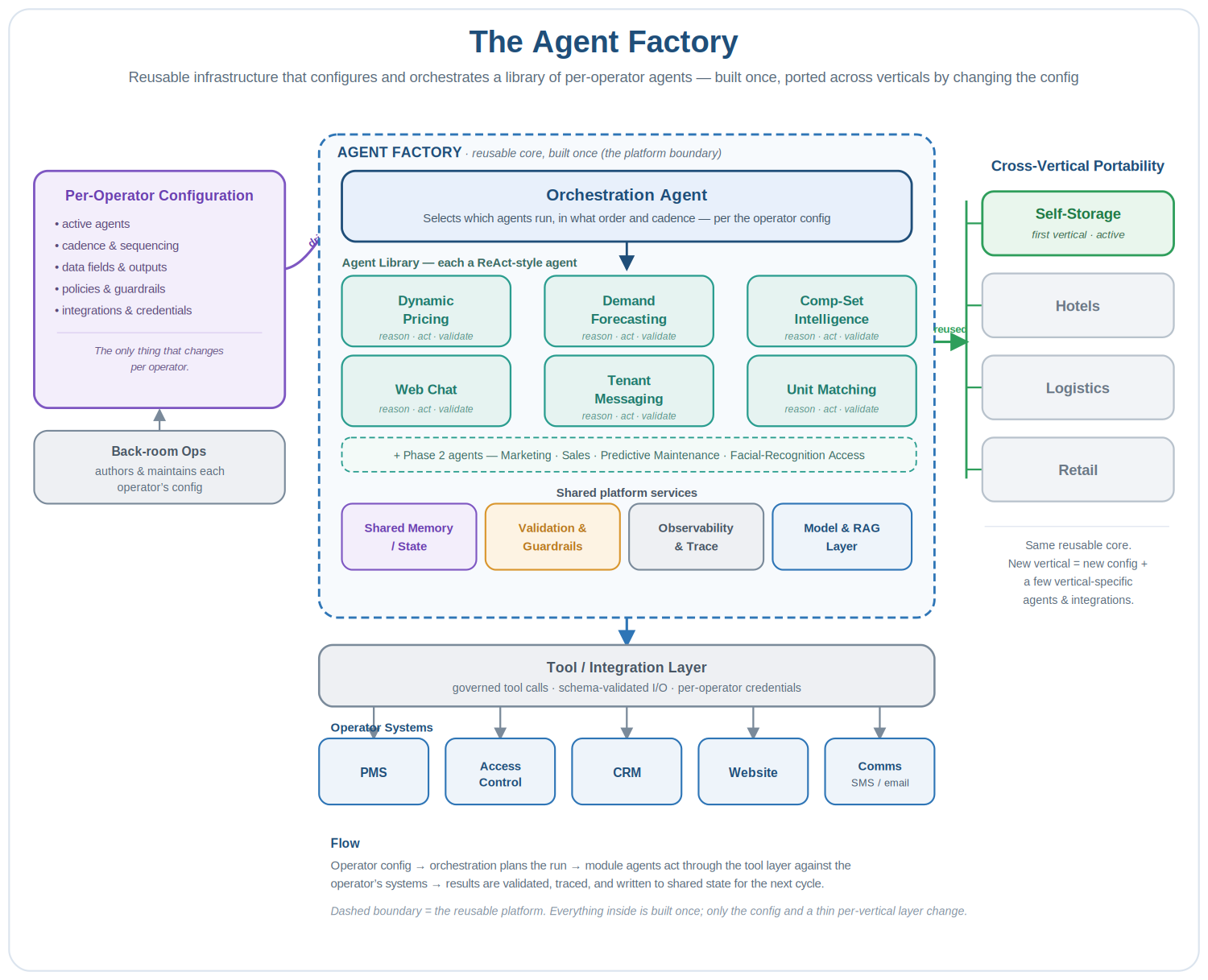
The reusable version of this pattern is what we internally call an agent factory: a standard library of capability agents, an orchestration framework system that decides which agents run, in what order, and with which inputs, and a per-deployment configuration that encodes how one organization uses the underlying tools. The same infrastructure ships on every deployment; only the configuration changes. For healthcare that means a new specialty, a new EHR environment, or a new document mix is a configuration change and some domain tuning, not a rebuild.
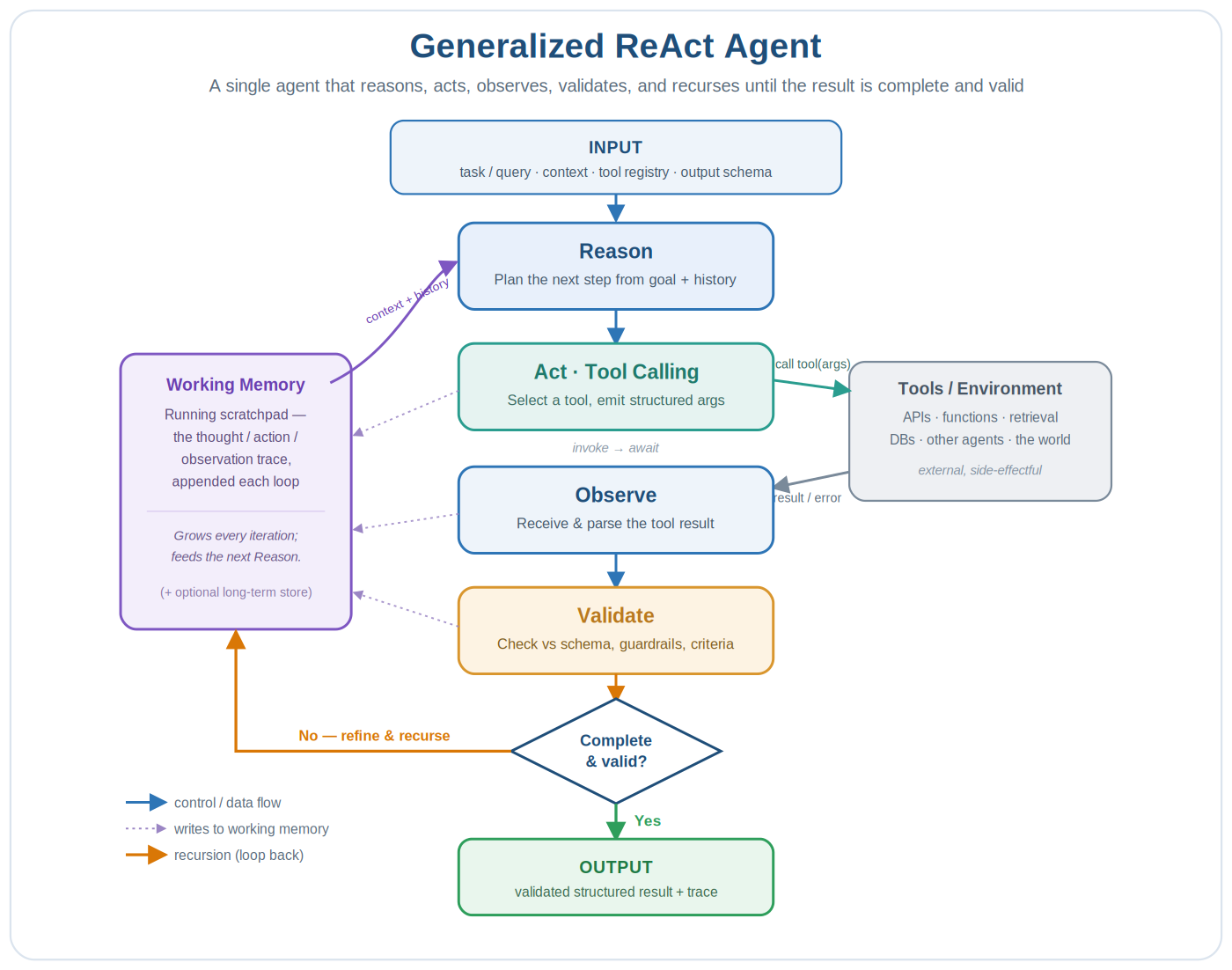
Underneath the orchestration, each agent needs a reasoning loop. The ReAct pattern (reason, act, observe, repeat) is the workhorse: the agent thinks about what it needs, calls a tool, reads the result, and decides the next step. For multi-step care coordination, a planning stage that writes an explicit plan before acting beats reacting turn by turn, because the plan is auditable. And every reasoning chain should be captured, because in a clinical setting a clinician needs to see why the system reached a recommendation, not just the recommendation. Chain-of-thought transparency is not a nicety here; it is what makes clinician validation possible.
In our production framework the planning step is literal, not metaphorical. A plan-builder agent classifies each incoming task's complexity and emits a dependency-ordered plan as structured JSON: every step names the agent type that runs it, the tools (access a database, document store, process inputs etc) it may call, the earlier steps it depends on, an output schema, and success criteria that define what a good result looks like before anything executes. Simple requests skip the machinery entirely through a fast path, because a follow-up question that existing context can answer should not pay the multi-agent tax, and users expect response time to track the complexity they perceive in the task.
Two properties of this design matter most in a clinical setting. Validation is decoupled from generation: a separate harness checks each agent's output against the plan's success criteria using programmatic checks plus an LLM judge. And the plan's per-step tool list is the real access-control decision: an agent holds exactly the tools its step was granted, which is how least-privilege access to patient data gets enforced structurally instead of by convention.
Inside each step, the ReAct agent runs a budgeted loop: reason about what is needed, call a tool, read the observation, and repeat up to a fixed iteration cap. The failure behavior is a deliberate choice: an agent that hits its cap returns its best partial result flagged as incomplete rather than erroring out, because in a clinical workflow a partial answer routed to human review beats a dead pipeline. Retries are layered by failure class rather than applied blindly: transport errors retry at the client, transient agent failures retry at the orchestrator, and a malformed plan retries at the planner with the exact error fed back for self-correction, while logical outcomes like an exhausted iteration budget are never retried, since re-running them cannot help.
Real patient data is not one modality. A production system has to combine clinical notes (text), labs and vitals (structured), radiology and pathology (imaging), waveforms (ECG, EEG), and genomics into one reasoning context, and reconcile them when they disagree. This is exactly the problem the SERP hand-waves at. In our own medical document work, handling varied patient-record layouts plus OCR-processed scans in the same pipeline is the multi-modal fusion problem in its most common real form: the record is a pile of differently structured documents, half of them scanned, and the system has to read all of them reliably. The specialty vision machine learning models that reach 92%+ accuracy in retail image contexts are the same architectural class used for pathology, radiology, and dermatology imaging; the modality changes, the pattern does not.
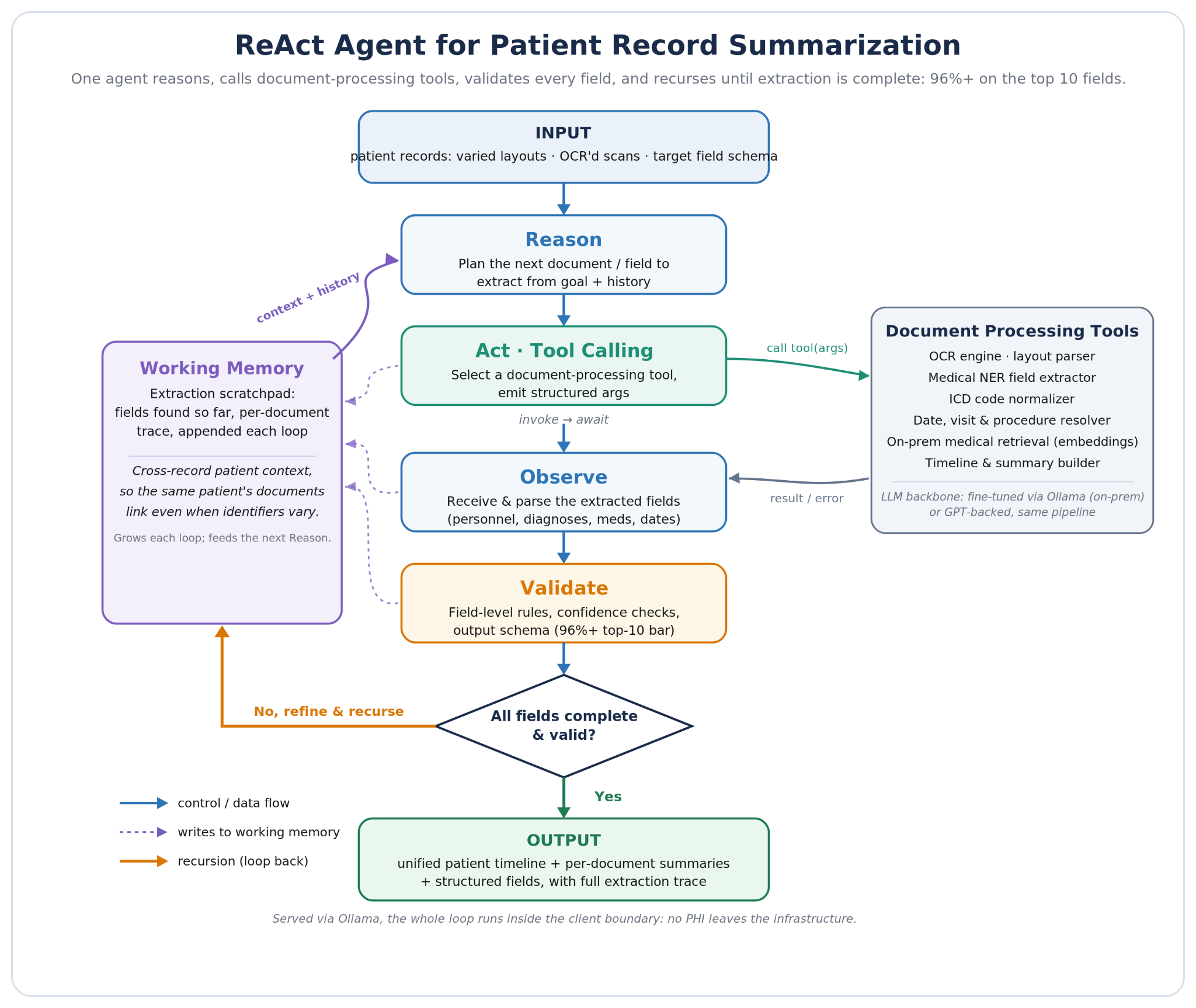
An agent that cannot read from and write to the EHR is a demo. Production integration means agents call FHIR resources to read the record and write back through FHIR or HL7 v2, with proper resource versioning and provenance so every action is traceable to a source. The hard part is rarely the read; it is cross-document reasoning when the same patient's records do not line up. In our patient-records Q&A system, a medical record-matching layer links related documents across the same patient even when the surface identifiers vary (different address, inconsistent date of birth, name spellings), which is the same resolution problem FHIR resource matching presents. Without it, half a patient's records get missed and the answers are quietly wrong.
The integration pattern that makes this safe is a single tool registry as the only door to the EHR. Agents cannot touch a clinical system except through one guarded entry point that validates every call against the tool's schema before executing and always returns a structured result instead of raising, so a failed call becomes an observation the agent can react to rather than a crash. That one choke point is also where credentials, rate limits, and the per-action audit logging that HIPAA accountability requires all live. Each registered tool ships with its own documentation (what it is, what its schema looks like, how to query it, and worked examples), so agents spend their iterations answering the question instead of rediscovering where the data lives.
Architecture detail: LayoutLMv3 + program synthesis breakdown.
Everyone names HIPAA; almost no one says what it requires technically. In practice a HIPAA-compliant agentic system needs PHI segmentation and tokenization inside agent context windows, audit logging at the level of individual agent actions (for BAA accountability), access control per agent (which agents may see which parts of the record), encryption in transit and at rest across the orchestration, and de-identification before inference where possible. The deployment decision that the vendor content skips is on-prem versus cloud. Managed model APIs cannot run inside a hospital's boundary, which is why our summarization system offers an Ollama-served fine-tuned model that runs entirely on the client's infrastructure, so no PHI leaves it, alongside the GPT-backed option for organizations comfortable with the managed-model tradeoff. Being able to offer both is the point; off-the-shelf platforms usually give you one.
A real patient history outruns any LLM context window, and the industry's default answer, summarize when full, is the wrong primary strategy for medical data because summarization is lossy, unsteerable, and unrecoverable: whatever the model drops is gone. Our systems follow a strict reduction ladder instead: raw beats compaction beats summarization. Recent tool results stay raw in context. Older results are compacted, meaning the full output is written to disk and the context keeps a short reference that advertises what the file contains, so nothing is destroyed and the agent re-reads on demand. The compaction policy is deterministic and age-based, with no LLM involved. Summarization is the last resort, and the metric we manage is how long an agent can run before that last resort fires.
Two healthcare-specific payoffs follow. First, traceability: because compaction is reversible, every intermediate result in a patient-record run remains recoverable on disk, which is exactly what an auditable clinical pipeline needs. Second, scale: sub-agents act as fresh context windows, so a discrete job like extracting the medications from one encounter gets its own agent, its own window, and returns only a structured result to the parent. A pile of records becomes many small, parallel contexts instead of one overflowing one, with short structured messages between agents keeping the whole thing efficient.
High-stakes actions need action-level policies, not blanket autonomy. The workable rule is agent-can-prep, human-must-approve for anything clinical: the system can assemble a care plan, draft an order, or prepare a referral, but a clinician approves before it takes effect. Confidence thresholds route low-certainty outputs to human review instead of shipping them, and patient-facing agents need prompt-injection defenses because patients (and their messages) are an untrusted input channel. A useful pattern from our Q&A work is tiering by question type: 50 preset clinical questions carry an accuracy guarantee, while open-domain questions return best-effort answers flagged at lower confidence, so the interface can treat the two differently.
Most articles in the agentic ai systems literature says human-in-the-loop is important and then stop. The interesting question is what the interface actually looks like. What does the clinician see when the agent proposes a plan: the recommendation, the reasoning chain, the source documents, and a confidence signal? When can the agent proceed asynchronously and when must it block on approval? How do handoffs work across shift changes? We have a fully operational version of this in a patient-facing setting: a dental services company's automated SMS agent manages the sales conversation end to end but runs on a monitoring dashboard where three staff oversee everything, take over mid-thread when the agent judges it necessary, and rely on built-in sentiment monitoring and do-not-contact recognition to know when to step in or stop. The clinical version raises the stakes, but the architecture, a monitoring surface plus context-preserving handoff plus automated escalation triggers, is the same.
Evaluation is where aspirational architectures and production ones diverge. Before a clinical system goes near patients you need simulation frameworks that run it against realistic clinical scenarios, adversarial testing (prompt injection, edge-case patients, contradictory records), comparison against specialist consensus, and a plan for FDA considerations if any action is autonomous. The most credible evaluation claim you can make is a public-benchmark result, because anyone can check it, which is why our medical embedding work, covered next, matters: state-of-the-art on public medical retrieval benchmarks is verifiable in a way that vendor accuracy claims never are.
Off-the-shelf agentic platforms (AWS Bedrock, watsonx Orchestrate, NeMo, IQVIA's agents) are the right answer more often than a custom-build shop will admit: for broad, non-specialty automation, for prototyping, and where a managed model's data-handling terms are acceptable, they are faster and cheaper to stand up. Custom wins in a specific set of conditions that healthcare hits constantly: specialty-specific clinical reasoning that generic models handle poorly, unusual EHR integrations, on-premise requirements where no PHI can leave the boundary, novel modalities, and any deployment where the accuracy floor has to be provably high.
The sharpest example is retrieval. Every agentic clinical system eventually retrieves something, a prior note, a guideline, a similar case, and the quality of that retrieval decides whether the downstream reasoning is grounded in the right evidence. General-purpose embeddings (OpenAI text-embedding-3, Cohere, Voyage) are trained on generic web text and measurably underperform on medical retrieval benchmarks, and, just as important for HIPAA, they run as managed APIs that cannot process PHI on-prem. We took the open-source MedEmbed model and improved it, reaching state-of-the-art MRR@5 on the TRECCOVID benchmark and 68% MRR@5 on NFCorpus, also state-of-the-art, running entirely on-prem. That is the off-the-shelf-versus-custom argument in one artifact: a good open-source medical model still left accuracy on the table, and the improvement is verifiable against public leaderboards.
The retrieval method matters as much as the embedding model. Our production systems also give agents literal file search (grep and glob over the processed document store) because in medical data the exact string is often the answer: ICD codes, dosages, and lab values that sit next to each other in embedding space can be opposites in fact, and 10mg versus 100mg embed almost identically while meaning very different things.
Classic retrieval augmented generation (RAG) could not use grep well because the user's words rarely match the document's words; agentic retrieval closes that gap because the agent generates and refines the search pattern on every recursion instead of passing the user's phrasing through. When multiple retrieval methods run in one system, their results merge by reciprocal rank fusion, which combines rankings by position rather than trying to reconcile a cosine similarity with a keyword score.
This is the biggest under-covered opportunity I see reviewing the literature, and it is where the real ROI is. Administrative costs are more than 40% of hospital expenses, and much of that is revenue-cycle friction that agentic AI is well-suited to attack: prior-authorization automation (assembling the clinical justification and submitting it), claim scrubbing before submission, denial analysis and automated appeals with similar-case precedent, coding assistance, and eligibility verification. These are text- and rules-heavy, lower-clinical-stakes, and high-volume, which is exactly the profile where agents pay off fastest and safely. The foundational capability is the same medical document extraction and retrieval covered above: a prior-auth agent has to read the record, find the supporting evidence, and match it to payer policy, which is medical record extraction plus policy retrieval, both of which are the systems this guide has already described.
Healthcare has different stakes, so the compliance vocabulary is non-negotiable: HIPAA for PHI, HL7 and FHIR for interoperability, GDPR where EU data is involved. Beyond naming them, a trustworthy agentic system has to address bias and fairness in clinical reasoning, full auditability and traceability of every agent action, and the regulatory pathway for anything autonomous (FDA Software-as-a-Medical-Device considerations, and the clinical-decision-support carve-outs that determine whether a given feature needs clearance). The architectural choices earlier in this guide are what make compliance achievable rather than aspirational: per-action audit logging supports BAA accountability, on-prem deployment via Ollama keeps sensitive patient data inside the boundary, agent-level access control enforces minimum-necessary access, and the consent and do-not-contact detection from our patient-facing work maps to TCPA constraints on patient messaging. Maintaining compliance is the client's responsibility; the job of the architecture is to make it possible to meet.
The rest of this SERP argues from hypothetical patients and future capability. Here are a few healthcare systems we have actually deployed, stacked the way a real agentic clinical system stacks: retrieval at the bottom, extraction and Q&A on top, and patient-facing automation as its own surface. The single strongest fact first: a medical AI startup raised its Series A on the back of the document system below, and two separate healthcare companies have raised rounds using variants of this work.
We fine-tuned and optimized the open-source MedEmbed embedding model to reach state-of-the-art MRR@5 on the TRECCOVID dataset, and 68% MRR@5 (also SOTA, the next highest model is 52%!) on NFCorpus, running on-prem. As I’ve written about in my general agentic retrieval guides, retrieval accuracy is everything in agentic ai, so this is the layer everything else depends on being as accurate as possible, and being on-prem is what makes it usable over PHI and compliance environments.
This model is optimized for retrieval of:
Built a production-level medical document summarization system that ingests varied patient record document types, including OCR-processed scans, and reliably extracts essential medical data: names of medical personnel, diagnoses, ICD codes, medications, and dates of visits and procedures. All extracted data rolls into a single patient timeline summary, plus document-level summaries per record.
Now deployed in production across both medical and legal industries with a customizable pipeline at each step.
• 96%+ accuracy on the top 10 extracted fields.
• 90%+ accuracy on every extracted field.
• Customizable pipeline at each step.
• Fine-tuned large language model served via Ollama, with a GPT-backed option for the same pipeline.
• The startup raised its Series A on the back of this work.
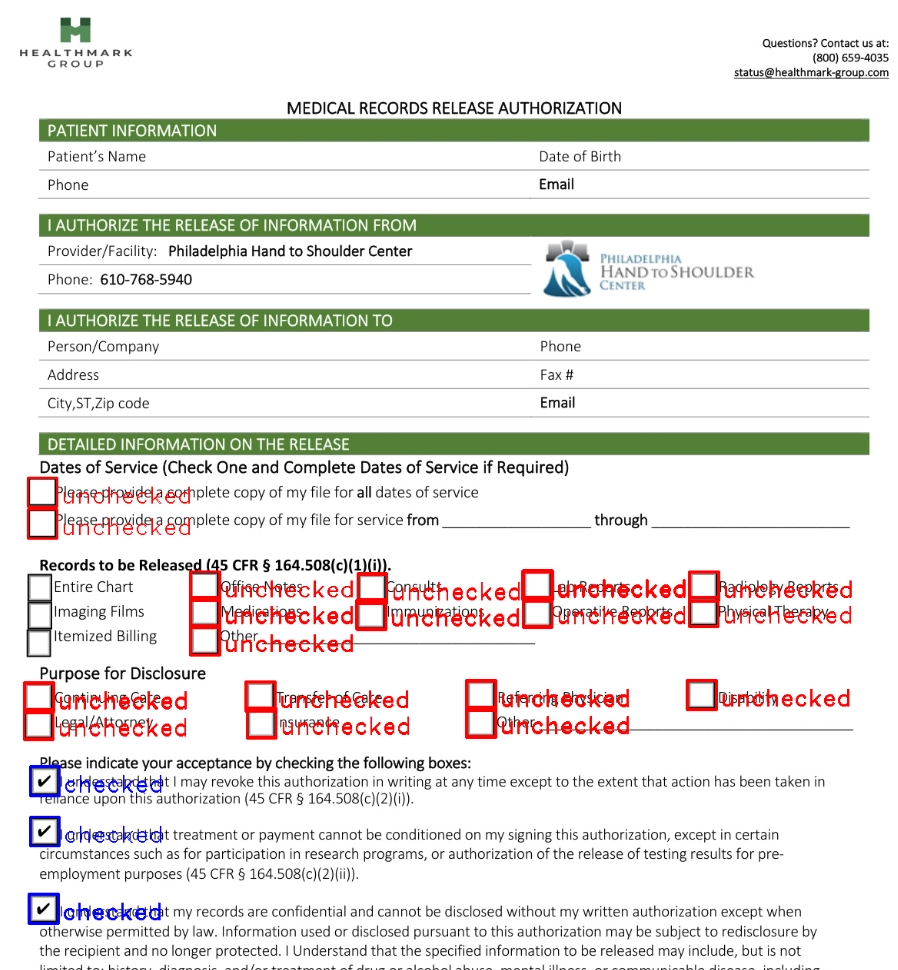
Question & Answer system built on top of medical document processing architecture. Users can ask highly detailed and domain specific questions about specific patients or locations across 1000s of documents. All answers include citations and grounded sources. The pipeline uses document understanding framework plus our program-synthesis layer to classify page type and visit context, so questions about referring physicians, healthcare providers, and dosage information return answers attributed to the correct document and visit with a chronology focus, not just the first match on the page. A medical record-matching architecture links related documents across the same patient even when patient information varies between records.
• 50 preset clinical questions all answered at >91% accuracy.
• 97.8% accuracy on document type classification
• 95.6% top-k = 5 retrieval
• Plus open-domain handling for questions outside the preset set.
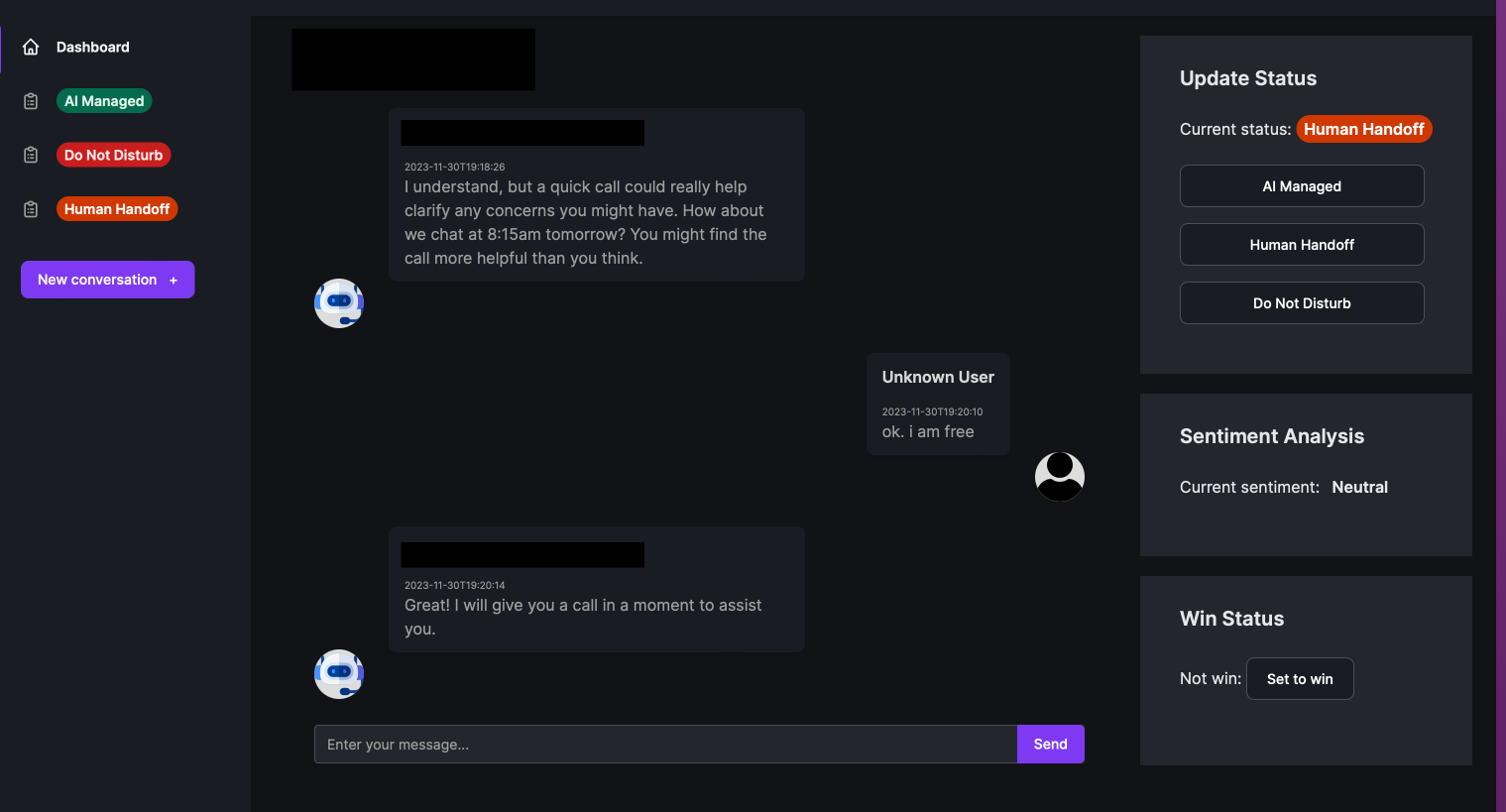
For a dental services company, an automated SMS agent replaced a 30-person SDR sales team with a fully automated system requiring only 3 sales people moving forward. Agentic system follows a client and domain specific SOP, running re-engagement follow-ups, and using sentiment and do-not-contact detection with human handoff, a 90% reduction in overhead. All conversations stored securely with PII data scrubbed. Daily data analytics about performance and conversions generated. Full data integration into CRM, sales tools, SMS service, and our custom dashboard.
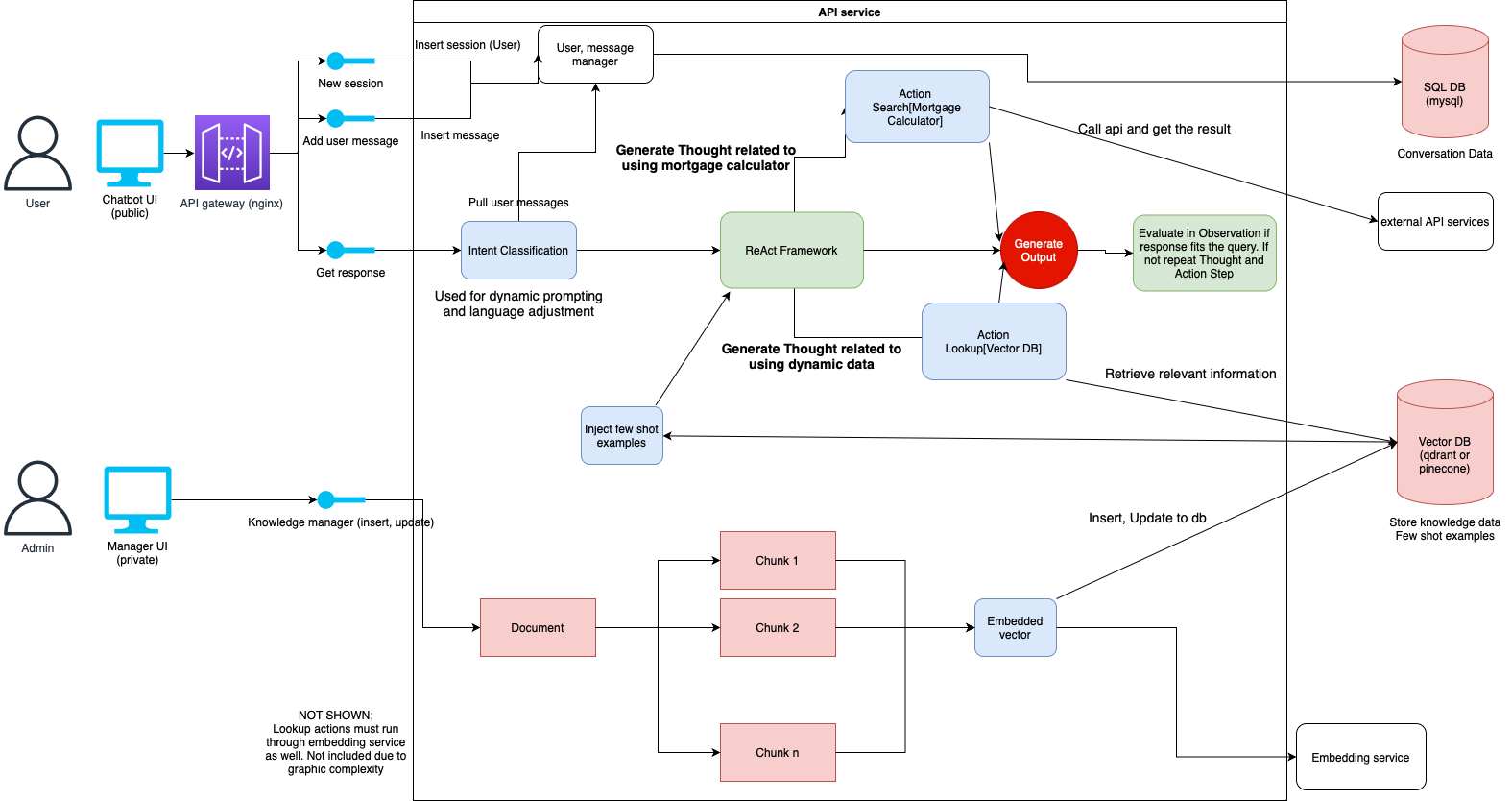
Across all four, the throughline is the pattern this guide describes: fine-tuned models where generic ones underperform, multi-agent and multi-step pipelines rather than one-shot calls, validation at every step, and human oversight designed into the interface, not bolted on.
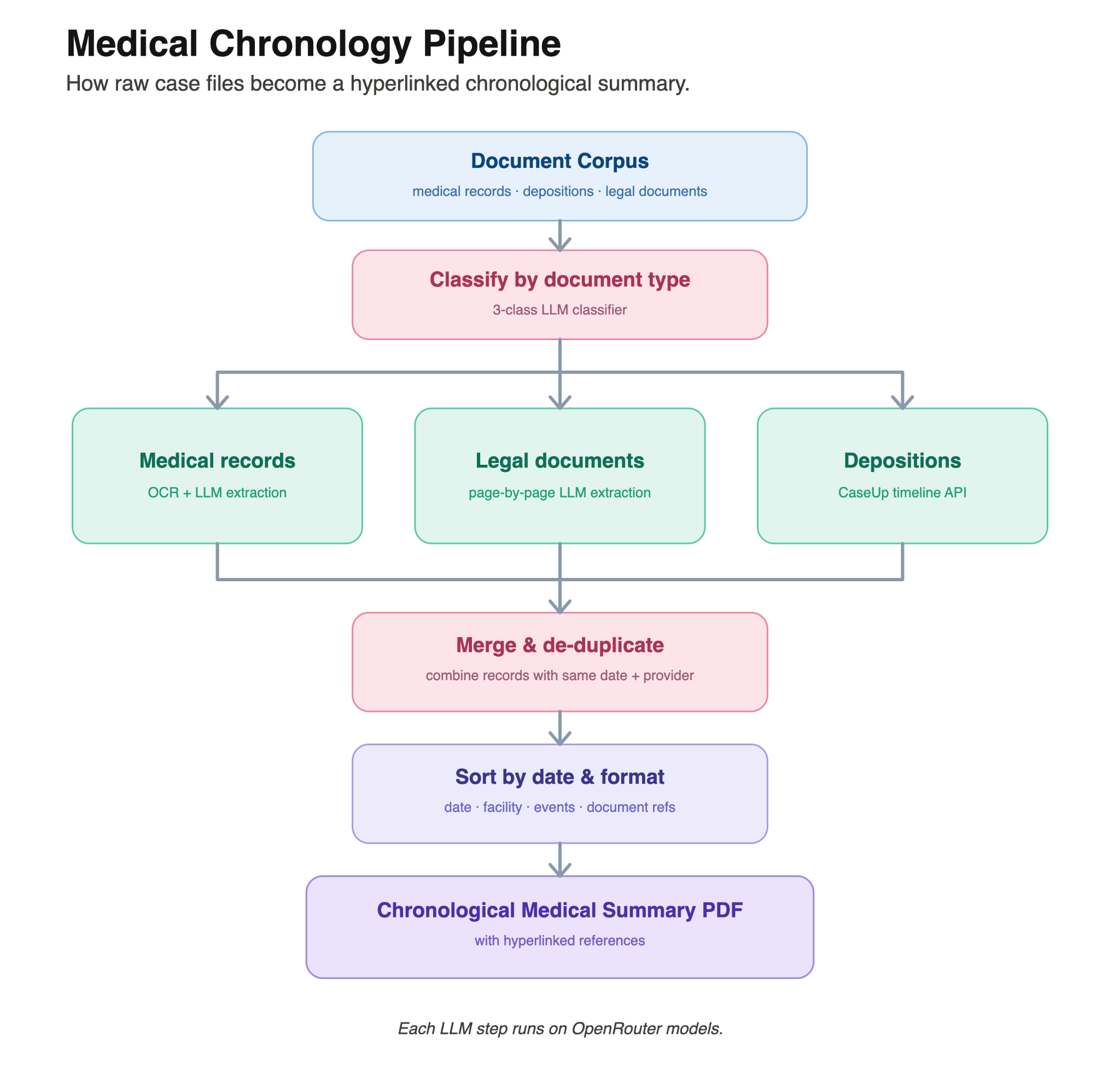
We built a fully agentic system to take in 10,000+ medical documents related to a personal injury case and generate a high end medical chronology report used in trial. Includes all relevant documentation for each visit regarding the case, with page and line level citations, quotes, and use case specific visit callouts (medication received, injury focus, provider callouts). System also allows for other documents as input such as police reports and deposition transcripts. Output is real PDF medical chronology.
Every system above is a production deployment with real metrics. If you are evaluating whether an agentic system can work in your healthcare environment, the fastest answer is a scoping conversation about your specific workflow and constraints. We've been working on agentic ai systems in healthcare since 2022 and have helped over 50 organizations build these solutions.
If you are implementing agentic AI in healthcare, the sequence that works is deliberately unglamorous:
Cross-specialty is the right scope for understanding the field, but every specialty changes the build. A few of the most common:
Our own deployed work spans dental (patient-facing automation) and general medical plus legal (the cross-industry document architecture), and the medical embedding model is specialty-general retrieval that applies underneath all of them. Results produced in a way healthcare professionals can read in plain english.
The academic reviews establish that agentic AI in healthcare is real, and the vendor visions show what it could look like. What neither gives you is a build you can run on your stack, in your specialty, under your regulatory constraints. That is the gap this guide is written into: the architecture is vendor-agnostic on purpose, because the right orchestration framework, the right cloud-or-on-prem split, and the right build-versus-buy call all depend on your environment, not the reference architecture's. If you are weighing whether to build custom or adopt off-the-shelf, that is the conversation we have with healthcare teams every week, and we will tell you honestly which one your use case needs.
In healthcare, agentic AI refers to autonomous, multi-step AI systems that reason, plan, and act across clinical and administrative workflows, calling tools like the EHR and imaging systems, validating their output, and escalating to supporting clinicians at defined checkpoints. It goes beyond generative AI, which produces a draft, and traditional process automation, which follows fixed rules.
Generative AI produces content from a prompt (a draft summary, a suggested reply); agentic AI pursues a goal across multiple steps, deciding what to do, calling tools, checking results, and taking or queuing actions. Generation is one step inside an agentic system with multiple autonomous agents rather than the whole product.
The most common in health care are clinical decision support, EHR & document summarization, clinical Q&A over the record, patient portal message triage, appointment scheduling, prior authorization and revenue-cycle workflows, clinical trial matching, and care coordination. Administrative and payer-facing uses tend to deliver value fastest at lowest clinical risk.
It sits under HIPAA for PHI, uses HL7 and FHIR for interoperability, and falls under GDPR where EU data is involved. Any feature that takes an autonomous clinical action may fall under FDA Software-as-a-Medical-Device rules, while some clinical-decision-support features qualify for carve-outs. Compliance depends on architecture: audit logging, access control, encryption, and where required, on-prem deployment.
No. It replaces execution and administrative volume, not clinical judgment. In every serious deployment, the agent prepares and the clinician approves anything with clinical consequence. The realistic model is a clinician supervising systems that do the grunt work or are used to multiply output for digital tasks. Healthcare leaders are using this to improve patient outcomes and reduce manual tasks for the team.
Bad retrieval leading to reasoning over the wrong evidence, hallucinated or unattributed answers, prompt injection through patient-facing channels, PHI leaving a compliant boundary, and autonomous actions taken without adequate human review. Each maps to an architectural control: domain-tuned retrieval, attribution and confidence thresholds, injection defenses, on-prem deployment, and agent-can-prep-human-must-approve policies. Poor design can lead to problems integrating into existing workflows and administrative burden not being reduced due to lack of trust.
Segment and tokenize PHI in agent context, log every agent action for BAA accountability, enforce per-agent access control, encrypt in transit and at rest, de-identify before inference where possible, and deploy on-prem when data cannot leave the boundary, for example a fine-tuned model served locally via Ollama rather than a managed API. Compliance is the deploying organization's responsibility; the architecture makes it achievable.
Real deployed examples include medical document summarization that extracts key fields at 96%+ accuracy and builds a unified patient timeline, a records Q&A system answering clinical questions at 91%+ with correct attribution, a patient-facing SMS agent that cut administrative overhead by 90%, and a custom medical embedding model that reached state-of-the-art on public medical retrieval benchmarks. On the vendor side, GE Healthcare and AWS have published a multi-agent oncology design, and Athenahealth ships agentic workflows with Salesforce AgentForce for Health.
The landscape splits into platform vendors (AWS Bedrock, IBM watsonx Orchestrate, NVIDIA NeMo, Microsoft AutoGen, Salesforce AgentForce for Health, IQVIA for life sciences) and custom development teams that build specialty-specific, on-prem, or accuracy-critical systems. Width.ai is the second group: we build custom agentic systems for regulated healthcare environments, including the on-prem, fine-tuned deployments platform vendors cannot offer. We’ve been building agentic ai platforms since 2022 that have helped over 50+ organizations.


