Claude for Small Business: More Output From the Same Hours, at a Fraction of the Cost of Hiring
Claude for Small Business explained for owners: 43 workflows by department, the tools they
Width.ai
October 20, 2026
Ask an ecommerce operator what AI has changed this year and the answer usually starts at the storefront: a support assistant that handles order questions, recommendations that shift as a shopper browses, a search box that understands a photo. Those changes are real, and they are the easiest to see.
Then look at what is actually slowing that operator down. A manufacturer flat file arrives with half the attributes missing. Two thousand new SKUs need categories, descriptions and specs before they can go live. And a growing share of shoppers start with an AI assistant instead of the site's search box, asking it which product to buy, and the answer comes from whichever product pages a model could read.
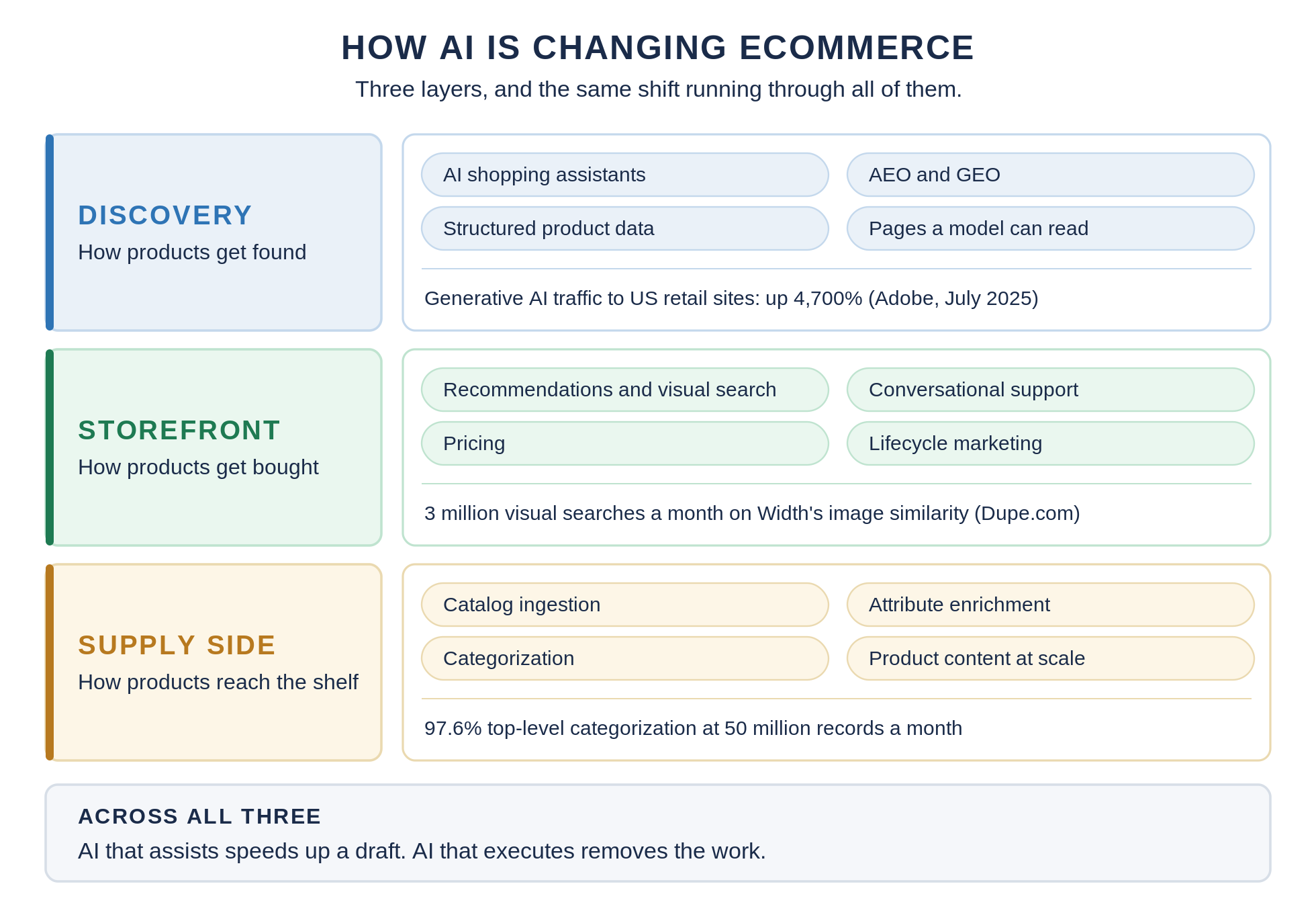
AI is changing ecommerce on three layers at once, and the storefront is only the most visible one. Underneath it, AI is changing how product data gets onto the shelf. In front of it, AI is changing how products get found. And across all three, the change that matters most is the move from AI that suggests to AI that does the work.
So the useful question is not which AI features a store should add. It is which layer is holding the business back, and whether the AI pointed at it is helping someone or removing the work. We build these systems at Width.ai and in Pumice, our product data platform, and the numbers below come from systems and prototypes we have built, alongside the outside research that holds up.
How AI is used in ecommerce today: On the storefront, AI ranks products, answers support questions, adjusts prices and times marketing. On the supply side, it reads supplier files, fills in attributes, assigns categories and writes product content. In discovery, it decides which product pages AI assistants can read and cite. The storefront is where the results are easiest to see; the other two are where most of the operational work sits.
The impact of AI on ecommerce: Adoption is no longer the open question. Across industries, McKinsey's 2026 State of AI survey found nearly nine in ten respondents saying their organizations use AI regularly in at least one business function, yet only 37% reporting any impact on EBIT. The survey ties the difference to how companies use it, starting with whether they redesign workflows around AI or bolt it onto the old ones.
The role of AI in ecommerce businesses. Our roundup of AI agents for ecommerce draws the line that runs through everything else: execution removes the work; assistance only speeds it up. A support tool that drafts a reply for an agent to send is assistance. One that checks the order, issues the return and closes the ticket is execution. Both have a role, and they are worth very different amounts.
The layers depend on each other in one direction. Discovery and the storefront both run on product data, so a gap on the supply side shows up twice: as a product an AI assistant cannot cite, and as a product page that does not convert when a shopper does arrive.
Stores have recommended products to customers for twenty years. What has changed is what information the systems use. Older machine learning algorithms leaned on what other shoppers bought; current ones also read the product itself, its images and attributes, which is why a new product with no purchase history can be recommended from its first day, as long as its data is complete.
Recommendations and search now rank products for each shopper rather than for the average one, and search increasingly starts from a photo instead of a typed query. Our visual search write-up describes Dupe.com using Width's image similarity algorithm for 3 million visual searches a month across a catalog of 10 million SKUs. The model behind that work retrieved the same product first 92.44% of the time on a benchmark of more than 10 million products. Visual search matters most in categories where shoppers cannot name what they want, like furniture, fashion and home decor.
Pricing models adjust prices against demand, competitor prices and inventory instead of on a fixed schedule. Our dynamic pricing explainer covers the approaches, and the value depends heavily on catalog size and margin structure. A pricing model is also only as good as the competitor data it reads, and matching a competitor's listing to your own SKU is itself a product data problem.
Lifecycle marketing is a smaller change with measurable results, and one of the more direct ways AI can boost sales from customers a store already has. In a prototype on one product category, a model we built predicted when each repeat customer was likely to buy next, and the system timed a follow-up email around that date and the hour the customer usually clicked. Compared with sending on fixed days, click-through rose 12% to 17% across four time windows, and conversion rose 7.5% to 12.5%, a statistically significant lift in three of the four. The email optimization case study has the details.
Agentic checkout, where an AI assistant completes a purchase on the shopper's behalf, is the newest storefront change and the least mature. It is real, and it is early. For it to work, an assistant needs product data it can trust and a store that exposes inventory, price and policy in a form a model can read.
The storefront use cases are also the ones that move customer engagement, customer satisfaction and customer experience. Personalized recommendations and well-timed follow-up emails keep shoppers engaged, a support assistant that resolves an order question in one conversation lifts satisfaction more than one that opens a ticket, and search that understands a photo or a plain-language question makes the whole customer experience faster. On its August 2026 earnings call, Walmart said shoppers who use Sparky, its AI shopping assistant, spend 40% more per order than those who don't.
Every one of these changes depends on the product data underneath it. A recommendation engine cannot recommend a product with no attributes, and a visual search cannot match a product photographed badly or not at all.
Support and shopping assistants have moved from scripted decision trees to language models that understand free text. The bigger change is whether they resolve a request or only deflect it. An assistant that can look up an order, check the return policy and start the return is doing the work. One that answers in fluent paragraphs and hands every real request to a person is assistance with better grammar.
Resolution depends on wiring more than on the model. The assistant needs access to orders, billing and policy, a confidence score that decides when to hand off to a person, and answers grounded in the store's own documents rather than in what a model guesses a return policy probably says. The FAQ chatbot architecture we use logs every conversation with customer behavior and learns from it: unanswered questions become draft knowledge-base answers that a person approves, resolution data re-ranks retrieval, and confidence scores are checked against outcomes to tune when the assistant hands off. It improves from real customer interactions instead of waiting for someone to edit it.
The failure modes are consistent: confident answers about policies that do not exist, and assistants that never escalate. Scale is not the hard part. Outside retail, NILES, a conversational system we built for the NeuroLeadership Institute, serves more than 10,000 customers with a separate knowledge base for each organization.
An off-the-shelf assistant is the right choice for a small catalog with simple policies. A custom build earns its cost when answers depend on order systems, the catalog is large, or the assistant has to improve without someone editing it every week.
Every storefront feature runs on product data, and product data is where most catalogs are weakest. Akeneo found that two-fifths of consumers returned a product in the past year because the details did not match reality. At a few hundred SKUs, a team can fix that by hand. At fifty thousand, with new products arriving weekly from dozens of vendors, writing and checking every attribute was never realistic, so the work got templated, copied from the vendor, or skipped.
The cost shows up in three places: returns when a description promises something the product is not, lost sales when a filter cannot find a product with a blank attribute, and products that sit unpublished for weeks while someone writes their content.
Rules and templates handled the easy part of this work for years. What changed is the hard part: reading an unstructured supplier PDF, deciding that two differently titled rows are the same product, and writing a description specific to this product rather than its category. Those were judgment calls, and models can now make many of them reliably enough that a person reviews the result instead of redoing it.
Content enrichment is where AI removes the most of that work. Grounded enrichment researches each product before writing anything: it finds the manufacturer's page, spec sheet or PDF catalog, confirms the source describes the same product, then fills the attributes and writes the title, description and bullets from what it found. The identity check is the step that keeps it honest. In our catalog ingestion agent, matching each record to the right product before writing was correct 97.57% of the time, with a 0.07% false-positive rate, on a 120,000-SKU catalog, at roughly 1,000 records an hour and 14 fields each.
Attribute enrichment fills the gaps that block filtering and comparison: material, dimensions, compatibility, the fields shoppers actually filter on. A light fixture without a bulb type, or a jacket without a fill weight, cannot be filtered, compared or recommended accurately. Our guides to attribute enrichment and automated product tagging cover the methods.
Pumice packages this layer for content enrichment at catalog scale. Its Merchandising Pipeline researches each product from manufacturer pages, PDF catalogs and the wider web, and confirms each source page is the same product before using it. It then generates attributes from text and images, writes titles, descriptions and bullets that follow your brand rules, and produces channel-specific versions for Amazon, Walmart and eBay, with rules, examples and validation on every run. Generated attributes go to a person for review beside the source they came from.
Getting this layer right is what makes the storefront and discovery layers work at all. Every filter, recommendation and AI answer about a product draws on the same record.
None of this should run unattended in a well-built system. AI does the research and the drafting, validation catches what it can, and a person reviews what is uncertain, which is the same pattern that makes agentic systems trustworthy.
B2B is where the supply-side change bites hardest. Distributors and wholesalers carry tens of thousands of part-numbered SKUs from vendor feeds and ERP exports, sell them on their own site and on Amazon and other marketplaces, and serve buyers who search by part number, specification and compatibility rather than by browsing. A missing voltage rating or thread size is not a cosmetic gap. It is the reason a buyer cannot confirm the part fits and orders from someone else.
AI changes three things in B2B ecommerce. The first is ingestion and enrichment from the formats B2B data actually arrives in, ERP exports, vendor spreadsheets and PDF line sheets, so a new line card does not take a quarter to load.
The second is categorization into each channel's taxonomy, often across languages. Our multilingual wholesale categorization work for a B2B marketplace reached 92.37% accuracy at the most specific category level in evaluation, working from a 297,000-record dataset partly in German.
The third is product pages that answer the specific questions buyers ask, including the ones they increasingly put to AI assistants before they reach a distributor's site. Pumice's guides to SEO for wholesale distributors, distributors and marketplaces go deeper on the page side, and our AI eBay lister applies the same approach to listing products on eBay.
B2B buyers also reorder. A distributor whose product records are complete and consistent can let buyers reorder by part number from any channel, which is a supply-side capability that shows up to the buyer as a storefront feature.
Generative AI in ecommerce shows up in more places than the product description. The generative AI use cases in ecommerce that hold up in production are product titles, descriptions, bullets and meta descriptions; attribute extraction from images, spec sheets and PDFs; category and collection copy; and support replies grounded in policy. Marketing copy is the other common use, and the same approach works outside the catalog: a marketing copy generator with 17 operations writes follow-up sequences and lead magnets inside its CRM.
The failure mode is just as consistent. In our supplier catalog ingestion write-up, a general-purpose model was given a sparse vendor row for a mirror and asked for a full product listing. It produced confident specifications that were simply invented, down to a walnut finish on a mirror whose real finish is honey brown. Nothing in the output signaled the error, and a shopper would have found out only when the box arrived.
The fix is grounding and validation. Generate from the manufacturer's own data rather than from the model's memory, then check every output against that source before it ships. Our enterprise agentic system screens generated content with HHEM-2.1, a hallucination detection model, as one step in exactly that kind of loop. Grounded generation is the pattern Pumice is built around: research the product first, generate second, and validate before anything reaches a page.
The other risk is sameness. When every retailer generates descriptions from the same manufacturer data with similar models, the output converges and product pages start reading like each other. Grounding fixes accuracy; differentiation comes from adding what only the retailer knows, like fit notes, compatibility with the rest of its catalog, and what its own reviews and returns say.
The practical rule for generative AI in ecommerce is simple to state and harder to follow: never let a model write a fact it did not read. Descriptions and marketing copy can be generated freely. Specifications, compatibility, materials and dimensions have to come from a source.
The third layer is how products get found, and it is growing fastest, from a small base. Adobe measured traffic from generative AI tools to US retail sites rising 4,700% year over year in July 2025, counted as shoppers clicking through from an AI answer, though Adobe notes that volume is still modest next to paid search and email. In a Bloomreach survey of 1,007 US adults aged 18 to 50, 61% said they had used tools like ChatGPT or Gemini to help them shop online. A separate McKinsey report on Europe found 38% of consumers there now use generative AI tools to research and decide on purchases.
What changes for a product page is the reader. It has to be readable by a model before it can be found by a person. That means complete, structured attributes, specifications grounded in the manufacturer's data, the same facts on every channel, and copy that answers the questions shoppers actually ask. A model comparing two products can only cite the facts it can find, so the product with the thinner record loses before a person ever sees it.
Consistency matters as much as completeness. If a marketplace listing says a product runs on 220 volts and the brand's own page says 110, a model has two conflicting facts and a reason to cite neither. Structured product markup, the same attributes on every channel, and specifications taken from the manufacturer remove that ambiguity. They are also the same fixes that make a page convert for a person, which is why the supply side and discovery are really one project.
Search engine optimization and answer engine optimization are different jobs on the same page. Our guide to the difference between SEO and AEO and our roundup of generative engine optimization tools cover the mechanics.
On the Pumice side, the PDP Optimization Playbook handles both for each product page. Give it a page and its target keywords, and it analyzes the pages ranking in search and the competitors showing up in AI answers, then returns a PDF report: a field-by-field review of the title, description, bullets and images, a checklist of the key details competitors cover, keyword frequencies across the competing pages, and a word count comparison. It is the same gap analysis an AI assistant runs implicitly every time it picks a product to cite.
Most of what the Playbook finds is a content gap, like a missing attribute, a thin description or a buyer's term the title never uses. That is why enrichment and page optimization work best as one loop: optimization shows what a page is missing, and enrichment fills it from the source.
Almost any ai technology gets called agentic now, so the useful test is the one from our ecommerce agents roundup: does the agent remove the work, or only speed it up? An agent that drafts listing copy for a person to rewrite is assistance. One that researches the product, writes the listing, validates it against the source and hands back something ready for review is execution.
We built one for Interpublic Group (IPG), a Fortune 400 marketing and advertising holding company serving around 3,000 brands, names like Kenvue and General Mills among them. It runs roughly fourteen ReAct agent nodes in LangGraph, organized into compliance, keyword analysis, and title and content generation, around a structure, generate and validate loop. Every node enforces its output with Pydantic models, generated content is screened for hallucination with HHEM-2.1, and every run is traced in LangSmith.
For readers outside engineering: a ReAct agent reasons about a step, calls a tool, reads the result and decides what to do next, and LangGraph wires many of those agents into a graph where each one does a single job and passes its output on.
The output is a client-ready optimization brief that a strategist reviews before any listing changes, replacing what used to take days of manual research. Agents doing the research and the drafting while people approve what goes live is the honest shape of agentic AI in ecommerce today.
Gartner expects 33% of enterprise software applications to include agentic AI by 2028, up from less than 1% in 2024. In the same release, it predicts that over 40% of agentic AI projects will be canceled by the end of 2027. The projects that survive will be the ones pointed at a specific job whose output can be checked.
In ecommerce, those jobs are already clear: researching and filling product records, optimizing listings against what ranks, resolving routine support requests end to end, and monitoring prices for the exact SKUs a store sells. Each has a defined input, an output a person can verify, and a reviewer at the end.
Agentic checkout, where an assistant buys on a shopper's behalf, is the frontier, and the estimates are large. McKinsey's European ecommerce report cites research that agentic commerce could orchestrate $3 trillion to $5 trillion in global B2C retail revenue by 2030. The infrastructure for it is being built now; the trust is not there yet.
What is the future of ecommerce in the next five to ten years? Three changes already underway point the direction, and none of them needs a breakthrough to continue.
What is less likely in that window is a fully autonomous store. The forecast that four in ten agentic projects get canceled is a reminder that agents without a clear, checkable job tend not to last.
The common thread is that the advantage moves upstream. The storefront changes that get the attention depend on supply-side and discovery work most shoppers never see.
The signs of which layer is holding a business back are usually visible already. If new products wait more than a week to go live, or filters return incomplete results because the catalog data has gaps, it is the supply side. If product pages have blank attributes and inconsistent specs across channels, it is discovery. If support tickets keep asking questions the catalog should answer, it is both the storefront and the data under it.
Name the job first: support, product data, product pages, discovery or marketing. Then favor tools that execute over tools that assist, because a tool that drafts something a person still has to check line by line has not removed much work.
Buy for commodity work, where any competent tool will do, like a standard support assistant on a small catalog. Build custom where catalog-specific accuracy drives revenue: categorization into your own taxonomy, ingestion from your vendors' formats, and product content grounded in your sources. That is the work we do at Width.ai, starting with a 27-day proof of concept on the layer that matters most.
AI is changing ecommerce on all three layers at once, and the businesses getting the most from their AI transformation are not the ones with the most AI features. They are the ones that found the layer actually holding them back, pointed AI at the work there, and checked what it produced. Start with one job, measure it against how the work is done today, and expand from there.
AI is changing ecommerce on three layers: the storefront, where it personalizes recommendations, search, support and pricing; the supply side, where it ingests, enriches, categorizes and writes product data at catalog scale; and discovery, where AI assistants increasingly decide which products shoppers see. Across all three, the shift is from AI that assists people to AI that does the work.
AI is used in e-commerce for product recommendations, visual and conversational search, better customer support, dynamic pricing, marketing campaigns, inventory management, attribute enrichment, product categorization and product content generation. The storefront uses are the most visible; the catalog uses often save the most work.
The role of AI in ecommerce is to remove work that does not scale by hand: writing and checking product data, answering routine support questions, matching products and personalizing what each shopper sees. Its most valuable role is execution, where it does the work and a person reviews it, rather than assistance, where it only speeds up a draft.
Over the next five to ten years, product data is likely to become the main competitive edge, agents will take on more research and drafting with people approving what goes live, and the storefront will become one of several surfaces, alongside AI assistants and marketplace search, that all draw on the same product record.
The main ones are invented product facts from ungrounded generation, templated content that makes every product page read the same, support assistants that answer confidently and never escalate, and autonomy without review. Projects also get canceled: Gartner predicts over 40% of agentic AI projects will be scrapped by the end of 2027, citing rising costs, unclear business value and weak risk controls.


